The White Shadow of the Herd – The Cattle Egret in Cyprus
Local Cypriot / Greek name: Γελαδάρης (Yeladharis) – literally “the cow bird.” Formally in Greek: Ερωδιός ο Βουκόλος (Erodhios o Voukolos) – “the herdsman’s heron.” The name says it all.
A Ghost in the Pasture
If you have ever driven through the Cypriot countryside and spotted a cluster of small, snow-white birds strutting boldly among cattle or sheep, you have already met the Cattle Egret.
It is one of those birds that seems oddly out of place, a delicate, white wading bird standing in a dusty field rather than at a water’s edge, yet it is perfectly, brilliantly at home. And its story is one of the most remarkable in the whole bird world.
Meet the Family – Herons in Disguise
The Cattle Egret belongs to the heron family Ardeidae – the same family as the familiar Grey Heron and the Great Egret – and despite looking like a small, snow-white egret, it is genetically more closely related to the large, classic herons of the genus Ardea. It is, in a sense, a heron that decided to abandon the waterside life and reinvent itself on dry land. It can reach 45–52 cm in length, making it notably smaller than the egrets it superficially resembles. Think of it as the compact, confident, working-class cousin of those more elegant waterside birds.
A Name Built on Ancient Confusion
The science behind this bird’s name carries a delightful historical blunder. In the 1700s, the Swedish explorer Fredrik Hasselqvist was persuaded by his Egyptian guide that the Cattle Egret was, in fact, the sacred ibis of the ancient Egyptians – revered as a representation of Thoth, the moon god. Hasselqvist’s papers eventually found their way to Linnaeus, who unwittingly perpetuated this case of mistaken identity in the bird’s scientific name Ardea ibis, first described in 1758.
So the Cattle Egret has been carrying a borrowed identity ever since – named after a completely different sacred bird. The former genus name Bubulcus is Latin for “belonging to cattle,” while its Arabic name, Abu Qerdan, meaning “father of ticks,” refers to the abundance of ticks in Egyptian heronries.
A Portrait in White and Gold
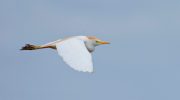
For most of the year, the Cattle Egret is a plain but handsome bird. The nonbreeding adult has mainly white plumage, a yellow bill, and greyish-yellow legs, and is a stocky, hunched bird with a relatively thick neck and sturdy bill. But come breeding season, something remarkable happens.
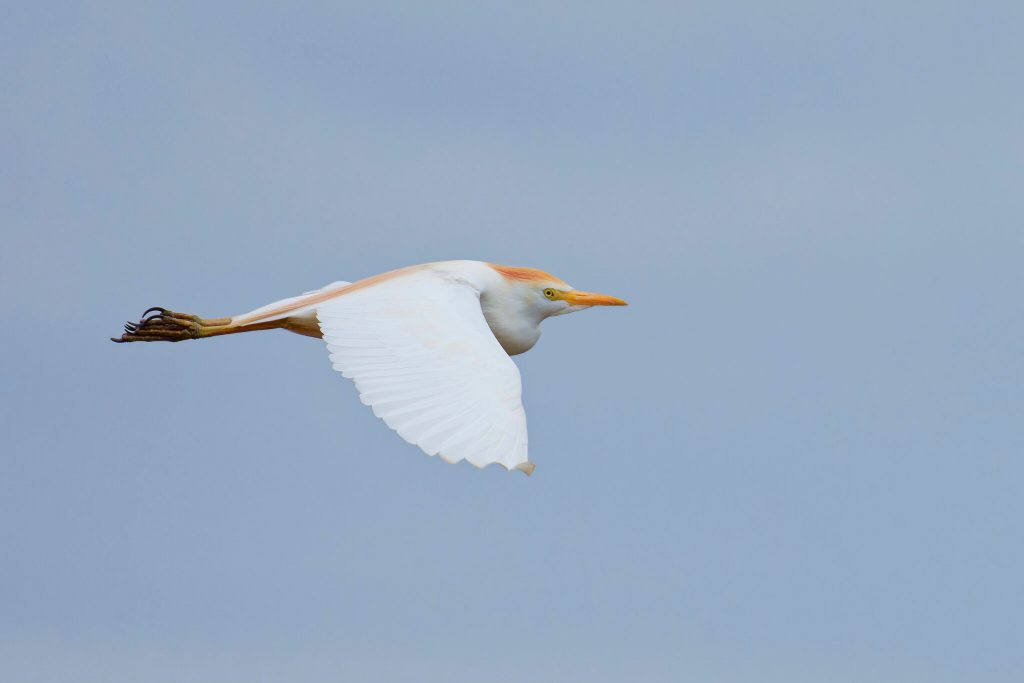
Adults develop warm orange-buff plumes on the back, breast, and crown, and for a brief, magical period just before pairing, the bill, legs, and irises flush bright red. It is as if the bird briefly dresses up for a celebration, then returns to its practical working attire.
Fun Facts Worth Sharing
- The Cattle Egret follows large animals – cattle, sheep, even buffalo – not to eat ticks from their skin as many people believe, but to catch the grasshoppers and insects that the animals’ hooves disturb from the grass.
- This bird has undergone one of the most rapid and far-reaching natural range expansions of any bird species. Originally native to parts of Africa, southwest Asia, and southern Europe, Cattle Egrets were first spotted in South America in 1877 – having apparently crossed the Atlantic Ocean on their own – and have since colonised much of the world.
- They are serial monogamists: they mate once a year, staying together until the end of the nesting season, but generally choose a new partner each year.
- The male courts females with elaborate, ritualised displays – shaking twigs and dramatically tilting his bill straight up to the sky. Sticks for the nest, meanwhile, are frequently stolen from neighbouring pairs.
More Than Meets the Eye – The Tick Myth Explained
The popular belief, even in Cyprus, is that Cattle Egrets pick ticks directly off cattle – a helpful, symbiotic relationship that earns them their welcome in the fields. The reality is subtler. They do remove ticks and flies from cattle and consume them, but the primary food source is the insects, frogs, and small vertebrates disturbed by the grazing animals. Still, farmers across Cyprus have long tolerated – and even welcomed – these birds in their fields, recognising that fewer flies and insects mean healthier livestock.
The Cattle Egret in Cyprus Today
In Cyprus, the Cattle Egret is a year-round presence: it is classified as a passage migrant, winter visitor, and a resident breeder. It can be seen at Oroklini Lake, Akrotiri Marsh, Athalassa Park, Agios Loukas Lake in the Famagusta district, and at various coastal areas during migration periods. You will also find it reliably in the agricultural heartlands of the Mesaoria plain, following the goats and sheep that still define so much of rural Cypriot farming life.
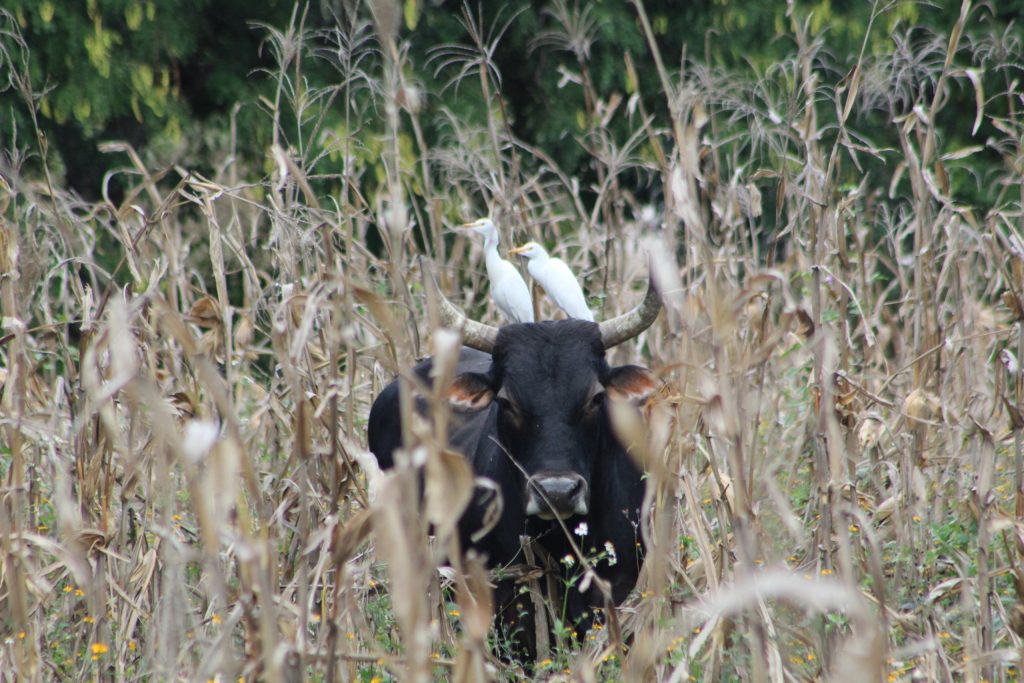
In a landscape where ancient farming traditions meet modern pressures, the Γελαδάρης (Yeladharis) – literally “the cow bird.” is a living thread connecting the pastoral past to the present. Formally in Greek: Ερωδιός ο Βουκόλος (Erodhios o Voukolos) – “the herdsman’s heron.” The name says it all.
Where to See It
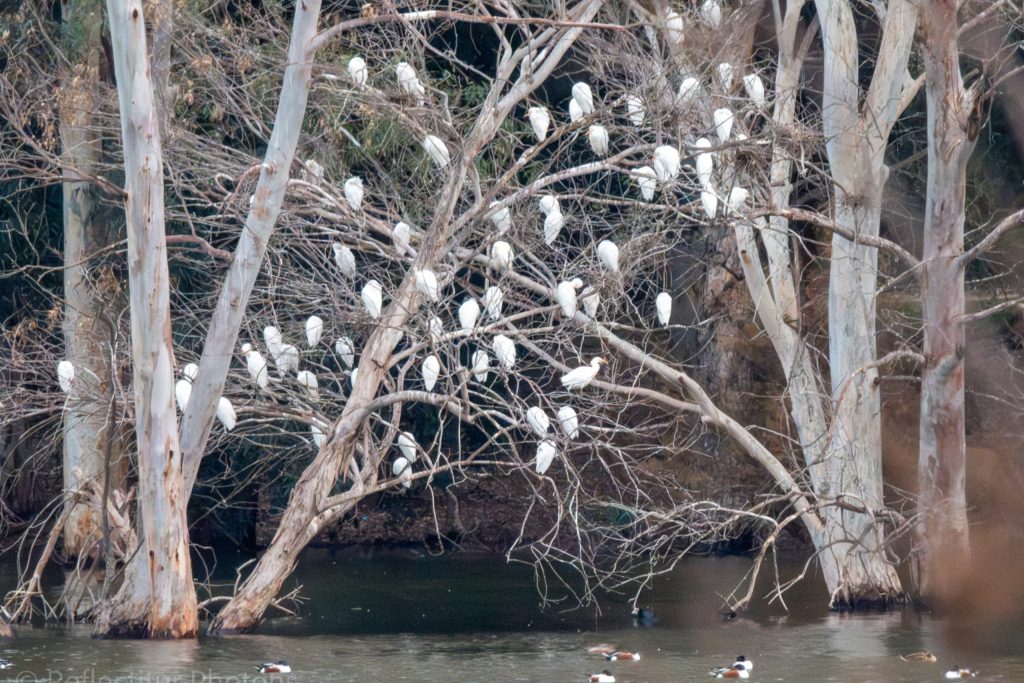
You do not need binoculars or a remote nature reserve to find this bird. A slow drive through the countryside near Athalassa, the wetlands of Akrotiri, or the fields around Famagusta in the early morning will very likely reward you with a sighting. Look for small, stocky white birds in or around herds of livestock – standing on a cow’s back, trotting busily through the grass, or rising in a small white cloud when a tractor moves through. In winter, large flocks roost communally in trees near wetlands, and the sight of dozens of white birds settling into the branches of a single tree at dusk is truly memorable.
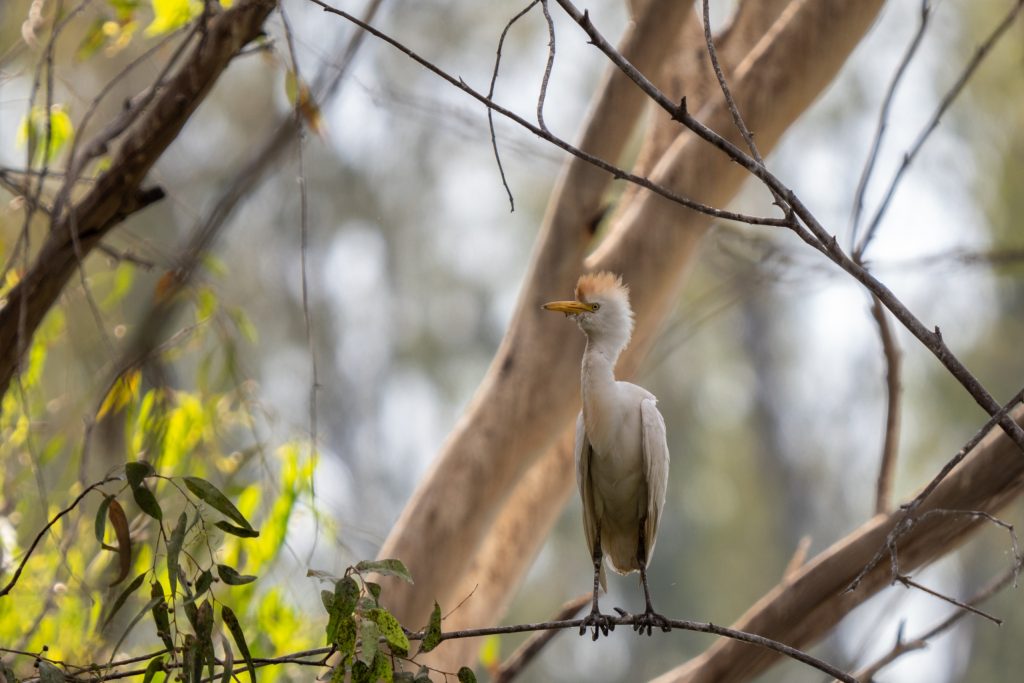
But if you truly want to understand what this bird is capable of, visit Lake Agios Loukas in the Famagusta district during late spring. Nature photographer and wildlife observer George Konstantinou, who has spent years documenting Cyprus wildlife, describes the breeding colony there as nothing short of extraordinary: “The spectacle during the breeding season is extremely impressive — for me it was the most impressive thing I have seen in my life. Dozens of pure white birds nesting in the trees next to the water, nests full of insatiable chicks deafening you with their voices, while the parents constantly come and go carrying food for their young. It offers a spectacle that is truly unreal for the standards of Cyprus.” Remarkably, the birds are entirely unbothered by people, allowing observers and photographers to get genuinely close — a rare gift in wildlife watching.
A Small Bird With a Very Big Story
The Cattle Egret is proof that nature rewards adaptability. While other birds cling to disappearing habitats, this little heron looked at the world’s farms and fields and saw opportunity. In Cyprus – an island shaped as much by its agriculture as its coastline – the Γελαδάρης has found a home perfectly suited to its character: practical, social, resourceful, and quietly beautiful. It is not the rarest bird on the island, nor the most spectacular. But it may be the most quietly impressive, and it belongs to Cyprus as surely as the olive tree or the mouflon.