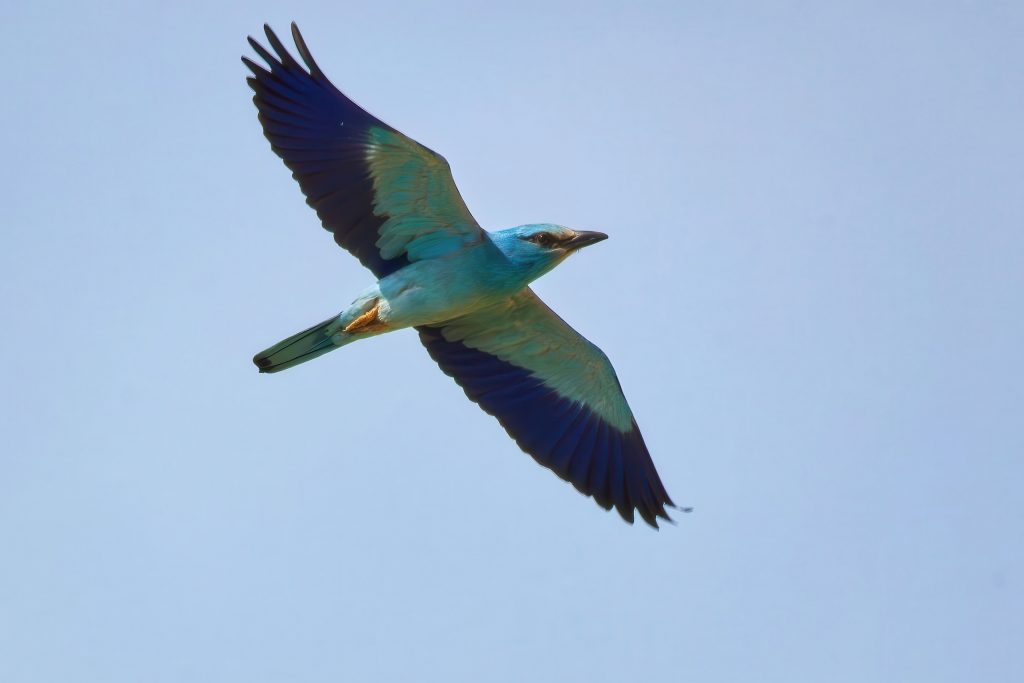
Every spring, a small miracle arrives unannounced across the open fields and olive groves of Cyprus. A bird so astonishingly blue it looks almost painted – as though someone dipped a jay-sized creature into a pot of turquoise and let it fly. The locals call it the Κράγκα (Krangka), and if you’ve ever caught one sitting on a telephone wire in the morning sun, you’ll understand why people stop their cars to look.
What Exactly Is a Roller?
The European Roller (Coracias garrulus) belongs to the family Coraciidae – the rollers – a small, ancient group of birds found mostly across Africa and tropical Asia. Think of them as the jewel-coloured cousins of kingfishers and bee-eaters: bright, bold, sit-and-wait hunters with a flair for the dramatic. The European Roller is the only member of its entire family that breeds anywhere in Europe, making it something of a continental rarity. It is a true Old World bird, connecting the warm farmlands of Spain and Cyprus to the open savannahs of Africa.
A Traveller Through Deep Time
Rollers as a group have existed for tens of millions of years, their fossil record stretching back into the Eocene epoch. The European Roller itself has been threading the skies between Africa and Europe for thousands of years, following the same migration corridors long before humans drew borders across the map.
In Cyprus, the bird’s relationship with people goes back to antiquity. The ancient Greeks were well acquainted with it – the name Coracias derives from the Greek korakias, referencing its crow-like call, and its striking plumage made it a creature of note in classical natural history. It was described scientifically by Carl Linnaeus in 1758, fittingly with the species name garrulus – Latin for “chattering” – a nod to its loud, rasping voice that contrasts so wonderfully with its silent, jewelled beauty.
Painted in Blue – A Portrait of the Krangka
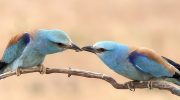
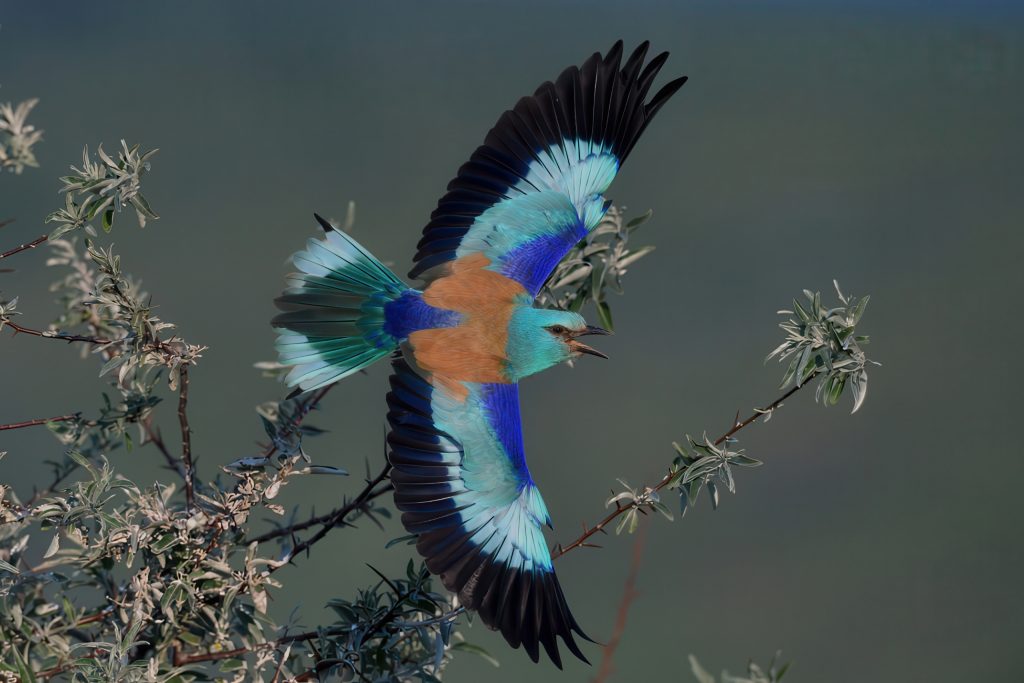
The European Roller is roughly the size of a Eurasian Jay – about 30 centimetres long with a wingspan stretching up to 58 centimetres. Its body is a rich, luminous turquoise-blue, deepening to a brilliant cobalt on the wings. The back and wing covers are a warm chestnut-orange, creating a colour palette that seems almost too vivid for the natural world. In flight, the wings flash with electric blue and black, visible from a considerable distance.
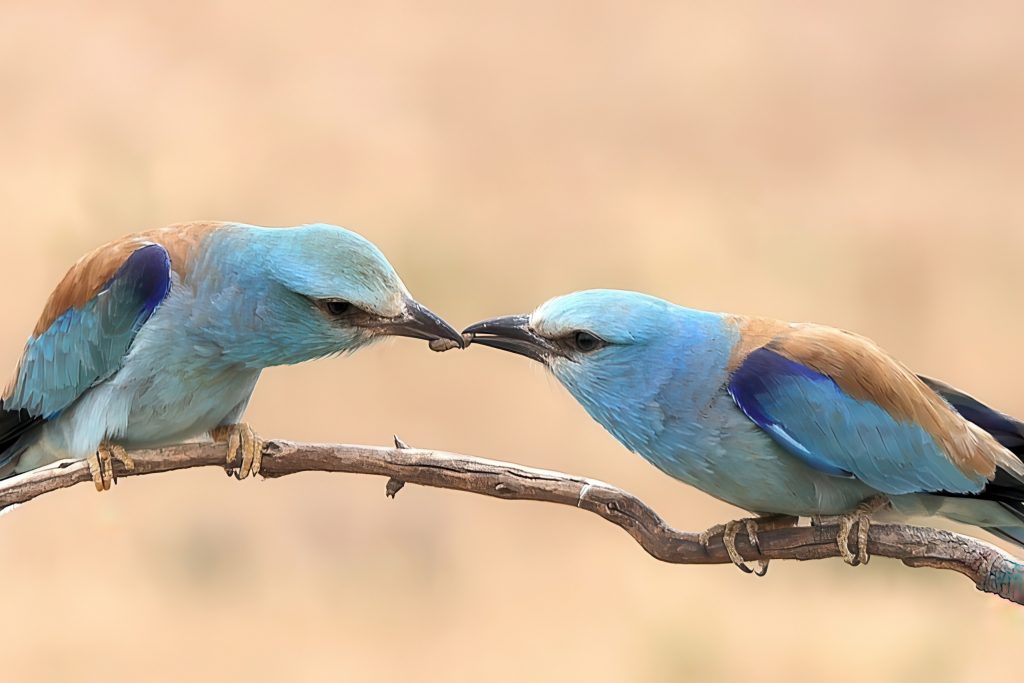
Both males and females look alike, which is unusual among brightly coloured birds. Young rollers are a paler, drabber version of the adults – still recognisably beautiful, just yet to fully find their paint.
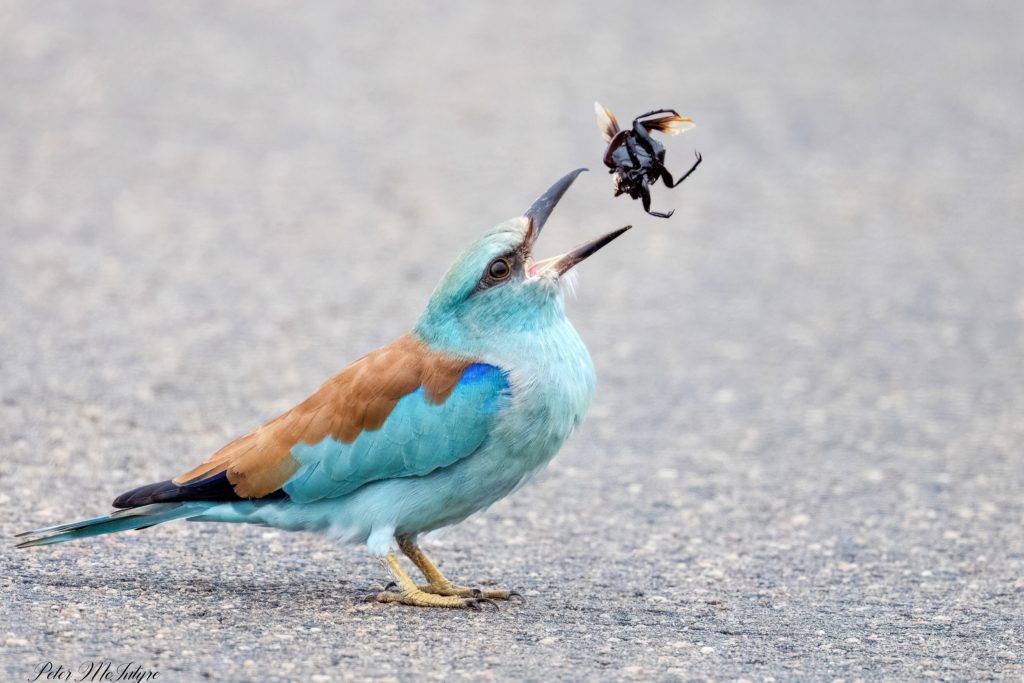
The bird’s call is anything but musical: a harsh, raucous rack-rack-rack, much like a small crow protesting loudly. It perches upright and still on exposed wires, branches, or fence posts, scanning the ground with great patience before dropping to snatch a large beetle, grasshopper, or lizard.
Fun Facts
- The name “roller” comes not from the bird’s rolling walk, but from its spectacular aerial courtship display – the male hurls itself into a series of twisting, tumbling, side-rolling dives that leave watchers genuinely open-mouthed.
- The European Roller is the only Coracias species that breeds in the Western Palearctic – in other words, across all of Europe and the Middle East, it stands alone as the single member of its tropical family willing to brave northern latitudes.
- Despite its tropical appearance, the European Roller winters in Africa south of the Sahara, in two distinct regions – from Senegal east to Cameroon, and from Ethiopia west to Congo and south to South Africa.
- The Sahel savannah around Lake Chad is a critical autumn refuelling stop for rollers migrating south – a bird seen in Cyprus in May may rest by Lake Chad in September.
- Its Cypriot Greek name Κράγκα is onomatopoeic – say it aloud and you’ll hear something very much like the bird’s actual call.
- One individual was once recorded colliding with an aircraft over the Arabian Sea during migration – a reminder of the extraordinary distances these birds travel.
A Roller’s Life: Nesting, Hunting, and Display
The European Roller finds its food – mainly medium to large insects, but also lizards, rodents, and occasionally small birds – from elevated perches, dropping to the ground to catch prey and returning to its post to eat. Large beetles, grasshoppers, and cicadas form the backbone of its diet, which is why the bird favours open agricultural land with plenty of insect life.
It nests in tree holes, cavities in sandy banks, old walls, and occasionally in buildings. In Cyprus, old olive trees and the traditional dry-stone walls of the countryside provide ideal nesting sites. Where natural holes are scarce, rollers will readily adopt wooden nest boxes – a fact conservationists in northern Cyprus have used to help the species recover in areas where old trees have been lost to agriculture.
The courtship display is unforgettable. The male rises high, then throws itself into a series of steep dives and rolling side-turns, calling loudly the whole time – a performance that looks more like controlled falling than flying. It is one of the more theatrical shows in the European bird world.
The Roller and Cyprus Today
The Karpaz Peninsula is still quite abundant in rollers, and the northern coast has been left relatively untouched by intensive agricultural practices – these areas offer the open, tree-dotted farmland the species depends on. Akrotiri, Paphos and Pissouri confirm the species does reach the south, but with lower frequency. These are likely passage migrants or birds using the remaining patches of suitable open habitat near the coast. The Mesaorya Plain was once dense with trees and scrubland but is now a monoculture of farmland pastures – and the roller population there has declined sharply as a result.
Active conservation initiatives are underway to enhance population stability through the installation of artificial nests in appropriate sites.
When and Where to See the Κράγκα
The European Roller is a summer visitor to Cyprus. The first birds typically arrive from late April, with numbers building through May. Autumn departure from Cyprus begins early – as early as July – making it one of the earlier migrants to leave, with most birds gone by August.
The best places to look are the open agricultural plains of the Mesaoria, the Karpaz Peninsula, and the quieter roads through the Paphos district and Akamas area. The bird favours telephone wires and exposed tree branches as lookout posts – simply drive slowly through open farmland on a warm May morning and scan the wires. When you find one, stop and watch. It will likely reward you with a hunting dive, or if you are very lucky, a rolling display flight.
The experience is best in the golden hour light, when the turquoise of its plumage ignites against the pale limestone hills – one of those wildlife encounters that stays with you long after you’ve driven on.
A Jewel Worth Knowing
The Κράγκα is not just a beautiful bird passing through. It is part of the living texture of the Cypriot countryside – a creature that connects this island to ancient Greece, to the savannahs of East Africa, and to the broader story of Mediterranean wildlife at a crossroads between three continents. To see one perched in the sunlight above a field of dry grass, turquoise and russet and bold, is to be reminded that wildness and beauty still share the island with us. And that is always worth knowing.