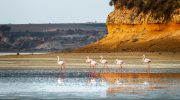
Every year, as the first autumn rains begin to fill Cyprus’s ancient salt lakes, something extraordinary happens. The shallow, glittering water starts to turn pink – not from the sunset, but from thousands of long-legged, rose-coloured birds wading in perfect, unhurried formation. The Greater Flamingo has arrived. And once you have seen it, you will never quite forget it.
The Family of Flame-Coloured Birds
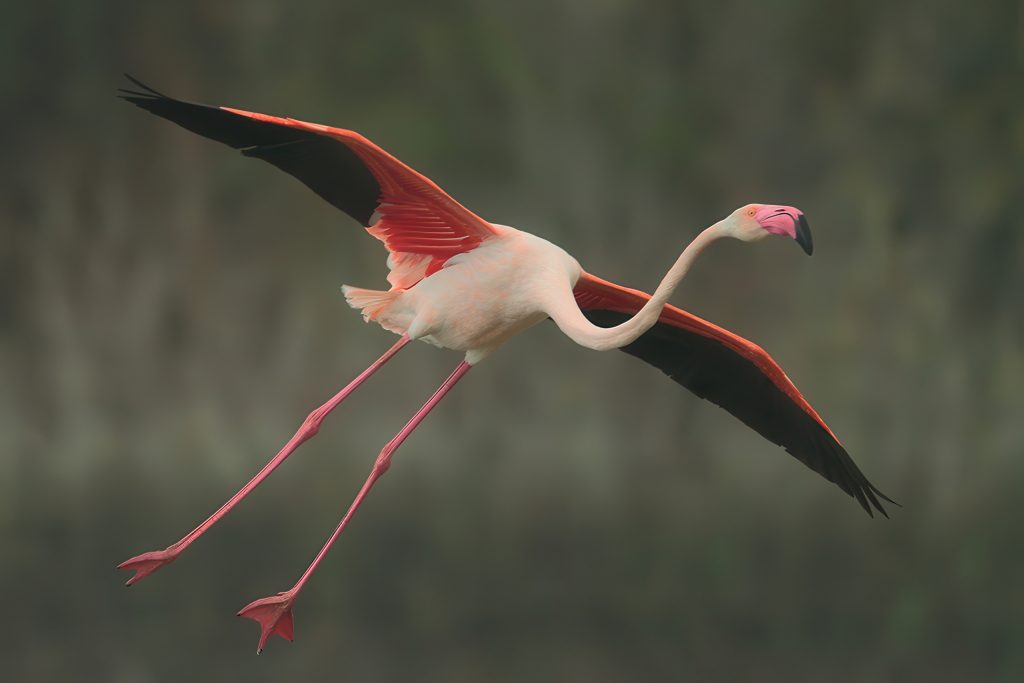
Flamingos are among the most instantly recognisable birds on Earth. They belong to the family Phoenicopteridae – an ancient and rather exclusive club with only six living species in the world, found across Africa, the Mediterranean, the Middle East, and the Americas. The name “flamingo” itself traces back to the Portuguese and Spanish word flamengo, meaning “flame-coloured,” rooted in the Provençal word flama – flame. Fitting, for a bird that looks as though it has been dipped in a warm sunset.
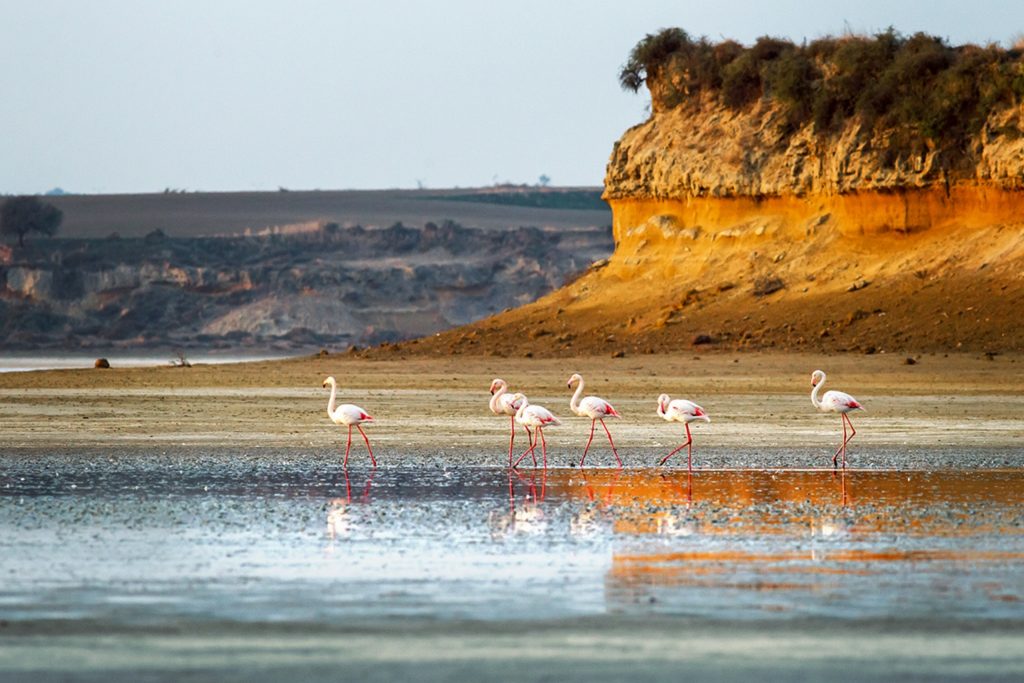
The species that visits Cyprus is the Greater Flamingo (Phoenicopterus roseus) – the most widespread and largest of all flamingo species in the world, found from the coasts of Northern Africa and the Middle East to the Mediterranean countries of Southern Europe. Its scientific genus name, Phoenicopterus, comes from Ancient Greek and means, quite simply, “crimson-feathered.”
An Ancient Bird with a Very Ancient History
Flamingos are not newcomers to the pages of history. Greater Flamingo fossils have been found in ancient Egypt, at sites dating back to the Pleistocene era – which means this bird was already wading in shallow waters long before the first human civilisations rose along the Nile.
The flamingo silhouette appears in some of the most ancient iconographic representations known to us, and for the Egyptians of the Predynastic Period, its colour was considered so significant that it was incorporated into their system of fundamental graphic signs. In the ancient world, the flamingo was not simply admired – it was consumed. Rich aristocrats and emperors such as Vitellius and Elagabalus considered the flamingo a gourmet food, and the Roman writer Apicius noted that the tongue of the flamingo was of the most exquisite flavour.
There is also a deeper, more poetic connection. Many scholars believe that the vivid red-pink plumage of the Greater Flamingo – fiery, otherworldly, blazing over still water – inspired the ancient myth of the Phoenix, that immortal bird born from flame. Its pink-to-crimson plumage, derived from carotenoid-rich algae and shrimp, directly echoes the Greek root phoinix, meaning “purple-red.” The connection between the flamingo and the legendary firebird is one of the most romantic footnotes in natural history.
A Portrait of the Bird Itself
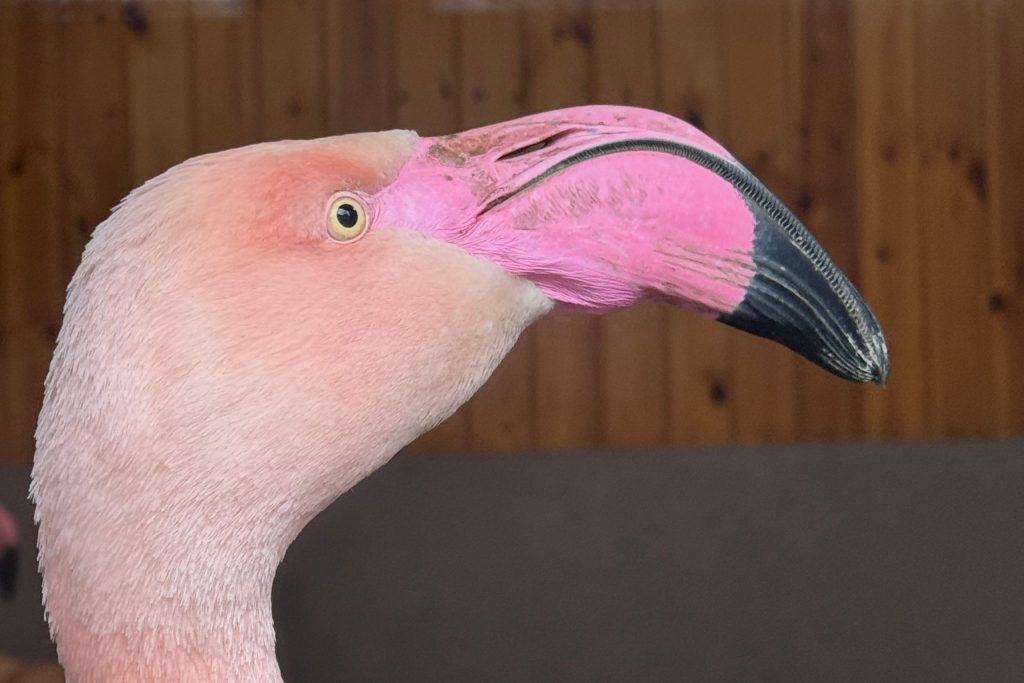
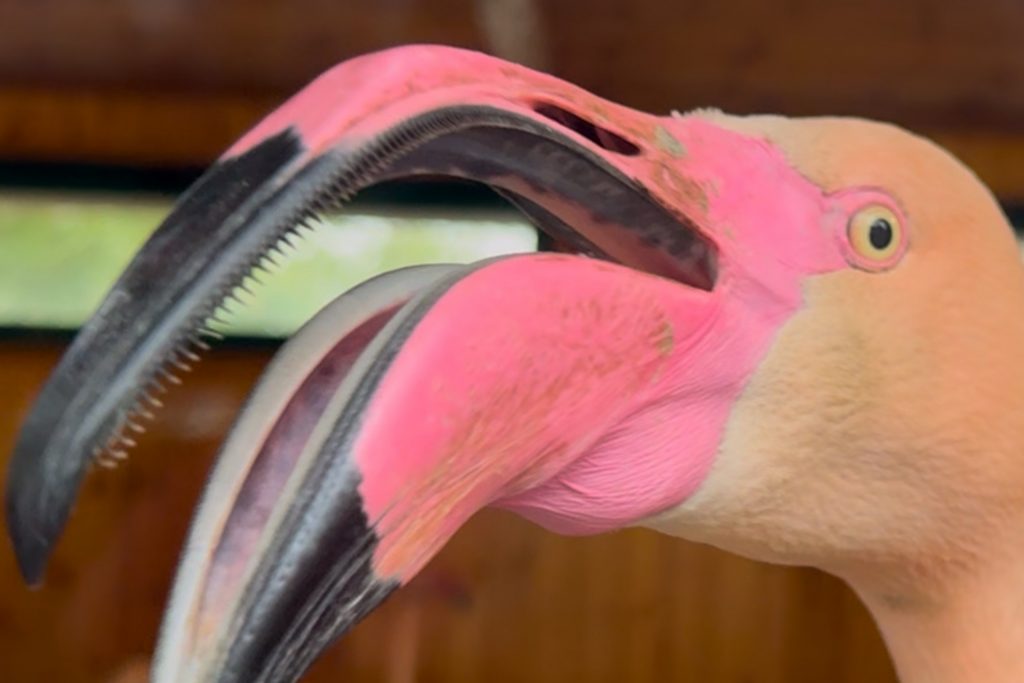
Stand at the edge of the Larnaca Salt Lake on a still December morning, and you will understand immediately why flamingos captivate people so completely. The Greater Flamingo is the largest of its family, standing up to 1.2 metres tall, with long salmon-pink legs, an elegantly curved neck, and a distinctive downward-bent bill that looks as though it was designed by someone with a delightful sense of humour – because, in a way, it was: it acts as a sophisticated filter, held upside-down in the water to sift tiny shrimp, algae, and plankton from the brine.
Their famous pink colour is not something they are born with – flamingo chicks hatch pure white. Greater Flamingos thrive during the rainy season by feeding on algae, crustaceans, and molluscs in saline lakes, and it is precisely these pigment-rich foods – especially tiny brine shrimp and blue-green algae – that gradually stain the feathers their signature rose pink over months and years.
Flamingos usually stand on one leg with the other tucked beneath the body. Why? Scientists believe it helps them conserve body heat or reduce muscular effort – though the truth is that even after decades of study, this endearing posture remains only partially explained. Some mysteries, it seems, are best enjoyed rather than solved.
Fun Facts Worth Knowing
- A group of flamingos has a name as spectacular as the birds themselves. A group of flamingos is officially called a “flamboyance.” Entirely appropriate.
- They can sense a rainstorm from hundreds of kilometres away. Flamingos appear to have a remarkable ability to sense distant rainstorms, likely by detecting subtle changes in atmospheric pressure hundreds of kilometres away, enabling them to locate newly flooded wetlands where food is abundant.
- The oldest known Greater Flamingo lived to be at least 75 years old. He was already an adult when he arrived at Adelaide Zoo in Australia in 1933. His exact birth year is unknown, which makes him even more mysterious.
- There is a black flamingo in Cyprus. A flamingo that is almost completely black with just a small tuft of white feathers near its rump was first seen in Cyprus in early April 2014, and has been spotted at both Akrotiri and Larnaca Salt Lakes. It is almost certainly the same individual seen in Eilat, Israel in February 2014.
- The word “flamingo” and “flamenco” share a root. Some linguists have noted that the Spanish word flamenco – both the dance and the word for Flemish people – shares its etymology with flamengo (flamingo), all of them coloured by the idea of fire, passion, and vivid spectacle.
Cyprus: Where East Meets West on a Wing
Every year, hundreds to thousands of flamingos arrive in Cyprus, mainly at Akrotiri and Larnaca Salt Lakes. They usually appear in November and stay until late February, travelling from breeding grounds in Turkey, Iran, and occasionally France and Spain.
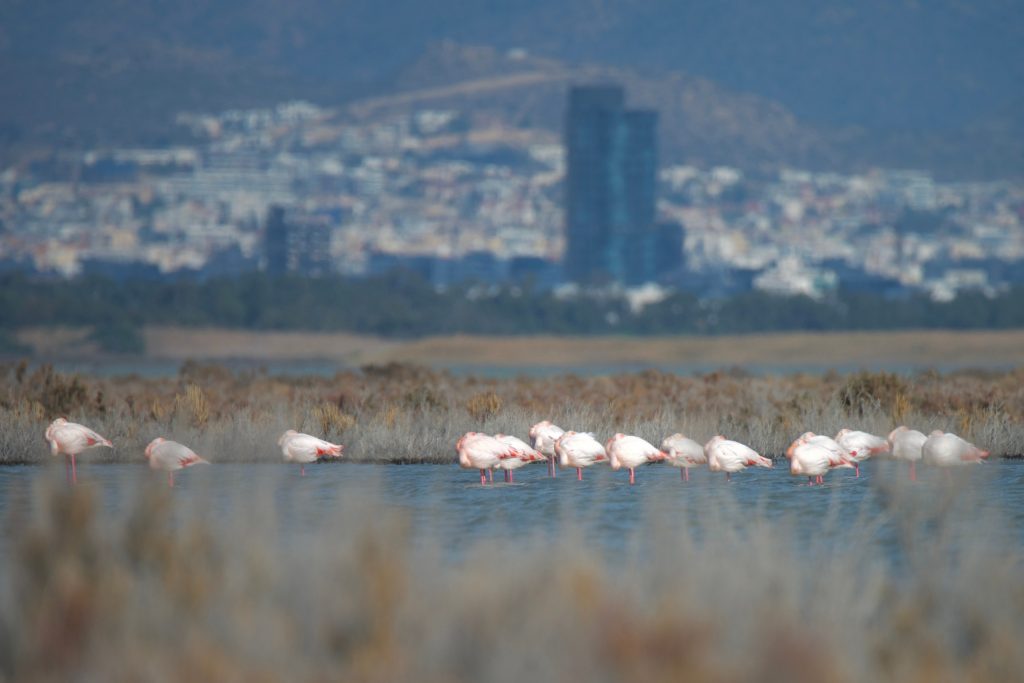
Ring-recovery studies have revealed the extraordinary geography of these journeys. Flamingos seen in Cyprus have come from countries including Iran, Algeria, Turkey, Sardinia, Spain, Morocco, Azerbaijan, France, and Egypt – making Cyprus not just a stopover, but a genuine international crossroads in the sky.
The Larnaca Salt Lake hosts between 2,000 and 12,000 flamingos in winter months, feeding off populations of the brine shrimp Artemia salina. In exceptional years, that number can rise much higher – estimations of their temporary population on the island have reached upwards of 20,000 individuals.
The water depth matters enormously. The depth of the water in the lakes plays a crucial role in how long they stay and how many arrive: if the water is too deep or too shallow, the birds simply move on.
Are They Trying to Stay Forever?
Here is where the story becomes genuinely exciting. Although Cyprus is mainly a wintering ground, the flamingos have shown real interest in breeding here during years when water conditions were ideal. The first suspected nesting occurred in 2001, followed by abandoned nest mounds found in 2003. In 2005, a few eggs were recorded at Akrotiri Salt Lake, but the attempt failed when water levels dropped too low.
More recently, after the exceptionally wet winters of 2018–2019 and 2019–2020, hundreds of flamingos stayed into the summer and began building nests. Around 200 nests were counted, and fragments of eggs were later discovered – clear evidence that the birds had laid them. Sadly, no chicks survived. But the attempt was made. And it may yet succeed.
However, there is a shadow over this hopeful story. Recent data from BirdLife Cyprus have raised serious concern: at Akrotiri Salt Lake, for the first time since systematic counts began in 1992, only 30 flamingos were recorded in January 2025 – far fewer than the usual thousands. The decline signals that the wetland is under severe pressure, with changes in water quality, pollution, and broader environmental stress identified as contributing factors.
Visiting the Pink Horizon
Seeing the flamingos of Cyprus is one of those experiences that stays with you long after you leave the island.
Larnaca Salt Lake is the most accessible spot – it lies right alongside the road leading to Larnaca International Airport, and on a good winter morning, the spectacle of thousands of pink birds reflected in still silver water, with the golden dome of the Hala Sultan Tekke mosque rising behind them, is one of the most visually stunning sights in all of Cyprus.
Akrotiri Salt Lake near Limassol is the island’s largest lake and a superb location, best explored via the Akrotiri Environmental Education Centre, which is free to visit and offers telescopes and viewing platforms overlooking the water.
The most reliable months for sightings are December, January, and February. Early morning and pre-sunset hours offer the best conditions – fewer people and softer light for observation and photography.
One important note: flamingos are highly sensitive to disturbance, especially during winter when they need to rest and feed before the breeding season. Getting too close, flying drones overhead, or approaching them on foot can cause serious stress. The best way to enjoy them is from designated bird hides or observation points. A pair of binoculars and a quiet morning are all you really need.
Why This Matters
The Greater Flamingo is not simply a beautiful bird. It is a living barometer of the health of Cyprus’s wetlands – those shallow, salty, seemingly inhospitable stretches of water that are, in fact, among the most biologically rich environments on the island.
The Larnaca Salt Lake complex has been declared a Ramsar site, a Natura 2000 site, a Special Protected Area under the Barcelona Convention, and an Important Bird Area – a remarkable list of international recognitions for a lake that many travellers only glimpse from the window of a plane.
Every flamingo that arrives in Cyprus carries with it a story of thousands of kilometres, of ancient instinct, of delicate ecological balance. Protecting their winter habitat means safeguarding water quality, regulating inflows, preserving food resources and minimising disturbance – not just for the flamingos, but for the whole extraordinary web of life that depends on these lakes.
Cyprus has always been a place where worlds meet – civilisations, cultures, migratory routes. Each November, when the flamingos descend from the sky and settle onto the glittering salt water, they remind us of that beautifully. The island turns pink. And for a few months, it is impossible not to feel that something quite magical is happening right at our feet.
Best viewing locations: Larnaca Salt Lake (near Hala Sultan Tekke), Akrotiri Salt Lake (via the Akrotiri Environmental Education Centre), Oroklini Lake, and Paralimni Lake.
Best season: November – February
Bring binoculars. Keep your distance. Leave only footprints.