Columba livia | Αγριοπερίστερο (Agriopéristero)
Most of us have walked past a pigeon without a second glance. Yet perched on the sea cliffs of Cyprus – far from any city square or café terrace – lives a bird that shaped civilisation, inspired goddesses, and carried messages across wars. This is not the feral city pigeon you brush off in a park. This is the wild rock dove, and its story on this island is older, richer, and far more surprising than you might expect.
From One Family, a Thousand Faces
The rock dove belongs to Columbidae, a family of over 350 species found on every continent except Antarctica. The rock dove itself, Columba livia, is the wild ancestor of every domestic pigeon ever bred – the racing homers, the white wedding doves, the fancy breeds, and the grey birds strutting across town squares from Nicosia to New York. When you look at any feral pigeon, you are looking at a domesticated descendant of this single wild species, shaped over thousands of years by human hands.
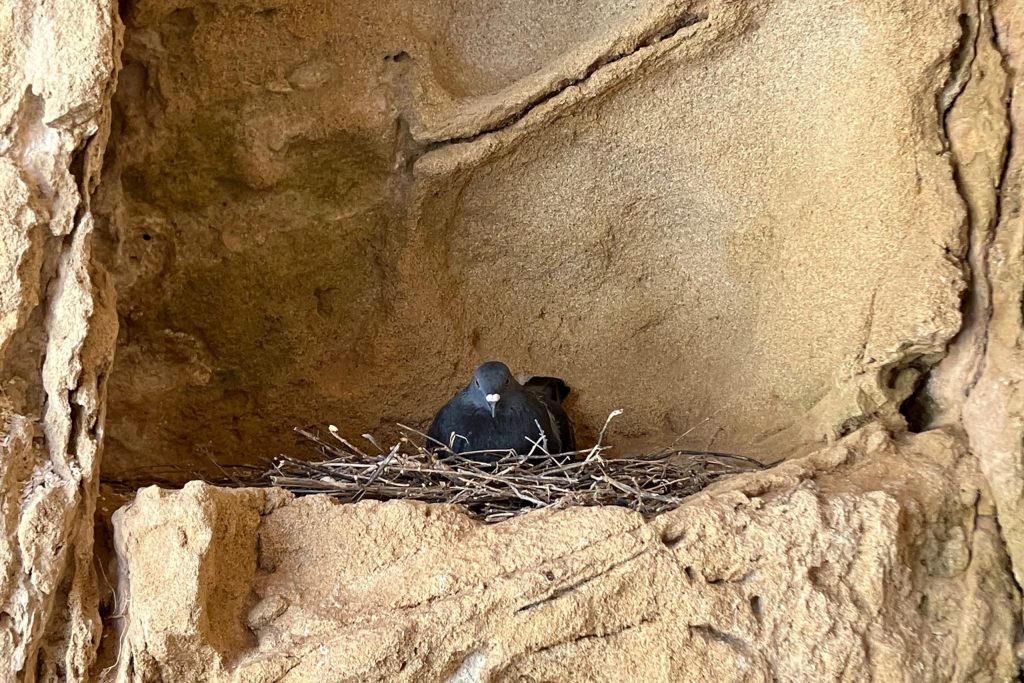
In Cyprus and Greece, the wild dove is known as the Αγριοπερίστερο (Agriopéristero) – literally “the wild pigeon” – clearly distinguishing it from the domesticated birds that long became part of everyday life.
A Bond Older Than History Itself
Fossil remains confirm the rock dove’s existence in the eastern Mediterranean for at least 300,000 years, and it was already woven into human civilisation long before written history. Used for food, ritual, and communication for over 5,000 years, it became one of the most significant birds in the ancient world.
On Cyprus, the dove carried extraordinary spiritual weight. Doves were sacred to Aphrodite, who absorbed this association from Inanna-Ishtar. During Aphrodite’s main festival, the Aphrodisia, her altars would be purified with the blood of a sacrificed dove. At the great sanctuary of Palaipaphos, doves gathered on the temple colonnades and were offered during major festivals. Roman coins from the island show doves perched upon the very rooftops of her temple.
The ancient Greek word for dove, peristerá, may derive from the Semitic peraḥ Ištar, meaning “bird of Ishtar” – a linguistic thread connecting Cyprus, as Aphrodite’s birthplace, to the deepest roots of this sacred bond.
A Portrait in Blue-Grey and Iridescence
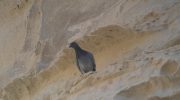
The wild rock dove is compact and elegant. It has a dark bluish-grey head, neck, and chest with glossy yellowish, greenish, and reddish-purple iridescence along its neck and wing feathers, two black bars on each wing, orange-red iris, grey-black bill with a white cere, and purplish-red feet.
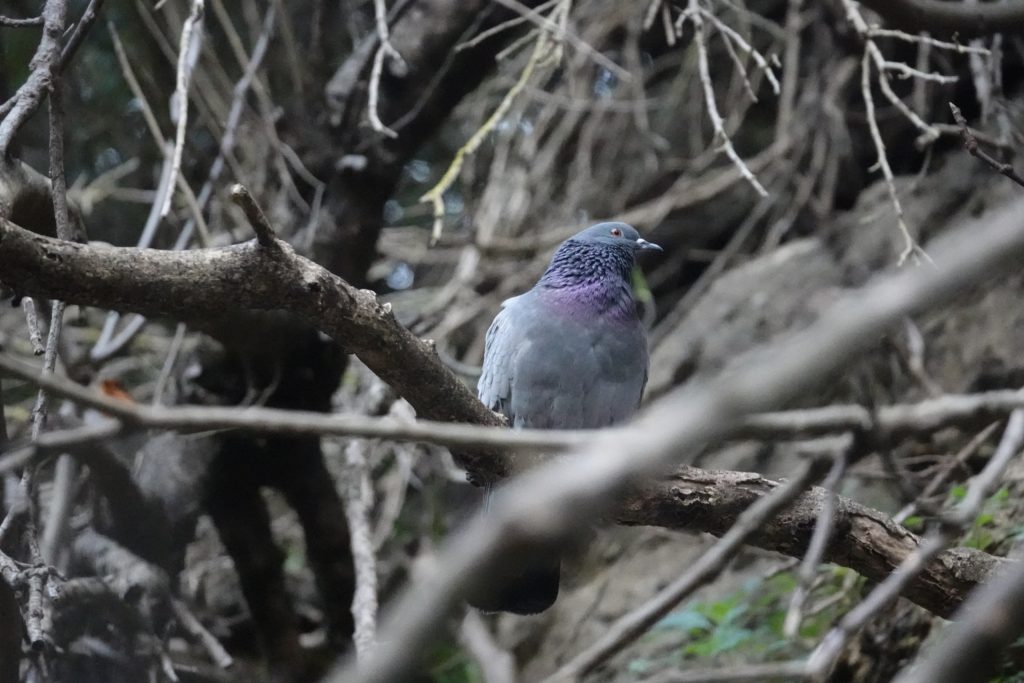
In flight, look for the white lower back – the most reliable field mark separating a true wild bird from a feral one. In Cyprus, wild rock doves nest on remote coastal cliff faces, particularly along the Akamas Peninsula, Cape Greco, and the Paphos coastline – landscapes unchanged since ancient times.
The subspecies present on Cyprus is Columba livia livia, found across western and southern Europe, northern Africa, Cyprus, Turkey, and western Asia.
Fun Facts Worth Sharing
- Every domestic pigeon descends from this bird. Darwin placed it at the centre of his theory of evolution, tracing hundreds of domestic breeds back to a single wild ancestor.
- Both parents produce milk. Unusually for birds, both male and female rock doves produce nutritious “crop milk” to feed their young in the first days of life.
- They drink like mammals. Unlike most birds, they can drink continuously without tilting their heads back – a rare biological trait.
- They have a dominant foot, showing “footedness” similar to human handedness.
- They featured on Cypriot coins – Roman-era currency from the island shows doves perched on the roof of Aphrodite’s temple at Paphos.
The Goddess’s Bird
The mythology surrounding the dove on Cyprus is beautifully layered. In Greek mythology, Peristera was a nymph transformed into a dove – one of Aphrodite’s sacred animals – and thereafter doves would always draw the goddess’s chariot. The Cyprian fertility goddess associated with Aphrodite was said to have risen from the sea, born from an egg brooded by a dove. This image – the dove as vessel of divine creation – feels entirely at home on an island that itself rose from the sea. Far from being merely decorative, the rock dove was a living bridge between the human and the divine across the ancient Mediterranean world.
The Wild Ones Today – A Conservation Story
Globally, the rock dove is listed as Least Concern by the IUCN, with an estimated world population of around 260 million individuals. But this headline figure conceals a quieter problem. Natural wild populations are increasingly affected by interbreeding with feral pigeons, with truly pure wild populations now more confined to remote cliffs and islands.
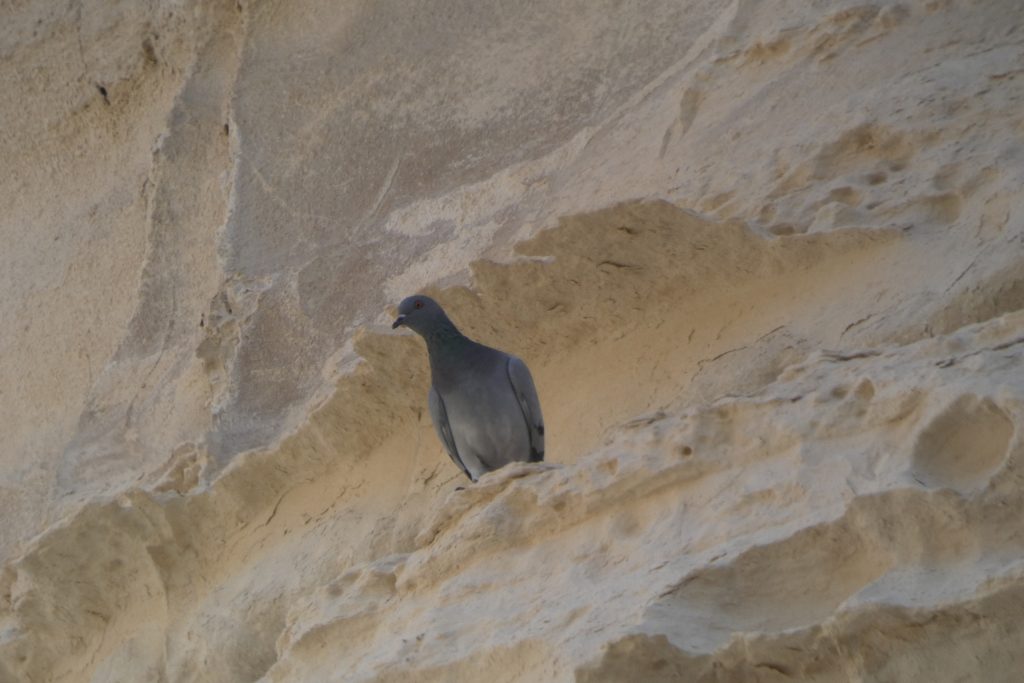
In Cyprus, this is a real concern. Feral pigeons have colonised towns and coastal areas, and where they meet wild rock doves they interbreed freely, gradually eroding the wild gene pool. The truly pure wild birds are retreating to the most remote sea cliffs, far from human settlement. Cyprus has no specific protection programme for the wild rock dove at present, though the species benefits from general bird protection legislation. The challenge for conservationists is as much about identification as protection – distinguishing a true wild bird from its look-alike relatives is genuinely difficult, even for experienced ornithologists.
Where to Find Them
The best places to look are the dramatic sea cliffs and rocky headlands where wild birds have nested undisturbed for millennia. Cape Greco near Ayia Napa offers spectacular coastal arches and sea caves. The Akamas Peninsula in the northwest, particularly near Lara Beach and the Baths of Aphrodite, is another stronghold. The Paphos coast between Coral Bay and Agios Georgios also offers ideal habitat.
Watch for the white lower back as they lift from the cliff face. Listen for the gentle rolling oo-roo-coo drifting from rock crevices on warm afternoons – one of the oldest sounds on this island.
Still Cooing Across the Centuries
There is something quietly profound about the rock dove’s place in Cyprus. On the same limestone cliffs where ancient worshippers once gathered, where Roman coins bore their image, where Aphrodite’s sacred birds nested in temple stones – the wild ancestor of all domestic pigeons still calls, still nests, still tends its young. The pigeon we ignore in the street is a reminder that wildness is never truly gone, only transformed. Somewhere on the Cypriot coast, above the turquoise Mediterranean, a small grey bird with golden eyes and an iridescent neck is living exactly as rock doves have always lived on this island – close to the sea, close to the stone, and close to a history that runs far deeper than any city square.