There is a fish in the waters around Cyprus that most people have eaten but far fewer have ever truly seen. It rests on rocky ledges in the semi-darkness, patient and watchful, like an old guardian who has been sitting in the same cave for longer than some of us have been alive. It is one of the most important fish in the Mediterranean Sea – and it carries a secret that most people would find astonishing. This is the story of the dusky grouper, and why it matters more than we may realise.
- From the Family of Giants – What Is a Grouper?
- Ancient Reefs and Ancient Names – A Fish with Deep Roots
- Portrait of a Ruler – What the Dusky Grouper Looks Like
- Five Things Worth Knowing – and Worth Sharing
- Nature's Most Remarkable Secret – The Fish That Changes Sex
- When the Sea Was Still Full – Cousteau's Giants
- A Species Under Pressure – What Science Tells Us
- The Reef's Last Line of Defence – A Guardian Against Invaders
- From the Farm to the Table – The Aquaculture Question
- The Grouper and Cyprus Today – Rofos on the Menu and in the Sea
- Into the Blue – Diving with Rofos
- A Fish Worth Protecting – Why Rofos Matters to the Island
From the Family of Giants – What Is a Grouper?
Groupers belong to a large and ancient family of sea fish called Serranidae, commonly known as the sea basses or groupers. Within this family, the genus Epinephelus alone contains nearly ninety species found in warm seas across the globe – from the coral reefs of the tropics to the rocky coastlines of the Mediterranean. They are robust, large-headed, deep-bodied fish built for life near the seafloor. Most are solitary, territorial, and remarkably long-lived.
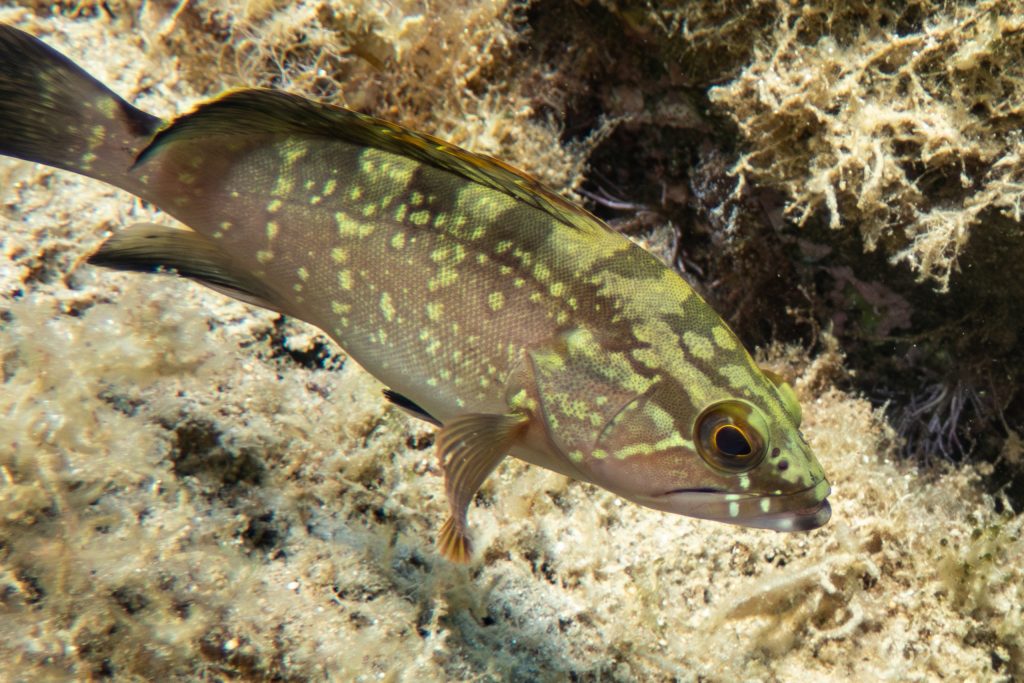
The dusky grouper (Epinephelus marginatus) is found in coastal waters throughout the Mediterranean, along the western coast of Africa, and off the coasts of South Africa, Brazil, Uruguay and Argentina – one of the widest distributions of any Mediterranean fish. In Cyprus it is known in Greek as ροφός (rofos), and it holds a cherished place both on restaurant menus and on the rocky reefs below the island’s coastline.
Ancient Reefs and Ancient Names – A Fish with Deep Roots
The grouper has been part of Mediterranean life for thousands of years. Ancient Greek and Roman fishermen knew it well, catching it along rocky shores using simple lines and traps. The fish was formally described by science relatively recently – Epinephelus marginatus was first described in 1834 by the English naturalist Richard Thomas Lowe, with the type locality given as the waters off Madeira – yet it had been part of Mediterranean culture, cuisine, and folklore for millennia before anyone gave it a Latin name.
Its importance to local fisheries across the sea is reflected in the variety of names it carries: garoupa in Brazil, cernia bruna in Italy, mero in Portugal, and merou rouge in Tunisia. Each name is a small piece of evidence that this fish has been deeply woven into the coastal life of many civilisations.
Portrait of a Ruler – What the Dusky Grouper Looks Like
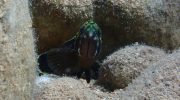
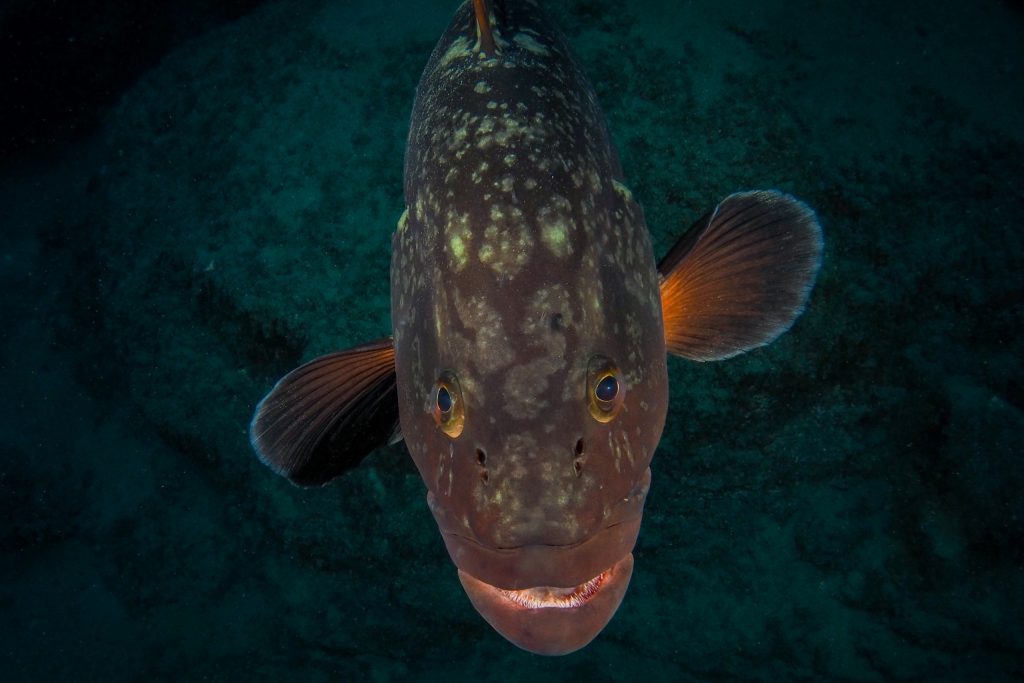
The dusky grouper has a high back and a laterally compressed body with a large mouth that extends behind the eyes. The lower jaw surpasses the upper jaw. The back and sides are brown to violet in colour, with yellow or white marbling, and the abdomen is yellowish. The overall impression is of something solid, powerful, and unhurried – a fish that has no need to be fast because it has learned to be clever.
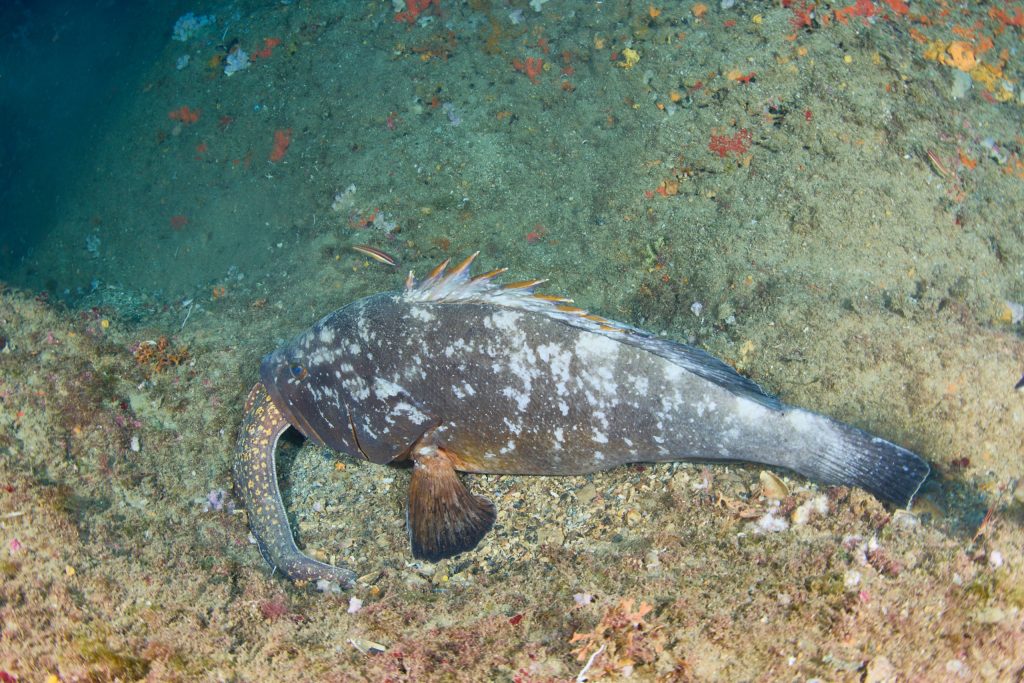
It can reach a maximum length of 150 centimetres and a maximum weight of 60 kilograms, though most individuals seen by divers today are considerably smaller, typically between 50 and 100 centimetres. Adults are solitary and territorial, preferring areas with a rocky substrate. Their main food is molluscs, crustaceans, and octopuses; as they grow larger, other reef fish become an increasingly important part of their diet.
Five Things Worth Knowing – and Worth Sharing
• It lives longer than most people expect. The dusky grouper can reach an age of over 60 years. The fish on that taverna plate may well have been swimming when you were in primary school.
• It is never actually black. Despite the name ‘blackfish’ sometimes used informally in Cyprus, dusky groupers are never truly black or dusky – in good light underwater, they reveal a rich mosaic of browns, golds, and cream.
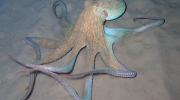
• It is an octopus specialist. One of its favourite foods is octopus, which it hunts by cornering it inside crevices – a battle of wits between two of the reef’s most intelligent creatures.
• The Spanish have a saying: ‘De la mar el mero y de la tierra el carnero’ – from the sea, the grouper; from the land, the lamb – placing it alongside lamb as the finest food their land and sea can offer.
• A single large grouper controls a territory and remembers it for decades. Remove that animal and the cave may stand empty for years, waiting for a successor that may never come.
Nature’s Most Remarkable Secret – The Fish That Changes Sex
Here is where the story of the dusky grouper becomes truly extraordinary, and where even lifelong fishermen are occasionally surprised.
The dusky grouper is a protogynous hermaphrodite, meaning that all fish begin adult life as females but, as they grow larger and older, eventually develop into males. Females reach sexual maturity from around five years of age, at a length of roughly 37 to 44 centimetres. Sex change typically begins at around 65 centimetres, with most individuals completing the transformation between 80 and 90 centimetres – usually somewhere between their ninth and sixteenth year of life, most commonly at around age twelve. Beyond this point, all large individuals are male.
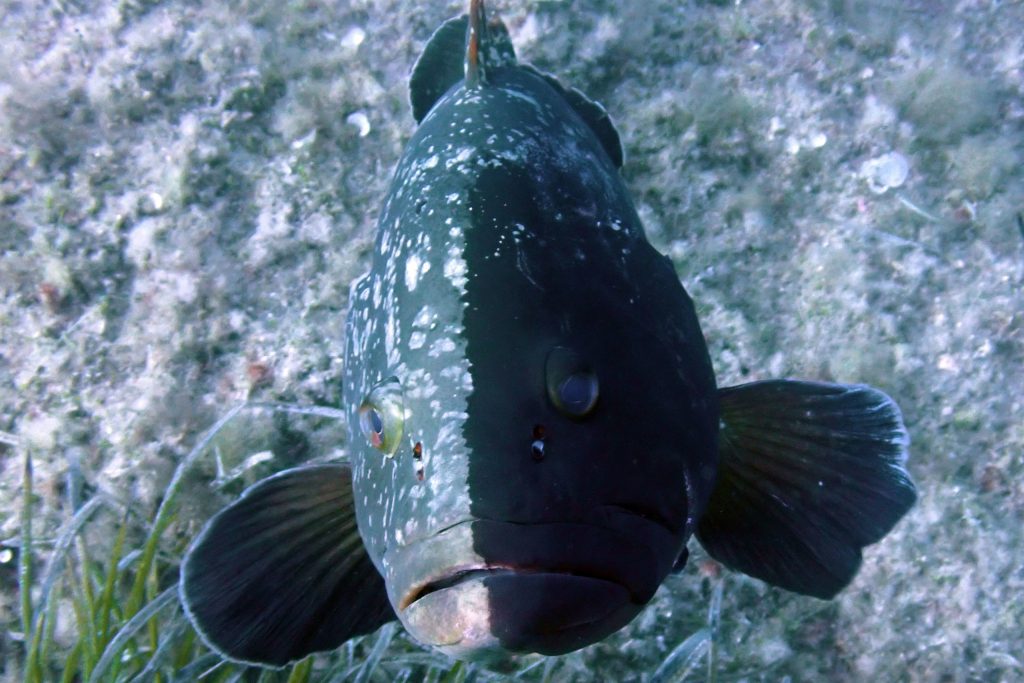
This single biological fact has enormous consequences for conservation. Every large grouper on a reef is almost certainly a male – and every one taken by a spearfisher is removing not just a fish, but the reproductive heart of that local population. During the spawning season, which in the Mediterranean lasts from June to September, dominant males set up territories and defend them aggressively. Spawning groups typically consist of around seven females to each male, making every large male irreplaceable.
When the Sea Was Still Full – Cousteau’s Giants
The story of the dusky grouper’s decline does not begin with industrial fishing. It begins with a rubber mask, a compressed air tank, and a moment of pure wonder.
In June 1943, Jacques-Yves Cousteau and his companions made their first dives in the Mediterranean with the newly invented Aqualung – and what they found astonished them. The sea was full. Enormous fish that had never learned to fear a human being simply sat on the rocks and watched the strange, bubbling newcomers arrive. In Cousteau’s landmark documentary The Silent World (1956), a huge grouper nicknamed Ulysses becomes almost a nuisance – so unafraid of divers and so drawn to their presence that he has to be temporarily placed in a cage.
That extraordinary innocence was precisely what made the grouper so vulnerable once spearfishing spread across the Mediterranean in the following decades. The largest, most visible males – sitting proudly at the entrance to their caves – were the first and easiest targets, and also the most irreplaceable. The 88% population collapse measured across seven countries between 1990 and 2001 was the final chapter of a process that had begun quietly in the 1950s, in the crystal-clear, gun-sight waters of the newly opened underwater world.
But here is the hopeful part: we know exactly what went wrong, and we know exactly how to fix it. In every protected area where spearfishing has been banned and reefs left undisturbed, the grouper has returned. The fish Cousteau filmed still exists. It just needs us to step back – and let it reclaim its cave.
A Species Under Pressure – What Science Tells Us
The dusky grouper is considered a flagship species for conservation and for the establishment of Marine Protected Areas across the Mediterranean. Due to many years of over-exploitation combined with its slow growth, strong site fidelity, and sex-change biology, it has been listed as Endangered on the IUCN Red List.
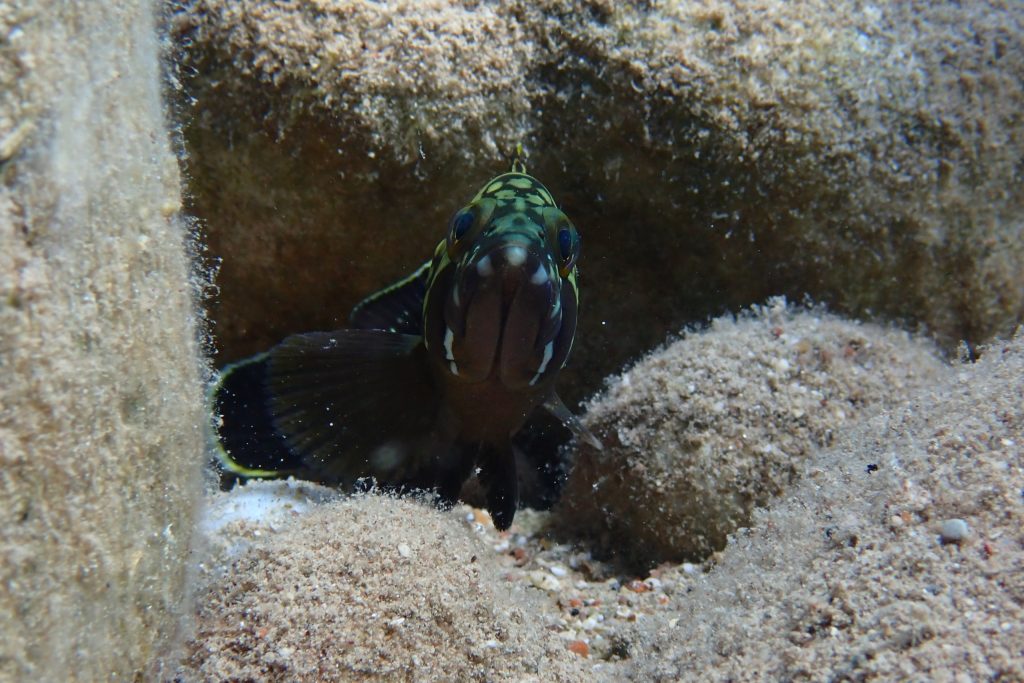
The slow pace of its life – late sexual maturity, long lifespan, and complex reproductive biology – means that what fishing pressure removes, nature restores only very slowly. Research using acoustic tracking has shown that the largest groupers are highly sedentary animals with a powerful attachment to their home territory. Once a large individual is removed from a reef, that specific cave may remain empty for years. Each fish is, in a very real sense, irreplaceable within its local ecosystem. Where protection has been put in place and enforced, this fish responds well. Where it has not, it disappears.
The Reef’s Last Line of Defence – A Guardian Against Invaders
The dusky grouper’s importance goes well beyond keeping smaller fish populations in balance. In the eastern Mediterranean, including the waters around Cyprus, two of the most damaging marine invaders of recent decades have been the lionfish (Pterois miles) and the silver-cheeked toadfish (Lagocephalus sceleratus), both of which entered via the Suez Canal and have spread rapidly through warming seas.
Multiple records of grouper predation on lionfish have been documented across the eastern Mediterranean. In the Bahamas, where a long fishing ban allowed grouper populations to fully recover, lionfish biomass showed a sevenfold reduction in areas where large groupers were abundant – a striking natural experiment in what a healthy, protected grouper population can achieve.
Scientists are careful to note that grouper predation alone cannot fully control established lionfish populations, and that direct human management will also be needed. But the message for conservation is clear: a well-protected grouper population is one of the very few biological tools the Mediterranean has in its own defence. Every large rofos left on a reef is not just a beautiful animal – it is a working part of the ecosystem’s immune system.
From the Farm to the Table – The Aquaculture Question
Here is something worth knowing before ordering grouper at a taverna: the fish on your plate is very probably not from the wild waters of Cyprus or the Mediterranean at all.
Groupers are among the most valuable species in global aquaculture, farmed extensively for their high market demand, superior flesh quality, and favourable growth traits. Several species are now farmed at industrial scale – in particular Epinephelus coioides and Epinephelus malabaricus, originating from Asian waters and produced in large quantities across Taiwan, China, and Southeast Asia. Much of the ‘grouper’ sold commercially in Europe arrives from these farms, often labelled simply as grouper or cernia with no further detail.
Attempts have been made to farm the Mediterranean dusky grouper itself, particularly in Italy, and research continues. However, this species remains extremely difficult and expensive to produce at scale due to its slow growth and complex biology. More promisingly, pilot experiments in Sicily have released hatchery-reared juvenile dusky groupers onto artificial reefs as a stock enhancement tool – not farming for the table, but raising young fish and returning them to the wild to rebuild depleted populations.
The practical takeaway for a diner in Cyprus is simple: if you are eating wild, local rofos, you are eating something genuinely rare and expensive. If the price seems ordinary, it is almost certainly a farmed Asian grouper species – perfectly edible, but a very different story from the old guardian of the rocky reef.
The Grouper and Cyprus Today – Rofos on the Menu and in the Sea
In Cyprus, the dusky grouper occupies two very different worlds. On land, it is a prized dish – baked whole, grilled over charcoal, or served in a taverna overlooking the sea. It commands a premium price and is associated with celebratory meals and the very best of Cypriot hospitality.
Underwater, it is one of the island’s most iconic encounters. Divers around Cyprus regularly find this large, solitary fish resting near rocky areas and wrecks. The population around Cyprus benefits significantly from Marine Protected Areas – most notably, the zone surrounding the Zenobia wreck near Larnaca, where fishing has been prohibited for many years and large groupers are now regularly seen resting on the wreckage among schools of sea bream.
The most compelling proof of what is possible comes from the Medes Islands in Catalonia, Spain – one of the longest-running marine protection experiments in the Mediterranean. Since the reserve was established in 1983 and all fishing was prohibited, the dusky grouper population there has gone from severely depleted to virtually full recovery, now approaching the maximum population the habitat can support. It took over two decades of strict protection – but it worked. The Medes Islands today are one of the best places in the Mediterranean to dive with large, confident groupers. They are, quite literally, proof of concept.
Into the Blue – Diving with Rofos
The dusky grouper is not a shy fish when it lives somewhere it feels safe. In protected areas, it will often sit completely still at the entrance to its cave, watching divers approach with what can only be described as regal indifference.
Where to look in Cyprus:
• Zenobia Wreck, Larnaca – Rated one of the top ten wreck dives in the world, the Zenobia lies on her port side outside Larnaca harbour. Large groupers rest on the wreckage year-round, protected by the surrounding Marine Protected Area. An Advanced Open Water certification is recommended.
• Rocky reefs around Paphos and Akamas – Undisturbed rocky seabed with caves and crevices provides ideal grouper habitat, with sightings reported throughout the year.
• Kyrenia area, Northern Cyprus – A dive site near Kyrenia harbour once made famous by a resident grouper regularly encountered by local divers; grouper presence in the area continues to this day.
The best season for encountering large individuals is late summer, when the water is warmest and spawning activity brings the biggest males out into the open. Even snorkellers in shallow rocky bays occasionally encounter juveniles – smaller, more colourful, and darting with the energy of youth before they settle into the measured patience of adulthood.
For anyone who wants to go deeper into the world of the dusky grouper, there is one book that stands apart. The Dusky Mediterranean Grouper, published in 2024 by Sakis Lazarides – a Cypriot underwater photographer who has spent decades diving the island’s reefs – is a stunning 80-page photographic guide covering every life stage of Epinephelus marginatus. Lazarides is not a scientist but something rarer: a patient, decades-long witness. His images have appeared in National Geographic and the World Wildlife magazine, and his quiet philosophy – “I try to do the good thing, always” – comes through in every photograph. The book is available on Amazon and was launched in Paphos in August 2024.
A Fish Worth Protecting – Why Rofos Matters to the Island
The dusky grouper is not simply a large fish on a reef. It is a measure of the health of Cyprus’s coastal waters. A reef with a thriving population of rofos is a reef where the ecosystem is working – where prey species are in balance, where rocky habitats are intact, where invasive species are kept in check, and where the sea is still clean and undisturbed.
Cyprus sits at the eastern end of the Mediterranean, at a crossroads of cultures and civilisations. Its seas have been fished for thousands of years. The dusky grouper has survived all of that history, but the last century of intensive fishing came closer to ending its story than any previous threat. The good news is that, unlike many marine creatures, this one recovers when it is given the chance.
Every time a diver descends alongside a large, unhurried rofos in the clear waters off Cyprus, they are witnessing something genuinely precious – a fish that has lived longer than many of us, carrying the memory of a cleaner sea, waiting patiently in its cave to see what we decide to do next. The choice, as it so often is, remains ours.