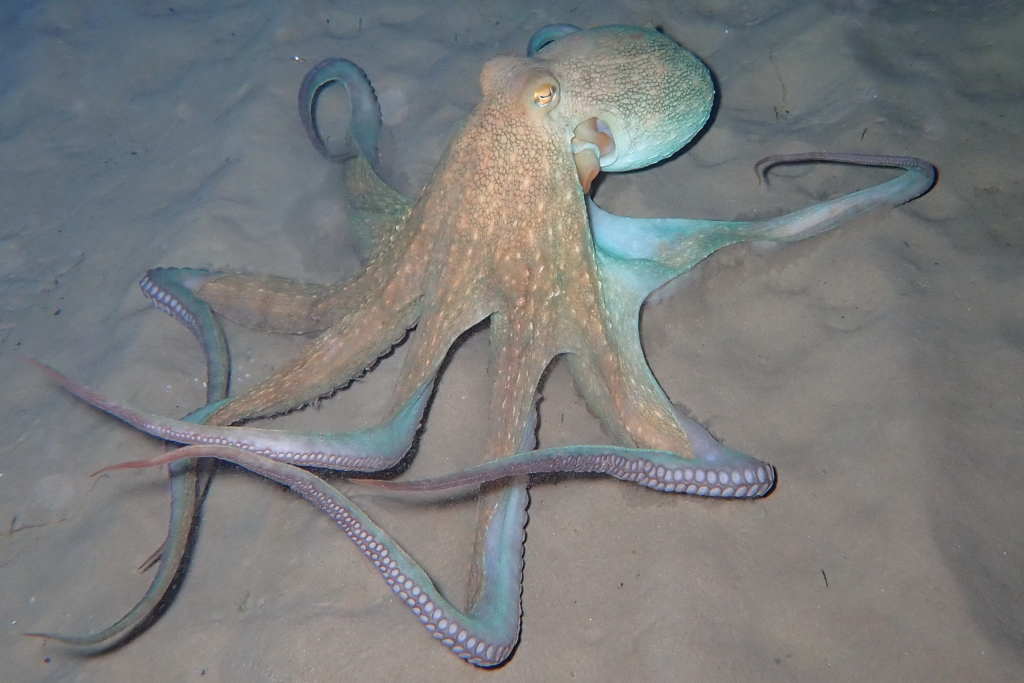
Lurking beneath the crystalline waters of Cyprus, pressed into a crevice no bigger than a fist and wrapped in perfect camouflage, lives one of the most intelligent animals on the planet. It has no bones, three hearts, and blood that runs blue – and yet it may just outsmart you.
A Mollusc Unlike Any Other
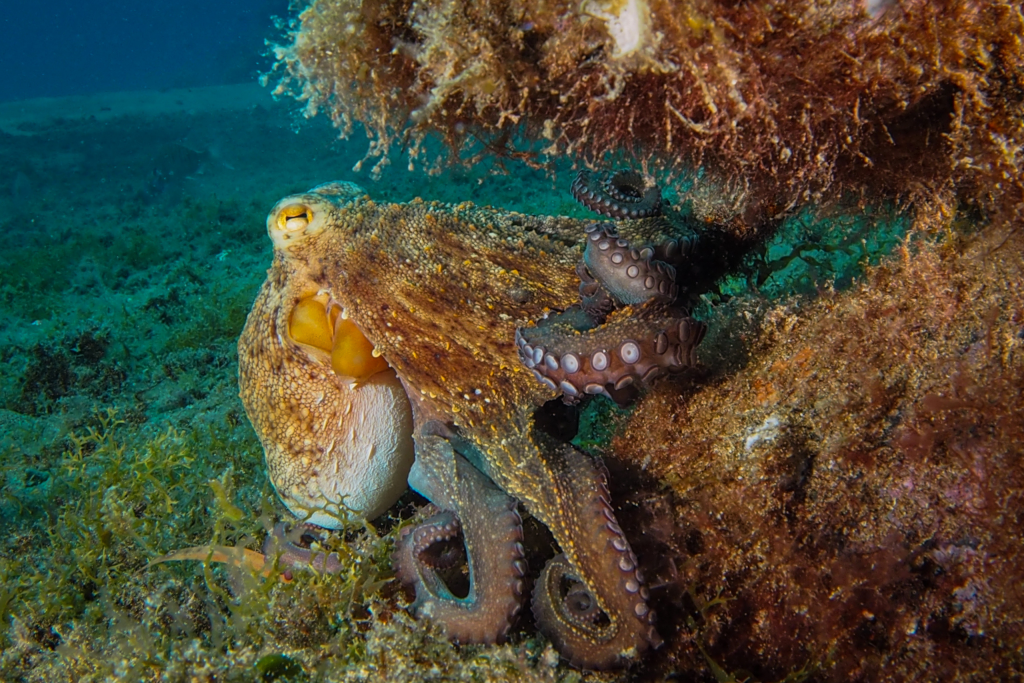
The common octopus – known in Cyprus by its Greek name χταπόδι (chtapódi) – belongs to an ancient and remarkable group of animals called cephalopods. The word comes from Greek: kephalé (head) and pous (foot), because in these extraordinary creatures, the foot of the animal has evolved directly into arms growing from around the head. Alongside squid, cuttlefish, and the nautilus, cephalopods represent one of nature’s most successful evolutionary experiments – soft-bodied animals that traded the protection of a shell for something far more powerful: intelligence.
Within this group, the common octopus (Octopus vulgaris) stands alone as the most studied octopus species in the world. It is found across the Mediterranean Sea and the eastern Atlantic, from the southern coast of England to the coasts of West Africa. Cyprus, positioned at the heart of the eastern Mediterranean, sits squarely in the middle of its range – and the octopus has been woven into the fabric of island life here for thousands of years.
As Old as Memory Itself
The octopus has shared the Mediterranean with humans since before recorded history. The Minoan civilisation of Crete – the Bronze Age culture that flourished across the eastern Mediterranean around 1500 BC – was so captivated by the octopus that it became one of the defining motifs of their ceramic art. Pottery was painted with swirling, eight-armed creatures in what archaeologists call the “marine style” – a tradition that echoes down through the centuries to reach us today in every seaside taverna where dried octopus hangs in the morning sun.
The ancient Greeks were equally fascinated. Aristotle, writing in the fourth century BC in his Historia Animalium, studied the octopus closely and described with remarkable accuracy how it changes colour to match the stones around it – behaviour he observed both during hunting and when the animal was frightened. His successor Theophrastus even wrote an entire treatise on animals that change colour, in which the octopus featured prominently. For the Greeks, the octopus embodied cunning and adaptability – qualities they also admired in their great hero Odysseus, who shared with the octopus the epithet polymetis, meaning “of many wiles.”
Archaeological evidence shows that fishing in Cyprus has deep roots. Records from the Cypro-Classical period onward document a rich tradition of catching fish and seafood using traps, lines, and nets – a tradition so carefully preserved that some fishing methods practiced by Cypriot fishermen in the 19th and 20th centuries can be traced directly to descriptions written by ancient authors more than two thousand years earlier.
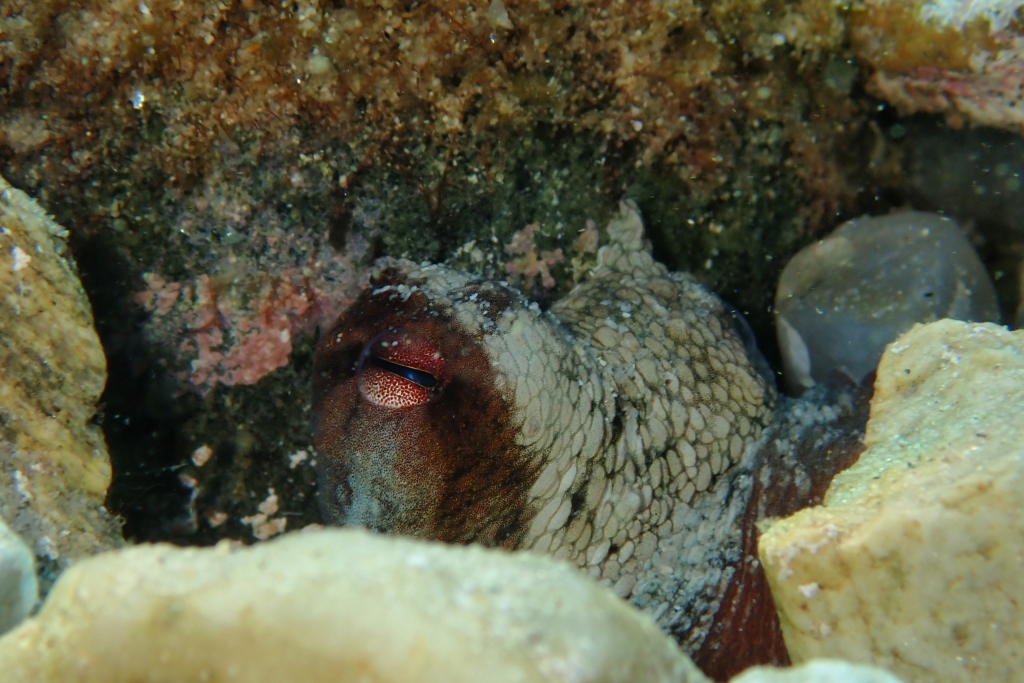
“The octopus seeks its prey by so changing its colour as to render it like the colour of the stones adjacent to it; it does so also when alarmed.” – Aristotle, Historia Animalium, 4th century BC
A Creature Built for Wonder
The common octopus is a medium to large species. The body – called the mantle – grows to around 25 centimetres in length, but the eight arms can extend to a metre or more, giving the animal a total span that can comfortably dwarf a dinner plate. Adults commonly weigh between 3 and 5 kilograms, though larger individuals exist. Despite this bulk, the octopus has no hard skeleton at all – only its beak, which resembles a parrot’s beak and is made of chitin, is truly rigid. This means an octopus can squeeze its entire body through any gap that its beak can pass through.
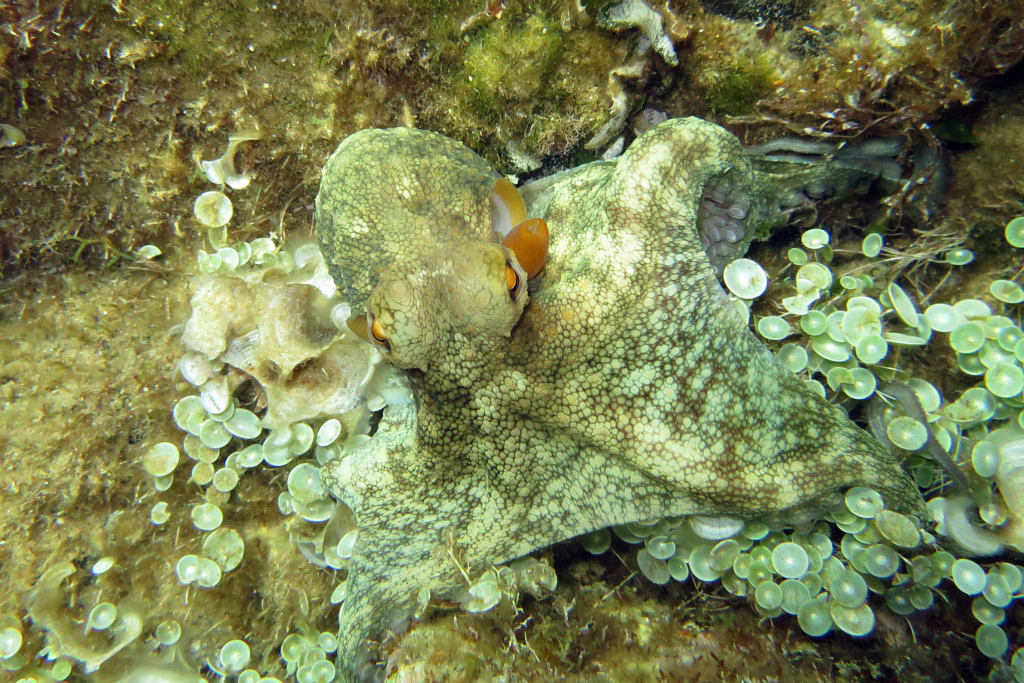
The skin is a marvel of biological engineering. Thousands of specialised cells called chromatophores expand and contract in milliseconds, allowing the animal to shift colour, pattern, and even texture instantly. It can roughen its skin into a warty landscape to mimic encrusted rock, or smooth it to a silky grey to disappear against sand. The octopus is, in essence, a living special effect – and it performs this trick entirely through nervous control, making it one of the fastest and most accurate camouflage systems in the natural world.
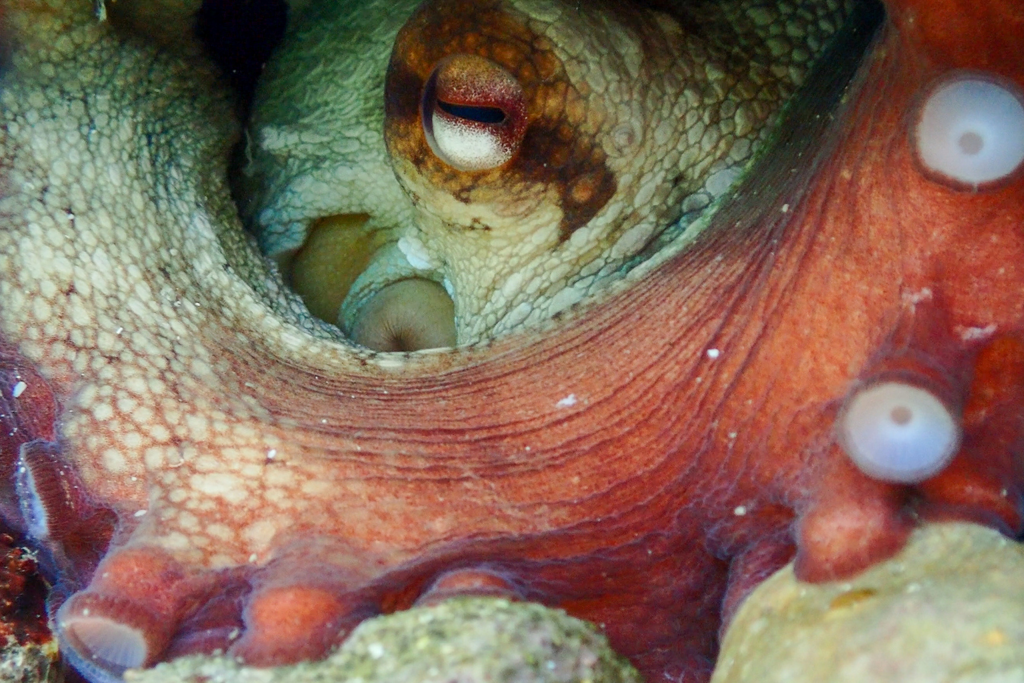
The nervous system of the common octopus is extraordinary. It has around 500 million neurons – comparable in number to a dog’s. But two-thirds of those neurons are not in the brain at all: they are distributed through the arms themselves, allowing each limb to act semi-independently, solving problems and exploring spaces without waiting for instructions from the central brain. Three hearts pump blue, copper-rich blood (called haemocyanin) through the body – two gill hearts and one systemic heart. When the octopus jets through the water by expelling water from its mantle, the systemic heart actually stops, which is why octopuses tire quickly when swimming and prefer to crawl.
- ~25 cm Mantle length
- 3–5 kg Adult weight
- 500M Neurons
- 3 Hearts
- 0–150 m Depth range
- 1–2 yrs Lifespan
The common octopus hunts primarily at dusk and by night, though Mediterranean populations have been observed active during the day as well. Its preferred prey includes crabs, crayfish, and bivalve molluscs such as clams and mussels. The octopus pounces on prey with its arms, paralyses it with a venomous saliva secreted from its beak, and – if the prey has a hard shell – drills a neat hole through it before extracting the soft flesh inside. Empty shells and crab carapaces piled outside a rocky crevice are a sure sign of an octopus den nearby.
Eight Surprising Things About the Common Octopus
- 1Octopuses are colour-blind. Despite their incredible ability to match the colours of their surroundings precisely, Octopus vulgaris has only a single type of photoreceptor in its eyes. Scientists believe it may use the edges of its pupils – which are shaped like a horizontal slit – to detect colour through a phenomenon called chromatic aberration, a bit like a camera that has turned an optical flaw into a feature.
- The common octopus was the first invertebrate animal to receive legal protection under the UK’s Animals (Scientific Procedures) Act 1986 – a recognition of its unusual intelligence and capacity to feel pain.
- They keep gardens. Octopuses collect shells, rocks, and bits of debris around the entrance to their dens, creating what researchers call a “midden.” This tidying behaviour may have inspired the Beatles’ 1969 song “Octopus’s Garden.”
- A female common octopus can lay up to 400,000 eggs in a single clutch. She guards them obsessively for weeks, fanning them with water, cleaning them constantly – and eating nothing at all. Most females die shortly after the eggs hatch, exhausted by the effort of motherhood.
- An octopus’s blood is blue – coloured by haemocyanin, a copper-based protein that transports oxygen, just as haemoglobin (iron-based and red) does in our own blood. This makes the octopus genuinely blue-blooded, which in human culture has always implied nobility.
- The early fossil record of octopuses goes back nearly 300 million years – long before the dinosaurs existed. The ink sac, which the common octopus uses to create a dark cloud that confuses predators, has been refined and perfected over almost three hundred million years of evolution.
A Mind in Eight Directions
One of the most debated questions in animal behaviour is whether intelligence requires a centralised brain. The common octopus challenges everything we thought we knew about this. Each of its eight arms contains its own cluster of neurons capable of independent control – they can taste, touch, and navigate a maze even when surgically detached from the body. Some scientists have argued that the octopus doesn’t so much have eight arms as it is eight semi-independent problem-solvers loosely coordinated by a central hub.
In laboratory experiments, Octopus vulgaris has been shown to distinguish the brightness, size, shape, and orientation of objects. It can learn to unscrew a jar to reach food inside, navigate complex mazes, recognise individual human faces, and – remarkably – raid lobster traps. There is growing evidence that individual octopuses have distinct personalities: some shy and cautious, others bold and curious.
Genetically, the Mediterranean population of common octopus represents a distinct pool from Atlantic populations, shaped by the sea currents and the history of the Mediterranean itself. Research has shown that the main vehicle for dispersal is the tiny, planktonic larval stage – newborn octopuses no bigger than a grain of rice that drift with currents for weeks before settling to the seabed and beginning their rapid growth toward adulthood. An octopus can grow from hatchling to full adult in as little as a year, making it one of the fastest-growing large invertebrates in the sea.
In Cyprus waters, the common octopus occupies rocky reefs, Posidonia seagrass beds, and sandy bottoms, typically between the surface and about 150 metres depth. It shares these habitats with moray eels, sea bream, grouper, and the occasional loggerhead turtle. Interestingly, Cypriot fishermen and divers have long observed a curious association between the common octopus and the painted comber (Serranus scriba), a small reef fish that sometimes follows octopuses during their hunts – apparently benefiting from prey flushed out by the octopus’s probing arms.
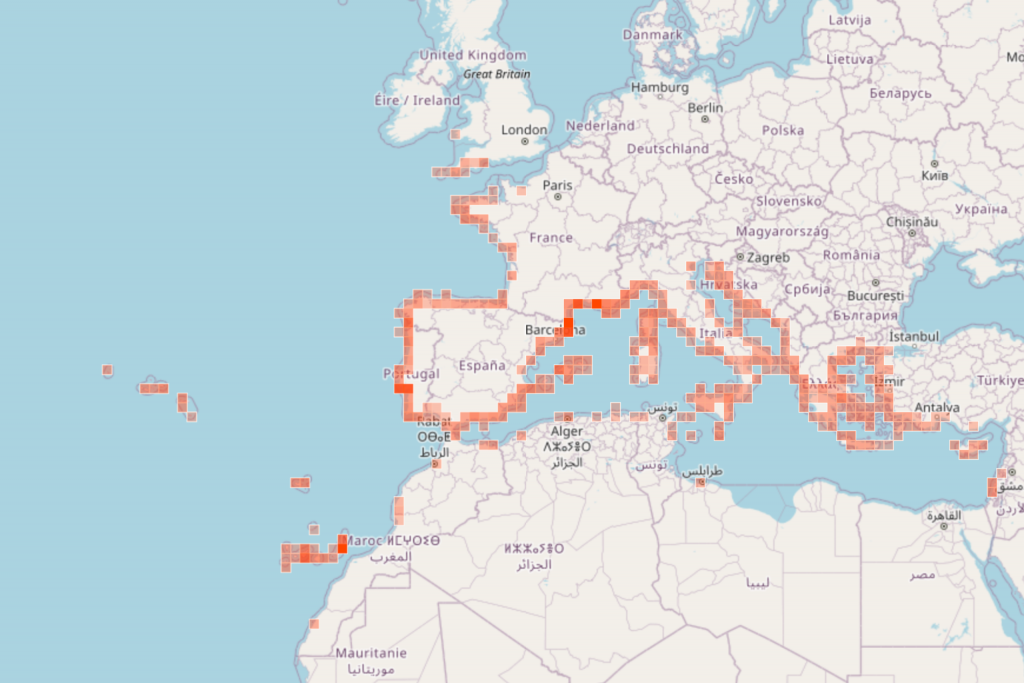
View Cyprus observations on iNaturalist →
From the Harbour Wall to the Taverna Table
Spend a morning in any traditional Cypriot fishing harbour – Paphos, Latsi, Zygi, Kyrenia – and you will almost certainly see octopuses hanging to dry in the sun. This ancient practice, shared across the entire eastern Mediterranean, is both practical and poetic: the drying concentrates flavour, tenderises the flesh, and transforms a raw catch into something ready for the grill. It is a ritual unchanged in its essence since the Bronze Age, connecting the modern Cypriot to a seafaring ancestry stretching back thousands of years.
On the Cypriot table, octopus – xtapodi – holds a special place. The dish known as χταπόδι κρασάτο (octopus cooked in wine) is one of the island’s most distinctive traditional recipes, requiring the octopus to be simmered slowly with olive oil, dry red wine, vinegar, Commandaria (Cyprus’s ancient sweet wine), cinnamon, cloves, and bay leaves. The recipe dates back to times before refrigeration, when wine and vinegar served as natural preservatives, allowing the cooked octopus to keep for several days. Villages across Cyprus have their own variations – the recipe from the now-occupied village of Limnia in Famagusta is particularly treasured.
In terms of ecology, the octopus remains an important part of Cyprus’s coastal food web – a top predator of crabs, molluscs, and fish that in turn is eaten by moray eels, larger fish, and dolphins. Its population in Cypriot waters appears stable, though the broader Mediterranean fishery faces ongoing pressure. More than 20,000 tonnes of common octopus are harvested globally every year, making it one of the most commercially important cephalopods in the world.
Why the Octopus Matters
There is something quietly profound about the presence of the common octopus in the waters around Cyprus. Here is an animal whose lineage extends back before the dinosaurs, whose intelligence rivals that of many vertebrates, and whose life has been intertwined with human culture on this island for at least three and a half thousand years. It has appeared in Minoan pottery, in Aristotle’s writings, in ancient fishing nets, in the deep traditions of Cypriot cooking, and – if you look carefully enough – in the dappled shadow of a rocky crevice not far from the shore where you are standing.
Cyprus is sometimes called the crossroads of civilisations. The octopus is, in its own way, a crossroads of kingdoms – sitting at the boundary between the familiar and the utterly alien, between the invertebrate world and the realm of complex minds. To meet one in the sea off Cape Greco or Akamas is to realise that intelligence, wonder, and mystery did not begin with us.