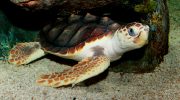
The loggerhead sea turtle represents one of the oldest living species on Earth. This marine reptile has survived for millions of years, adapting to changing oceans while maintaining its essential form and behaviors. The species gets its common name from its remarkably large head, which houses powerful jaw muscles capable of crushing hard-shelled prey like whelks, conchs, and horseshoe crabs.
Cyprus holds special significance for loggerhead turtles in the Mediterranean. The island’s beaches serve as critical nesting sites where female turtles return every two to four years to lay their eggs. These ancient creatures navigate across vast ocean distances to find the exact beaches where they were born, using mechanisms that scientists believe involve magnetic fields, water chemistry, and possibly star navigation.
Evolution and Natural History
Loggerhead sea turtles belong to the family Cheloniidae, which includes all living sea turtles except the leatherback. The species received its scientific name Caretta caretta from the French word “caret,” meaning turtle. Carl Linnaeus first classified the species in 1758, though it underwent several name changes before scientists settled on the current designation in 1873.
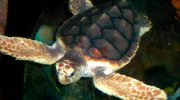
The Mediterranean Sea hosts a distinct regional population of loggerheads. These turtles differ slightly from their Atlantic cousins, typically reaching smaller adult sizes. While Western Atlantic loggerheads average around 250 pounds and can exceed 400 pounds, Mediterranean individuals rarely surpass 200 pounds. Adult carapace length typically measures between 30 and 42 inches.
The species evolved its characteristic features over millions of years. The heart-shaped shell provides protection while allowing streamlined movement through water. The reddish-brown coloration helps with camouflage in coastal waters. Powerful flippers enable both long-distance ocean travel and the laborious task of excavating nests on beaches.
Physical Characteristics and Life Cycle
Adult loggerheads have reddish-brown shells with pale yellow undersides. The skin ranges from yellow to brown, creating effective camouflage in their marine environment. Males and females look identical until maturity, when males develop thicker tails and curved claws on their front flippers used for gripping females during mating.
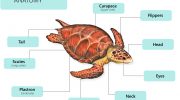
The massive head contains specialized salt glands behind each eye. These organs filter excess salt from ingested seawater, maintaining proper body chemistry. On land, the salt excretion creates the false impression that turtles cry, though this simply represents normal biological function.
Loggerheads demonstrate temperature-dependent sex determination. Sand temperature during the middle third of egg incubation determines whether hatchlings become male or female. Warmer temperatures produce more females, while cooler conditions yield more males. This biological mechanism makes the species vulnerable to climate change, as rising temperatures could skew sex ratios.
The species reaches sexual maturity remarkably late, between 17 and 33 years of age. Scientists estimate lifespan at 47 to 67 years, though some individuals may live considerably longer. This delayed maturation means that conservation efforts take decades to show results in population numbers.
Nesting in Cyprus
Cyprus represents a crucial stronghold for Mediterranean loggerheads. Approximately 10 percent of all loggerhead turtles nesting in the Mediterranean choose Cypriot beaches. The summer population reaches an estimated 1,200 to 1,500 individuals across the island.
Nesting occurs from late May to early August. Females come ashore almost exclusively at night, reducing exposure to heat and predators. Each female nests three to five times per season at roughly two-week intervals. She excavates a chamber about 40 centimeters deep using her rear flippers, deposits 70 to 150 eggs, then covers the nest and returns to sea.
The main nesting beaches in the Republic of Cyprus include Lara and Toxeftra in the Akamas Peninsula, and beaches around Polis Chrysochous and Gialia. Additional nesting occurs at Pervolia and Kiti on the south coast. In northern Cyprus, Alagadi Beach near Esentepe and Golden Beach in the Karpaz Peninsula serve as important nesting sites.
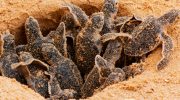
Incubation lasts approximately 50 to 60 days, depending on sand temperature. Hatchlings emerge mostly at night, when cooler temperatures and reduced predator activity improve survival odds. The tiny turtles exhibit phototropic behavior, instinctively heading toward the brightest point on the horizon. Under natural conditions, this means moving toward moonlight or starlight reflected on the sea.
Conservation Challenges and Successes
Only one in 1,000 hatchlings survives to reach adulthood. Natural predators include ghost crabs, foxes, birds, and marine fish. Once turtles grow large enough, sharks become the primary predator, though mature loggerheads can often avoid attacks by presenting their flat shells.
Human activities create additional threats. Coastal development destroys nesting habitat. Artificial lighting disorients hatchlings, causing them to crawl inland rather than toward the sea. Fishing gear, particularly trawls and longlines, captures and drowns turtles. Plastic pollution poses severe risks, as turtles mistake plastic bags for jellyfish.
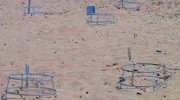
Despite these challenges, conservation efforts in Cyprus have achieved measurable success. The Society for the Protection of Turtles in Northern Cyprus, founded in 1991, works with the University of Exeter’s Marine Turtle Research Group on systematic monitoring and protection. Volunteers screen nests with protective cages to prevent predation by foxes and dogs. They relocate nests that are too close to the water to prevent flooding.
Numbers have increased consistently over the past decade on monitored beaches. The success reflects sustained effort rather than quick fixes. Protected status under EU Natura 2000 designations covers key nesting sites, though enforcement and boundary disputes continue.
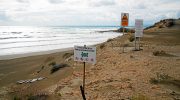
The Lara Bay Turtle Conservation Station, operated by the state Department of Forests and Fishery, protects eggs from both natural predators and human disturbance. Conservationists monitor nesting activity throughout the season and assist hatchlings in reaching the sea safely.
Feeding and Behavior
Loggerheads are carnivorous throughout their lives, though diet varies by age and location. Hatchlings feed on small animals living in floating sargassum mats. Juveniles and adults consume a wide variety of bottom-dwelling invertebrates, including conchs, clams, crabs, horseshoe crabs, sea urchins, sponges, and fish. The powerful jaws easily crush shells that would protect prey from other predators.
During long migrations, loggerheads eat jellyfish, floating mollusks, squid, and flying fish. More than 100 species of invertebrates and 37 types of algae live on the shells of loggerheads, creating mobile ecosystems. These hitchhikers include barnacles, tunicates, sponges, and various crustaceans.
Young loggerheads spend 7 to 12 years in open ocean environments, a period researchers call the “lost years” due to difficulty tracking them. They drift with currents along ocean fronts where prey concentrates. Eventually they recruit to coastal waters, becoming bottom feeders in lagoons, estuaries, and shallow seas.
Experiencing Loggerhead Conservation
Several beaches offer opportunities to observe loggerhead conservation work. Lara Bay in the Akamas Peninsula provides the most developed visitor infrastructure. The conservation station operates throughout nesting and hatching season, with staff available to explain ongoing work.
Access to Lara Bay requires a vehicle capable of handling rough dirt roads, though careful drivers can reach the area in standard cars. Visitors must follow strict rules to protect nesting sites. Umbrellas and shade structures are prohibited because they can damage underground nests. Dogs are not permitted. Visitors should bring sun protection, water, and food, as no facilities exist nearby.

Alagadi Beach in northern Cyprus allows visitors to observe nesting and hatching under controlled conditions. The volunteer-run program offers guided experiences where small groups can watch turtles come ashore to nest or see hatchlings released. Advanced booking is essential, as participant numbers are strictly limited.
Best viewing times run from late May through September. Nesting peaks in June and July, while hatching occurs mainly in August and early September. All observation happens at night when turtles are naturally active. Visitors should expect to remain quiet and avoid using lights, which disturb the turtles.
A Living Link to the Past
The loggerhead sea turtle matters to Cyprus because it represents continuity with the natural world that existed before human modification of coastlines. These creatures have returned to the same beaches for thousands of generations, maintaining behaviors shaped over millions of years. Their survival depends on protecting the specific beaches they recognize as home. For Cyprus, maintaining healthy loggerhead populations demonstrates commitment to preserving natural heritage alongside cultural heritage. The turtles serve as ambassadors for broader ocean conservation, since their survival requires healthy marine ecosystems across the Mediterranean. By protecting loggerheads, Cyprus contributes to maintaining the biological diversity that makes the Mediterranean unique. These ancient mariners remind us that some cycles operate on timescales far longer than human lives, and that our responsibility extends beyond our immediate needs to encompass the natural systems that will outlast us.