Hidden in stone walls, sheltering under the bark of olive trees, and spiralling patiently across the morning earth – Cyprus is home to well over 120 species of land snail, a quarter of which exist nowhere else on the planet. This is their story.
- Unhurried, Unnoticed, Unmistakable
- Carrying Their World on Their Backs
- On the Table Since the Stone Age
- A Thousand Shapes, One Blueprint
- The Curious Life of the Snail
- Masters of the Mediterranean Summer
- Still on the Table, Still in the Wall
- When to Look, and Where to Find Them
- The Spiral that Connects Everything
Unhurried, Unnoticed, Unmistakable
Walk out into a Cypriot garden after a winter rain and you will find them everywhere – clinging to walls, crossing paths with studied deliberation, leaving gleaming silver threads across the stone. Land snails are among the oldest and most quietly successful inhabitants of this island, and yet most people walk past them without a second glance. That, it turns out, is a serious mistake.
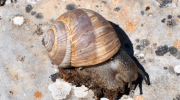
Cyprus is home to a remarkable diversity of land snails, with species found nowhere else on Earth. Some are the size of your thumbnail; some could fill a teacup. Some have towers twisted like little pagodas; others are as flat and white as a communion wafer. They have fed people here for ten thousand years, inspired ancient mythology, and are, in the eyes of many biologists, one of the best examples of island evolution in the entire Mediterranean. And yet their story is almost entirely untold.
Carrying Their World on Their Backs
Land snails are molluscs – the same broad animal group that includes octopus, clams, and oysters. What sets them apart from their relatives is their move onto dry land, where they breathe through a primitive lung rather than gills, and carry a coiled shell that serves as both home and shield. This combination of a protective shell and a moist, mobile body has proved remarkably durable: snails have been living on land for over 300 million years, long before the dinosaurs appeared.
The ones we see in Cyprus belong mainly to a group called Pulmonata – the lung-breathers – and their order, Stylommatophora, is notable for the characteristic four tentacles on the head: two short ones for touch and smell, and two longer ones tipped with eyes. When alarmed, a snail can retract its entire soft body back into the shell within seconds, sometimes sealing the opening with a thin membrane of dried mucus to lock in moisture during dry spells.
“Cyprus harbours around 120 species of land snail distributed across 35 different families – a richness that surprises almost everyone who hears it.”
The island’s biodiversity records, compiled by naturalist George Konstantinou over decades of fieldwork, confirm that Cyprus harbours around 120 species of land snail distributed across 35 different families – a richness that surprises almost everyone who hears it. Most Cypriots, he notes, only know the large, edible species; the miniature ones, some no larger than a pinhead, remain largely invisible to the casual visitor. But they are there, in extraordinary numbers, quietly shaping the ecology of soil and stone.
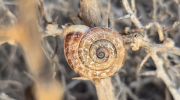
The limestone hills and ancient stone walls of Cyprus provide ideal habitat for the island’s remarkable diversity of land snails.
On the Table Since the Stone Age
The relationship between people and snails on Cyprus is astonishingly old. Archaeological excavations at some of the island’s earliest Neolithic settlements have turned up shell remains that point to snails being a regular part of the diet. Sites at Khirokitia, Sotira-Teppes, Kantou-Kouphovounos, and Ayios Epiktitos-Vrysi – settlements dating back roughly 9,000 years – have all yielded food remains in which land snails appear alongside grain and bone. In the later Aceramic Neolithic period, around 7000 BC, snails were already a trusted source of protein for Cyprus’s earliest permanent communities.
This is not merely local history. Across the Mediterranean, snails have been eaten since prehistoric times, and in ancient Rome they were considered a delicacy – kept in special enclosed gardens called cochlearia, fed on wine and herbs to improve their flavour. The word “cochlea” – Latin for snail shell – is still used today in anatomy to describe the spiral chamber of the inner ear, a testament to how deeply the form of the shell has impressed itself on human imagination.
In Cyprus, the snail’s spiral shell carries a more poetic resonance still. Aphrodite – the goddess born from sea foam who first came ashore on Cyprus – was closely associated with shells as symbols of beauty, fertility, and the turning of life itself. The spiral, appearing endlessly in nature from galaxies to fern fronds, was read by ancient peoples as a sign of life and regeneration. To find that symbol alive and moving in your garden must have felt, to a Neolithic farmer, like something worth noticing.
A Thousand Shapes, One Blueprint
The diversity of land snail shells in Cyprus is quietly astonishing. At one end of the scale sit the large, round snails of the Helix family – robust, globular shells up to five or six centimetres across, often banded with cream and brown and so familiar they barely register as unusual. These are the ones on restaurant menus, the ones village grandmothers collect after rain. At the other end sit creatures so small they live out entire lives between the cracks of a limestone rock, their shells barely visible to the naked eye.
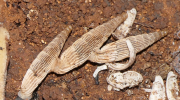
In between is a world of extraordinary sculptural variety. The genus Albinaria – the door snails – produces long, elegantly tapered shells resembling miniature towers or spindles, often only a centimetre or two in length. What makes them extraordinary is not just their shape but the tiny internal mechanism that gives them their name: a small calcified plate called a clausilium that acts like a self-closing door, swinging shut when the snail withdraws, without the need for a mucus plug. It is, in its own miniature way, a marvel of natural engineering.
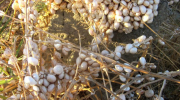
Then there are the white, sun-bleached snails so common on roadsides and dry hillsides in summer – species of Theba, Trochoidea, and Xeropicta – whose pale shells are not an accident but an adaptation. Light-coloured shells reflect sunlight more effectively, helping the snail stay cooler during the long summer aestivation. Cyprus’s fierce sun has, over thousands of years, selected for whiteness.
Cornu aspersum
GARDEN / BROWN SNAIL
The most familiar large snail in Cyprus and across the Mediterranean. Brown-banded shell up to 4 cm. Eaten in Cyprus as saligkária – stewed, fried, or simply boiled with olive oil and lemon.
Helix cincta
BANDED SNAIL
A striking, neatly banded species reaching up to 5 cm. Originally from the Levant, it was likely brought to Cyprus by ancient human trade. One of the most prized edible snails on the island.
Albinaria virgo
TOWER / DOOR SNAIL (ENDEMIC)
A slender, spindle-shaped snail found only in Cyprus. Part of one of the great land snail radiations of the Mediterranean – the Albinaria genus contains over 140 species across Greece and Turkey.
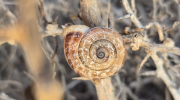
Eobania vermiculata
CHOCOLATE-BAND SNAIL
A beautifully marked snail with dark spiral bands and a solid white shell. Common in the lowlands and cultivated areas of Cyprus, and edible – traditionally prepared after autumn rains.
Trochoidea liebetruti
CYPRUS CONE SNAIL (ENDEMIC)
A small, top-shaped endemic species found only on the island. One of many Cypriot endemics that evolved in isolation over thousands of years, occupying specific rock and scrubland habitats.
Theba pisana
WHITE ITALIAN SNAIL
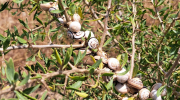
The classic white aestivating snail seen in hundreds on roadside vegetation during summer. Its pale shell is an adaptation to intense heat, reflecting sunlight to prevent fatal overheating.
The Curious Life of the Snail
- All snails are hermaphrodites. Every individual has both male and female reproductive organs – but they still need a partner to reproduce. Mating can last several hours.
- The love dart. Before mating, many land snails fire a small calcified spike – the “love dart” – into their partner. This is not aggression: it improves reproductive success by slowing digestion of sperm.
- One quarter are unique to Cyprus. Around 26% of Cyprus’s land snail species are found nowhere else on Earth. Isolation over thousands of years has driven rapid evolution into new forms.
- The door that seals itself. Albinaria door snails possess a unique internal closing mechanism – a tiny calcified flap called a clausilium – making a mucus plug unnecessary.
- A snail can sleep for years. In extreme drought, some Mediterranean snails have been documented surviving three to four years in deep aestivation – sealed, dormant, and waiting for rain.
- Their mucus has medical uses. Snail secretion (the mucus trail) is now used in cosmetic and dermatological products for its skin-repair properties. Cyprus has a small but growing heliciculture (snail farming) industry.
- Left-handed shells are rare. Almost all snail shells coil clockwise (dextral). Finding a sinistral – left-coiled – individual is extremely unusual and is caused by a single genetic mutation.
- Snails have teeth. Instead of jaws, land snails use a rasping tongue called a radula, studded with thousands of tiny teeth, to scrape food from leaves, bark, and stone surfaces.
Masters of the Mediterranean Summer
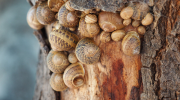
One of the most extraordinary things about Cyprus’s land snails is how completely they have adapted to the island’s searing, dry summers. Between roughly June and October, when rain disappears and temperatures routinely exceed 38°C, most land snails enter a state called aestivation – a summer version of hibernation. They withdraw deep into their shells, seal the opening with a plug of dried mucus (called an epiphragm), and reduce their metabolic rate to a minimum. Some species climb up onto vegetation or stone walls, presumably to escape ground heat; white-shelled species become almost invisible against sun-bleached limestone.
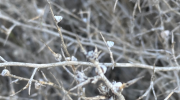
During this dormancy, their heartbeat drops to almost nothing, their water loss is minimised, and they live off stored energy for months at a time. When the first autumn rains arrive – usually in October or November – they emerge within hours, sometimes in spectacular numbers. Cypriot collectors know exactly what a September downpour means: the snails are back.
Reproduction also follows this rain calendar. Snails lay their eggs in autumn after the first rains, digging small chambers in soft soil where the eggs incubate through the cooler months. Young snails hatch in winter and spend several months growing before the next summer forces them into dormancy again.
The genus Albinaria – whose representatives have diversified so spectacularly across Cyprus, Greece, and Turkey – is of particular interest to evolutionary biologists. With over 140 species recognised, it represents one of the most intensive radiations of land snails in the Mediterranean. Cyprus’s own Albinaria species appear to have diverged from mainland ancestors as the island became geographically isolated, each finding slightly different niches in the island’s varied limestone landscapes. The result is a group of animals whose shells look remarkably different yet whose internal anatomy remains strikingly similar – the classic pattern of rapid, visible evolution driven by island isolation.
Still on the Table, Still in the Wall
Land snails remain embedded in Cypriot life in a way that is easy to overlook but difficult to overstate. After the first rains of autumn, villages across the island fill with the sight of people – often older women – walking the fields with plastic bags and buckets, collecting the large edible species. The Cypriot word saligkária (σαλιγκάρια) is not an archaic term; it appears on restaurant menus in Nicosia and Limassol, and dishes such as snails stewed in tomato sauce, or boiled and dressed with olive oil and lemon, remain common on village tables. The large Helix cincta – the banded snail – is especially prized. In Cyprus, very large specimens were traditionally called mnouhari, boiled and served simply with oil and lemon.
Beyond the kitchen, Cyprus’s endemic snails face real pressure. Over-collection of edible species without adequate regulation, habitat loss through urban expansion, and the drying trend associated with climate change all pose genuine threats. A handful of endemic species are already listed as endangered by the IUCN. Naturalists and conservationists have called for the kind of seasonal collection limits that exist in France and other European countries to be established in Cyprus – where, at present, the collecting of land snails remains largely unregulated.
When to Look, and Where to Find Them
Land snails in Cyprus are not difficult to find – but timing makes all the difference. The summer months, from June to October, offer virtually nothing: snails are sealed and sleeping through the heat. The magic happens at either end of this long dormancy.
A Practical Spotter’s Guide
Finding land snails in Cyprus is more about season and habitat than luck.
🌧️
- Best season: October to April
After the first autumn rains, snails emerge in large numbers. Spring (February–April) is the most active period, with snails visible during and after rain, particularly in the morning.
🪨
- Best habitats
Old stone walls, limestone scrubland, olive groves, and the edges of cultivated fields. The Troodos foothills and the Akamas Peninsula host particularly rich snail communities.
🔍
- Look small
Most people only notice the large edible species. Take time to examine stone walls, rock crevices, and dry vegetation – dozens of tiny species live in these microhabitats and are easily missed.
🍽️
- Try them on the plate
Autumn and winter restaurant menus in villages across the Troodos and Paphos regions often feature freshly collected snails. It is one of the oldest continuously eaten foods on the island.
☀️
- Summer observation: look up
In summer, look for dormant snails sealed to walls, stone, and roadside vegetation – pale white clusters of Theba pisana are especially visible on dry scrub and fences.
📱
- Record your finds
Cyprus’s land snail records are incomplete. Recording and uploading observations to iNaturalist (inaturalist.org) genuinely contributes to scientific knowledge of the island’s biodiversity.
The Spiral that Connects Everything
There is something worth sitting with in the fact that the oldest human settlements on Cyprus – people who had only just discovered farming, who had never heard of Aphrodite or philosophy or the Roman Empire – were already eating snails and leaving their shells in the earth. Ten thousand years of continuity, sealed in a coil of calcium no larger than your fist.
Cyprus is an island, and islands are where evolution does its most interesting work. The sheer number of snail species that exist here and nowhere else – shaped by limestone, by the long dry summer, by the particular chemistry of the Troodos geology – is a reminder that biodiversity is not only found in rainforests and coral reefs. It is here, in the garden wall, in the crack of a rock, in the spiral that has been turning since before our species existed.
Next time it rains, look down.