6 minutes read See on map

On a warm spring morning anywhere on Cyprus, perched on a stone wall or a swaying pine branch, a small black-and-white bird fills the air with a strange buzzing rattle of a song. This is the Cyprus Wheatear – and this island is the only place in the world where it breeds. That alone makes it worth getting to know.

What Kind of Bird Is It?

The Cyprus Wheatear belongs to a group called wheatears, small, energetic birds found from the Arctic to the Sahara, almost always in open rocky landscapes. About thirty species exist worldwide, and they are all recognised by the same thing: a bright white flash on the rump as they fly.

© Christoph Moning www.inaturalist.org

The scientific name of the whole group, Oenanthe, comes from the ancient Greek words for wine and flower, because these birds traditionally returned to the Mediterranean each spring at the same time the vines began to bloom. The English name ‘wheatear’ is far less romantic – it simply means ‘white bottom’ in old English. Same bird, very different poetry.

From Subspecies to Star: A Bird Finds Its Identity

For most of the twentieth century, nobody thought the Cyprus Wheatear deserved its own species status. Scientists classified it as just a local variety of the Pied Wheatear, a similar-looking bird from the Middle East. It was only in 1982 that researchers finally made the case for it being something entirely its own – pointing to differences in size, song, and one particularly unusual feature: male and female Cyprus Wheatears look almost identical. In most wheatear species, the sexes are strikingly different. Here, they match. That alone set the Cyprus bird apart.

Today it is firmly recognised as one of three bird species on Earth that exist nowhere else but Cyprus – alongside the Cyprus Warbler and the Cyprus Scops Owl.

Bold Colours, Bolder Personality

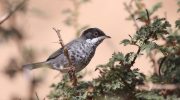
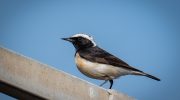
About the size of a sparrow, the Cyprus Wheatear is smart-looking: jet black wings and face, crisp white crown and belly, with a warm buff wash on the chest. Both sexes dress alike – unusual in the bird world.

© Konstantin Solovev www.inaturalist.org

What makes it truly stand out, though, is its character. Unlike most of its rocky-hillside relatives, this bird loves trees. It hunts from high branches, darts into the air to catch insects, and sings from treetops five to ten metres off the ground. Its song sounds far more like an electric grasshopper than anything you’d expect from a bird – a rapid, buzzing rattle that carries through the forest long before you spot the singer.

Did You Know?

  • Two local names: Cypriots call this bird either Σκαλιφούρτα or Πετροκλής, both names rooted in the Cypriot dialect – a language that preserves words from ancient and medieval Greek no longer found in standard modern Greek.
  • Weighing less than 20 grams, it may cross the entire Sahara Desert non-stop during its autumn migration to Ethiopia and Sudan. Tiny bird, extraordinary journey.
  • Young birds are remarkably loyal to home: around 92% of chicks born on Cyprus return to breed within just one kilometre of where they hatched.
  • Male and female look almost identical – rare among wheatears, and one of the key reasons scientists recognised this as a separate species.
  • One of only three bird species in the entire world that breed exclusively on Cyprus.

Σκαλιφούρτα – A Cypriot Name for a Cypriot Bird

Σκαλιφούρτα (Skalifourta) or Πετρόκλης της Κύπρου (Petroklis tis Kyprou). The word “σκαλιφούρτα” (or sometimes σκαλαφούρτα) is a Cypriot dialect name of popular, folk origin, closely tied to the bird’s behaviour and appearance:

Σκάλι / Σκαλίζω – The first part likely refers to the bird’s habit of scratching or pecking at the ground (“σκαλίζω” = to scratch/dig lightly) or to its tendency to perch on stones and rocks (“σκαλώνει” = clings or settles on high/rocky spots).

Φούρτα / Φούρτακας – The second part probably relates to the bird’s distinctive plumage or the way it moves its tail. The tail is strikingly black-and-white, which in older local naming traditions was associated with similar black-and-white-tailed rock-loving birds (sometimes called “ασπροκώλες” = white-rumped ones in folk speech).

© martind www.inaturalist.org

In short, “σκαλιφούρτα” is a vivid, home-grown Cypriot nickname that captures how this little bird darts among stones, flicks its contrasting tail, and forages energetically on the ground – exactly the lively character that generations of Cypriots have observed and named in their everyday language.

The total population of Cyprus Wheatears sits somewhere between 100,000 and 200,000 individuals. The birds spend winter in the open grasslands of Sudan and Ethiopia, returning to Cyprus from late March. Males always arrive first, a week or so ahead of the females, to claim the best territories before the breeding season begins in earnest.

Why It Still Matters

BirdLife International has formally recognised Cyprus as an Endemic Bird Area – one of the most important in Europe – largely because of birds like this one. The Cyprus Wheatear is listed as Least Concern on the global conservation scale, and its numbers look stable. But researchers keep a watchful eye: urban sprawl, intensive farming, and shifting insect populations driven by climate change are all worth monitoring for a bird that depends entirely on one small island to reproduce.

© oosty www.inaturalist.org

For many Cypriots, the return of the Skalifourta each spring is as sure a sign of the season as almond blossom. It is a bird that belongs here, in every sense of that word.

How to Find One

When: March to October – present all over the island. Best for song and display: April, May and June.

Where: Everywhere from the Troodos forests to coastal hillsides and village gardens. Look along old stone walls, rocky scrubland, and open woodland edges.

Cyprus Wheatear
© Uriel Levy www.inaturalist.org

Tip: Hear it before you see it. The buzzing, rattling song is unmistakable. Males sing for hours from exposed high perches – treetops, wires, tall rocks.

Worth Knowing

There is something quietly wonderful about an animal that has chosen one island as its whole world – that has evolved here, adapted here, and returned here every spring across thousands of years. The Cyprus Wheatear is not a flashy creature. It is small, and its song is strange. But it is entirely irreplaceable.

To see one is to understand something true about Cyprus: that this island, at the crossroads of three continents, is not just a place things pass through. It is a place where life found its own voice. The Cyprus Wheatear is part of that voice.
Discover more about the fascinating edges of Cyprus

Cyprus Warbler: The Island’s Hidden Singer

Cyprus Warbler: The Island’s Hidden Singer

Somewhere in the sun-baked scrubland of Cyprus, perched on the very tip of a thorny branch, a small grey bird opens its beak and fills the warm Mediterranean air with a fast, rattling, slightly scratchy song. It is not the most melodious sound in the bird world, but it is entirely its own. The Cyprus Warbler is one of only three bird species on Earth that breed exclusively on this island, and that alone makes it extraordinary. But there is more to this little bird than you might expect. What is it’s Local Name, and Why? The Cyprus Warbler is known in the Cypriot dialect as τρυπομάζης (trypomazis), τρυποράσ'ης (tryporassis), τρυποβατούιν (trypovatuin), and μαυροτσιροβάκος (mavrotsirovakos). The first three names all share the same root: τρυπώνω — to squeeze through, to slip into, to burrow. The bird earned this name honestly. It nests in low, dense bushes and almost always flies very low, darting between shrubs rather than rising into the open sky. Anyone who has watched one disappear into a thicket the moment they raised their binoculars will immediately understand the name. The Cypriot dialect captures this perfectly — trypomazis is, in spirit, the one who vanishes into the scrub. The fourth name, μαυροτσιροβάκος — the black warbler — simply nods to the bold dark colouring of the male, with…

Read more
The Cyprus Scops Owl

The Cyprus Scops Owl

On a warm spring evening in Cyprus, as the last light fades over an olive grove and the first stars appear, a small, haunting sound rises from the trees – a soft, rhythmic double whistle, repeated over and over into the dark. You might not see the creature making it, but you will certainly hear it, and once you know what it is, you will never forget it. That sound belongs to one of Cyprus's most treasured and exclusive residents: the Cyprus Scops Owl, Otus cyprius – a bird that exists nowhere else on Earth. A Tiny Owl with a Big Claim to Fame Owls belong to one of nature's most ancient and successful bird groups, the order Strigiformes, which has been flying through the world's nights for over 60 million years. There are more than 200 species of owls alive today, spread across every continent except Antarctica. The genus Otus – the scops owls – is the largest group within this family, with around 60 species worldwide, found from Europe and Africa all the way to Asia and the Pacific islands. Most are small, secretive, insect-eating birds of the night, perfectly designed to vanish into tree bark during the day and come alive after dark. The Cyprus Scops Owl (Otus cyprius) is a small owl endemic to Cyprus. It…

Read more
Aphrodite’s Ancient Companion: The Cyprus Hare

Aphrodite’s Ancient Companion: The Cyprus Hare

Long before the island became famous for its beaches and bronze, this fleet-footed creature was already racing through its fields – sacred, storied, and irreplaceable.  If you have ever driven through the Cypriot countryside at dusk and caught a pair of amber eyes frozen in your headlights before vanishing into the darkness, there is a good chance you havealready met the Cyprus hare. This golden-brown creature – Lepus europaeus cyprius – is not just a wild animal. It is an endemic subspecies found nowhere else on Earth, a living thread woventhrough ten thousand years of Cypriot history, mythology, and daily life. And it is far more interesting than you might think.  Ears Long, Heart Faster Still  The hare belongs to the Order Lagomorpha – an ancient group of plant-eaters that includes hares, rabbits, and the small round-eared pikas of mountain regions. Despite their appearance,lagomorphs are not rodents. They form their own distinct branch of the mammal family tree, one that stretches back at least 53 million years into the geological past. There are around 32 speciesof hare in the world, from the Arctic hare of the frozen north to the Cape hare of Africa's savannahs.  The European brown hare (Lepus europaeus) is one of the most widespread, ranging from Western Europe across Central Asia and into the Middle East. But the animal living on Cyprus issomething special – it has been isolated on this island long enough to develop its own identity. Formally described as a distinct subspecies in 1903 by British zoologist George Edward HamiltonBarrett-Hamilton, the Cyprus hare is recognised as unique to the island, shaped by millennia of island life into something subtly but meaningfully its own.  Arrived with the First Farmers  Cyprus was probably never connected to the mainland by a land bridge. Every land animal on the island arrived either by swimming, floating on driftwood, or – most commonly – being broughtby people. The Cyprus hare is believed to have been introduced by Neolithic settlers arriving from the Levant and Anatolia, probably around 10,000–9,000 years ago, during the same remarkablewave of human activity that also brought the island its first sheep, goats, foxes, and domestic cats.  These early settlers were already accomplished farmers and hunters. Cyprus offered extraordinary hunting grounds, and the hare would have been a welcome and practical addition to theisland's fauna – fast-breeding, easily hunted, and nutritionally rich. Over the millennia that followed, with no wolves, bears, or large cats to challenge it, the hare flourished across the landscapeand quietly evolved into its own island form.  Hare bones have been found at Neolithic sites across the island, confirming that this animal was a significant food source for Cyprus's earliest communities. In a very real sense, the hare has beenpart of Cypriot life longer than written history itself.  The hare is the main and largest prey species on Cyprus – present in every district of the island in satisfactory numbers, remarkable given the intense hunting pressure it endures year after year.  A Study in Speed and Stillness  About the size of a small cat but leaner, longer, and built entirely for speed, the Cyprus hare weighs 3.5–5 kg and wears a warm tawny-brown coat that fades to white on the belly. Those famous long ears swivel independently to catch any sound – and double as a summer cooling system, radiating heat away from the body like living radiators. Unlike rabbits, hares never dig burrows. They rest in shallow ground hollows called forms, and their young – called leveret – are born fully furred and wide-eyed, ready to scatter within hours of birth. In late winter, something remarkable happens: normally shy and nocturnal, hares appear in broad daylight, chasing each other across fields and boxing. For years this was assumed to be rival males competing. It is almost always a female, either rejecting a male or testing his persistence. She is very much in charge.  The Cyprus hare is entirely herbivorous – grass, herbs, wildflowers, and field crops in summer; twigs, bark, and buds in the leaner months of winter. It also practises a curious dietary habit sharedby many lagomorphs: it re-ingests its own soft green droppings directly from the body, recovering proteins and vitamins that were not fully absorbed the first time.  Things Worth Knowing Over Coffee  Hares can see almost 360 degrees around them – their only true blind spot is directly in front of their nose. They can even sleep with their eyes open.  A young hare under one year of age has a special name: a leveret. A group of hares can be called either a husk or a down – two of the more poetic collective nouns in the animal kingdom.  The Cyprus hare's breeding season runs from January to August – one of the longest of any European mammal. A female can produce up to four litters per year.  In ancient Greece, the hare was considered so fertile that it was believed a female could conceive a second litter while already pregnant with the first – a reproductive phenomenon known assuperfetation, which has since been confirmed by science.  The English phrase "as mad as a March hare" refers to exactly the same spring-boxing behaviour that any Cypriot farmer has likely observed at the edge of their olive grove in February orMarch.  The natural predators of the Cyprus hare are birds of prey (including owls and buzzards) and the Cypriot fox (Vulpes vulpes indutus). There are no wolves, lynx, or large cats on the island tothreaten it.  Two or three adult hares can consume as much vegetation as a single sheep.  Sacred to the Goddess Born from the Sea  Cyprus is the birthplace of Aphrodite – and the hare was one of her sacred animals. Because of its extraordinary fertility, it was seen as a living symbol of love, desire, and abundance. Young men in ancient Greece would gift a live hare to someone they admired: the meaning was clear without a single word.…

Read more