Somewhere in the sun-baked scrubland of Cyprus, perched on the very tip of a thorny branch, a small grey bird opens its beak and fills the warm Mediterranean air with a fast, rattling, slightly scratchy song. It is not the most melodious sound in the bird world, but it is entirely its own. The Cyprus Warbler is one of only three bird species on Earth that breed exclusively on this island, and that alone makes it extraordinary. But there is more to this little bird than you might expect.
- What is it’s Local Name, and Why?
- How This Bird Got Its Scientific Recognition – and Why It Was Found Far From Home
- Dressed to Impress – What the Cyprus Warbler Looks Like
- Five Things Worth Knowing About the Cyprus Warbler
- Life in the Scrub – Diet, Breeding, and Behaviour
- A National Bird in a Complicated Position
- Where and How to Find It
- Why This Small Bird Matters Enormously
What is it’s Local Name, and Why?
The Cyprus Warbler is known in the Cypriot dialect as τρυπομάζης (trypomazis), τρυποράσ’ης (tryporassis), τρυποβατούιν (trypovatuin), and μαυροτσιροβάκος (mavrotsirovakos). The first three names all share the same root: τρυπώνω — to squeeze through, to slip into, to burrow. The bird earned this name honestly. It nests in low, dense bushes and almost always flies very low, darting between shrubs rather than rising into the open sky. Anyone who has watched one disappear into a thicket the moment they raised their binoculars will immediately understand the name. The Cypriot dialect captures this perfectly — trypomazis is, in spirit, the one who vanishes into the scrub.
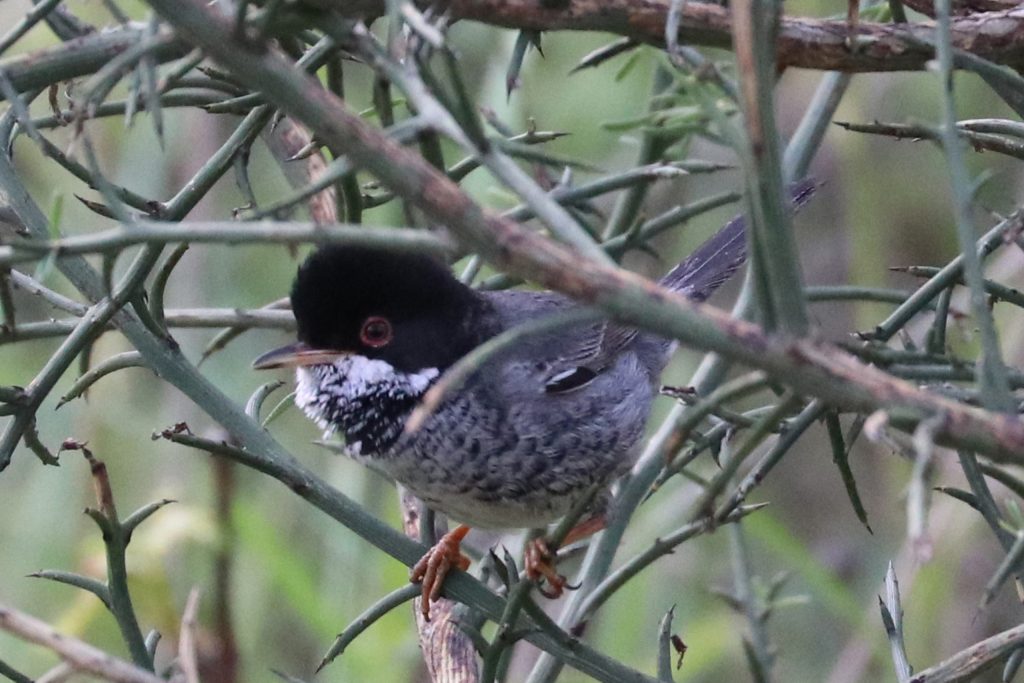
The fourth name, μαυροτσιροβάκος — the black warbler — simply nods to the bold dark colouring of the male, with his black head and heavily streaked chest.
How This Bird Got Its Scientific Recognition – and Why It Was Found Far From Home
The Cyprus Warbler was first formally described in 1872 by the English clergyman, Bible scholar, traveller and ornithologist Henry Baker Tristram – with its type locality, curiously, recorded as En-Gedi in Palestine. This seems puzzling at first, because the bird breeds only on Cyprus. The explanation lies in the fact that Tristram encountered it during the winter months, when a portion of the population migrates to the eastern Mediterranean and Middle East.
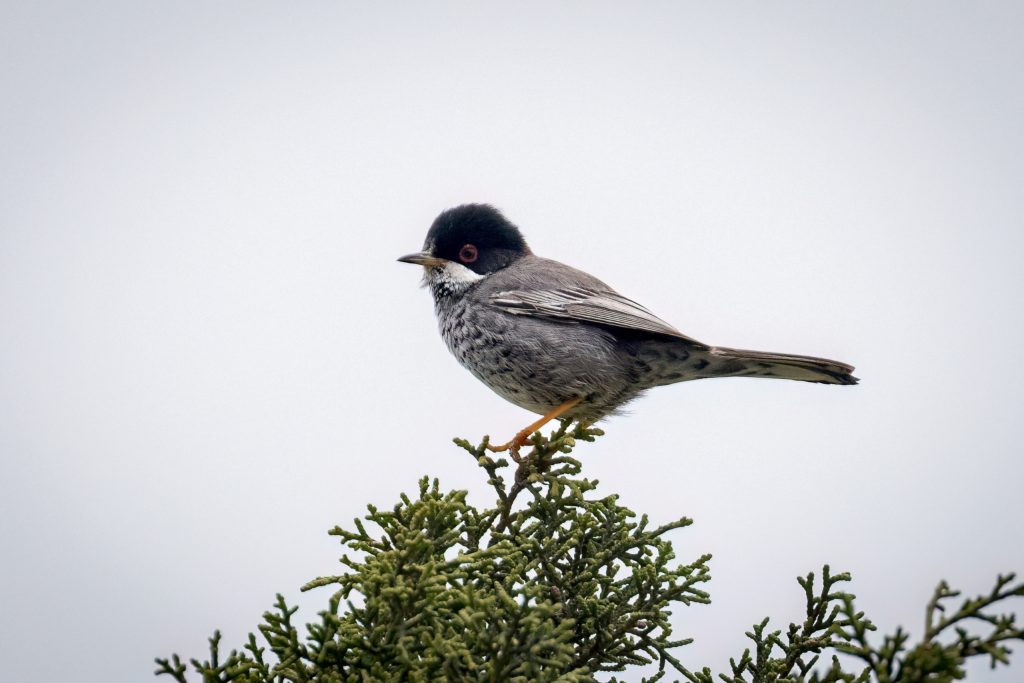
He saw the bird, described it scientifically, and the rest is ornithological history. The species was later placed in the genus Sylvia for many decades, before modern genetic research reshuffled the taxonomy and moved it – along with most of its relatives – to Curruca. The name melanothorax comes from Greek: melas (black) and thorax (chest) – a perfect description of the boldly patterned male.
Dressed to Impress – What the Cyprus Warbler Looks Like
At just 12.5 to 13.5 centimetres long, the Cyprus Warbler is a small bird, roughly the size of a blue tit. But what it lacks in size, it more than makes up for in appearance – at least if you are a male.
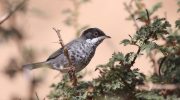
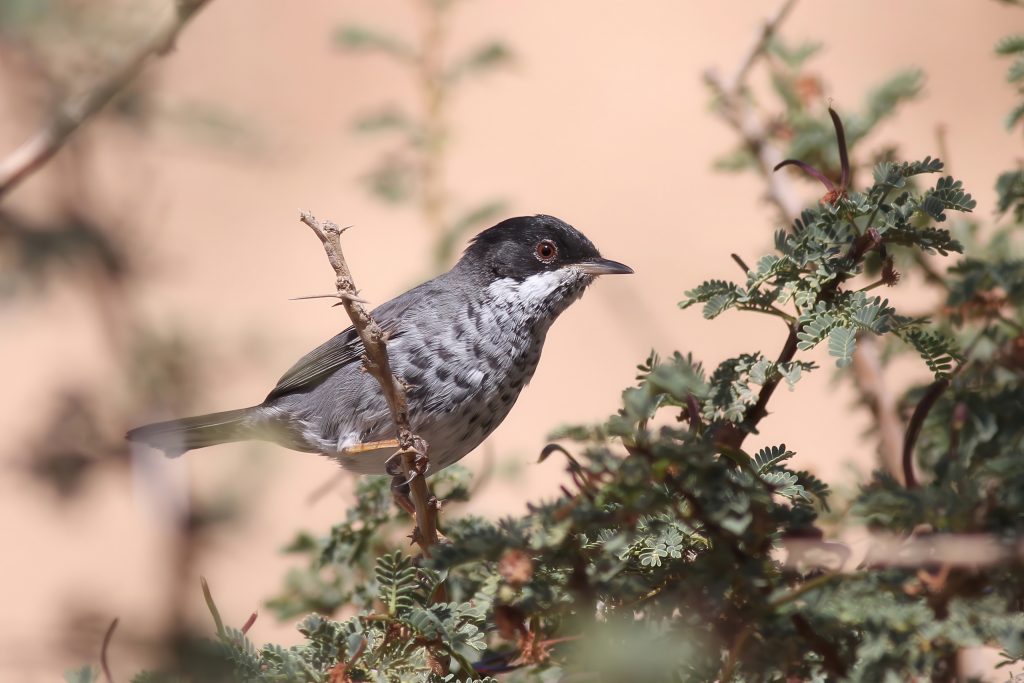
The adult male has a grey back, a jet-black head, white malar streaks (sometimes called “moustaches”) running along the face, and – uniquely among typical warblers – underparts heavily streaked with black. This bold patterning of black on white gives the male a distinctive, almost formal appearance, like a tiny bird dressed for a very important occasion. The upperparts are dark with well-patterned wing feathers, and the long tail is often carried cocked upward.
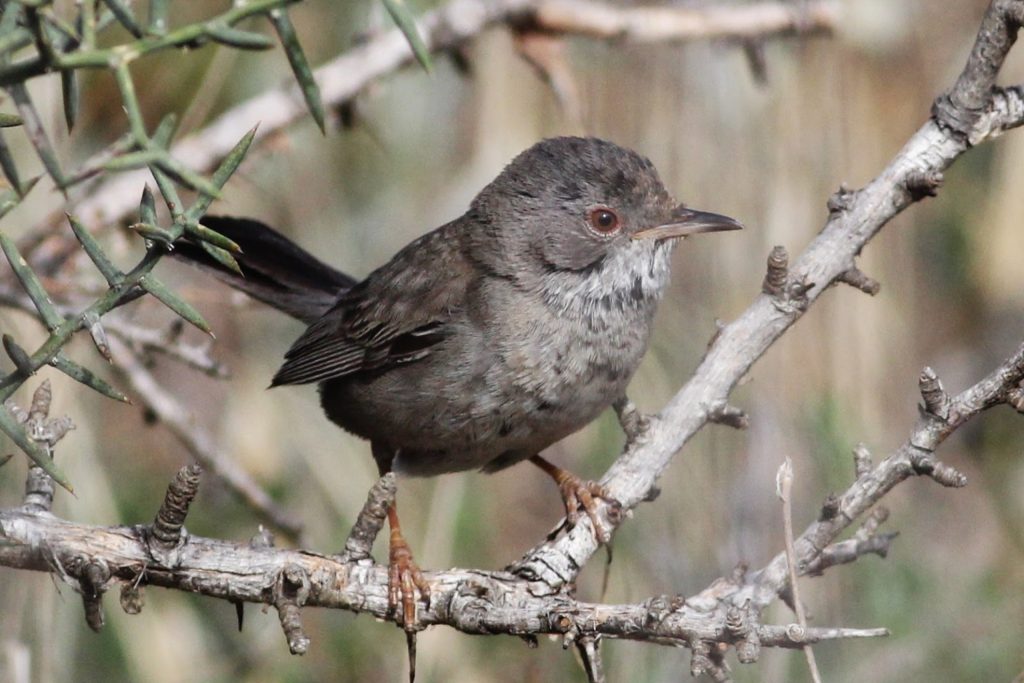
The female is considerably more understated. She is mainly grey above, with a greyer head, and whitish below with only light spotting. But even she has a subtle calling card: female Cyprus Warblers always have patterned undertail coverts – a quiet detail that helps separate them from similar species at a glance.
Both sexes share bright red orbital rings around the eyes – a flash of colour that gives the bird a fierce, alert expression, quite at odds with its modest size.
Five Things Worth Knowing About the Cyprus Warbler
- As a tribute to its status, the Cyprus Warbler was depicted on a Cypriot postage stamp in 1968, and later on the ten-pound banknote — quiet but lasting acknowledgements of how deeply this little bird is woven into the island’s identity.
- It is one of only 31 bird species endemic to Europe. The Cyprus Warbler is one of just 31 bird species considered endemic to Europe – meaning it breeds nowhere else on the entire continent. To meet one, you have to come to Cyprus.
- Its song is loud, fast, and unmistakable. The Cyprus Warbler’s calls include a sharp, grating “tchek” used as a contact call, a prolonged ticking rattle, and a sudden churring “tcharr-tcharr-tcharr” rattle. It is often the sound that tells you one is nearby long before you ever catch a glimpse.
- The male is a bold performer. The Cyprus Warbler is more easily seen in spring, when males set up their territories by singing from the tops of bushes. The male becomes bold on its territory, perching out in the open and occasionally performing a half-hearted song flight, often triggered by competition between rival males.
- It holds its tail like a proud flag. It is often very active with its tail cocked while foraging among the vegetation. This habit gives it a jaunty, self-assured look – charming for such a small creature.
Life in the Scrub – Diet, Breeding, and Behaviour
The Cyprus Warbler breeds in well-vegetated rocky slopes and foothills, open oak and pine forests with bushy undergrowth, dense scrub, and maquis, from sea level up to 1,400 metres of elevation. This is the classic Mediterranean landscape – aromatic, sun-warmed, buzzing with insect life. And that is precisely what the warbler is after.
The Cyprus Warbler feeds mainly on invertebrates such as spiders, flies, midges and butterflies. Berries can supplement the diet after the breeding season. It is a patient, methodical forager, moving low down from bush to bush and picking invertebrates from vegetation and branches, foraging in low scrubs and more rarely in trees or on the ground.
The nest is built in low shrub or gorse, and 3 to 5 eggs are laid. The Cyprus Warbler is monogamous and breeds solitarily. The breeding nest is made by the female. Outside the breeding season, this otherwise solitary creature becomes slightly more sociable: it may form small groups of 10 to 30 individuals.
A National Bird in a Complicated Position
The Cyprus Warbler is the national bird of Cyprus. That is a proud title – but it comes with responsibility. The species is not currently considered globally threatened, but it faces real and growing pressures.
The recent breeding colonisation of Cyprus by the Sardinian Warbler has raised concerns that it might be displacing the endemic Cyprus Warbler. The Sardinian Warbler – a close relative, physically similar, and equally feisty – first arrived as a breeding species on the island in the early 1990s and has since spread widely. Research suggests the two species prefer subtly different scrub habitats, but where they overlap, the Cyprus Warbler appears to fare less well.
Beyond competition, the species is threatened by changes in farming practices, agricultural expansion, urban development, pesticides, and illegal netting and shooting. During 1998–2011, in an area of western Cyprus spanning about one-quarter of the global breeding range, the species declined at a rate of approximately 59% per decade – a figure that prompted calls for a review of its conservation status.
The global population was estimated at 70,000 to 140,000 pairs in 2015. That is not a small number, but it is a population entirely contained within one island and one narrow wintering corridor – which makes every loss felt more acutely.
Where and How to Find It
The Cyprus Warbler can be seen in scrub and bushy areas all over Cyprus, all year round. It is more likely to be found on the west and south-west of the island, where scrubland habitat remains extensive and relatively undisturbed. The Akamas Peninsula, the hills around Paphos, the Troodos foothills, and the Akrotiri Peninsula are all excellent locations.
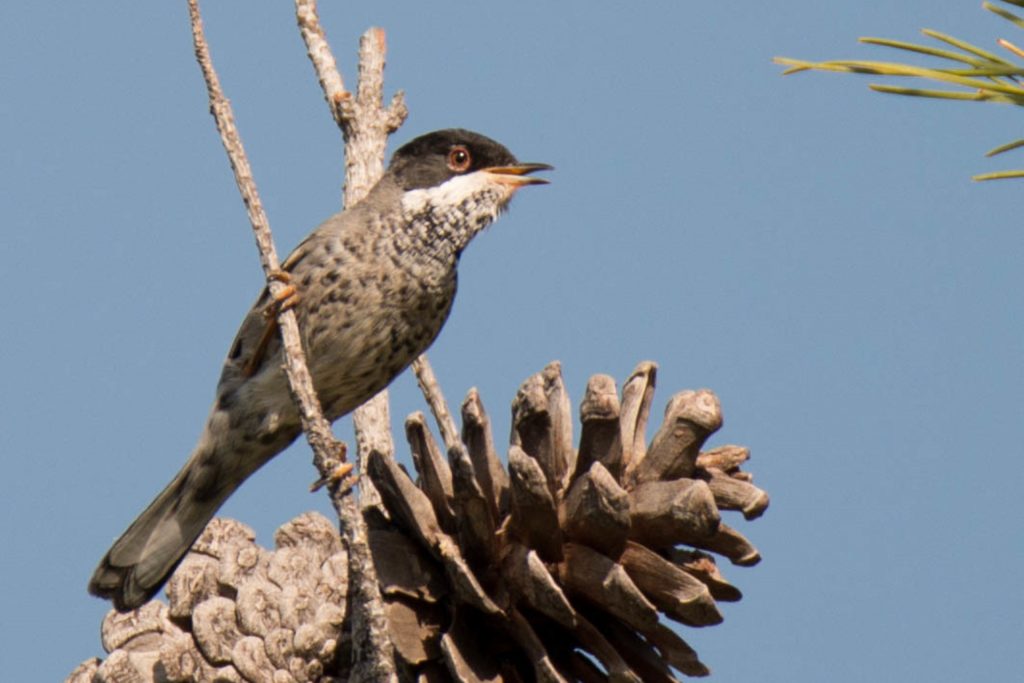
The experience of finding one is part of the pleasure. It is difficult to see, as it is small in size and likes dense vegetation – but the hoarse alarm call often betrays its presence. Stand quietly near a dense patch of cistus, lentisk, or gorse on a warm spring morning. Listen for the rattling, churring song. Then wait. With patience, a male will almost certainly emerge to the top of a branch, tail cocked, red eye gleaming, and sing as if he owns the entire hillside – because, in his mind, he does.
No special equipment is needed. A pair of binoculars and an early morning are enough. The bird does the rest.
Why This Small Bird Matters Enormously
There is something quietly profound about a creature that exists in only one place on Earth. The Cyprus Warbler did not choose its island – it evolved here, shaped by millennia of Mediterranean sun, dry summers, and thorny scrubland. It is as much a part of Cyprus as the carob tree, the mouflon, or the ancient olive grove.
When this bird sings from a hilltop bush in the spring light, it is not simply making noise. It is performing a ritual older than any human settlement on the island – a declaration of territory, of identity, of belonging. And in a world where habitats shrink and species disappear with troubling regularity, a bird that has endured here this long deserves our attention, our respect, and our protection.
To know the Cyprus Warbler is to understand something essential about what makes this island unique. And once you have heard that scratchy, rattling song drifting across the phrygana on a warm Cypriot morning, you will never quite forget it.