Every spring, something extraordinary happens above the fields and coastal cliffs of Cyprus. A cascade of colour – blues, golds, greens, and chestnuts – streaks through the warm air with a liquid, rolling call that sounds almost like laughter. This is the European Bee-eater, one of the most visually stunning birds to ever grace the Mediterranean skies. To see one is to stop whatever you are doing. To see a hundred of them, which is entirely possible in Cyprus, is to feel the world has briefly become a little more magical.
- A Bird with Jewels for Feathers
- From Linnaeus to the Levant: A Species Written in Time
- A Portrait of the Bird Itself
- Fun Facts Worth Sharing
- Where the Sky Fills with Colour: The Bee-eater and Cyprus Today
- The Cyprus-specific conflict:
- The real impact on beekeeping:
- Where and When to See Them
- More Than a Pretty Bird
A Bird with Jewels for Feathers
The European Bee-eater (Merops apiaster) or Μελισσοφάγος in Greek, belongs to the family Meropidae – a group of around 30 species of insect-eating birds found across Africa, Asia, and parts of Europe. They are, without question, among the most brilliantly coloured birds on the planet. Within this family, the European Bee-eater is by far the most widespread, ranging from Portugal in the west to Mongolia in the east. It is what scientists call a long-distance migrant: a bird that lives a double life, spending summers in the warmth of the Mediterranean and winters deep in the heart of sub-Saharan Africa.
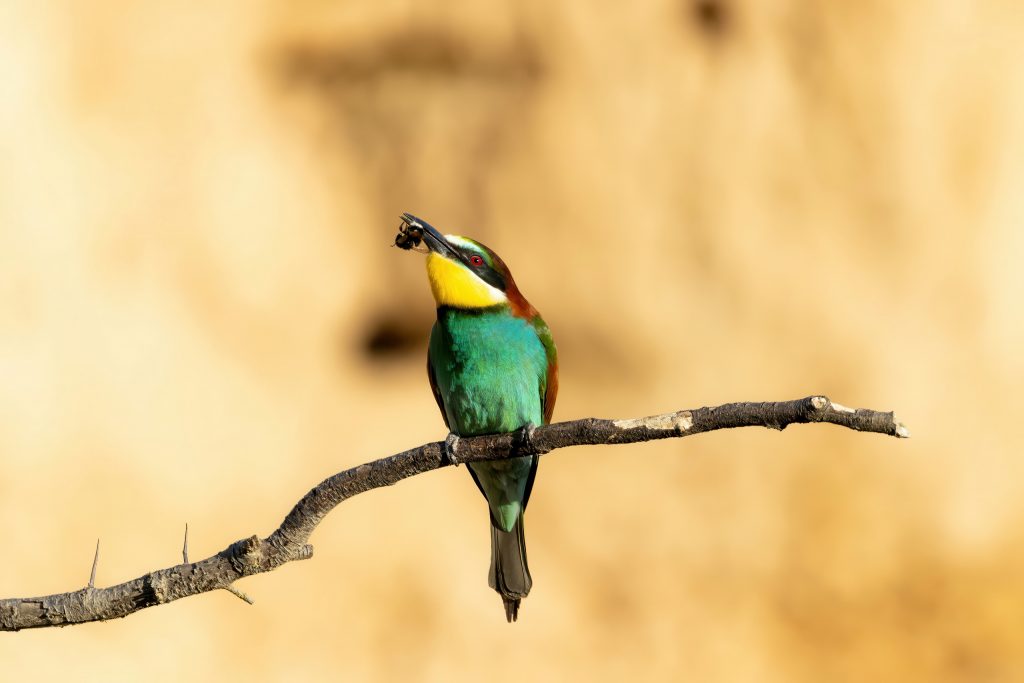
Sometimes called the “Golden Bee-eater” in parts of its range, it is present over large areas of Europe, Asia, and Africa during at least some portion of the year. In Cyprus, it is not a resident – it is a seasonal visitor, but one that arrives in such dazzling numbers that its presence defines the character of the island’s spring and autumn.
From Linnaeus to the Levant: A Species Written in Time
The European Bee-eater was formally described by the Swedish naturalist Carl Linnaeus in 1758 in the tenth edition of his Systema Naturae. Both the genus name Merops (μέροψ) and the species name apiaster are derived from Ancient Greek and Latin words meaning “bee-eater”, from apis, the Latin word for “bee.” The ancient Greeks and Romans would have known this bird well – it appears in classical texts, and its striking plumage made it hard to overlook. Even the ancient Egyptians depicted bee-eaters in tomb paintings, recognising the bird as a symbol of warmth, summer, and the cycle of renewal.
Cyprus itself lies at the heart of one of the great bird migration corridors of the ancient world – the eastern Mediterranean flyway – and the island has been a resting point for millions of birds, including bee-eaters, since long before humans arrived to name them. Because bee-eaters use landmarks to orient themselves during migration, Cyprus serves as a natural bottleneck where birds crossing the Mediterranean can accumulate in large numbers.
A Portrait of the Bird Itself
There are birds that blend into their surroundings, and there are birds that seem to have been designed purely to astonish. The Bee-eater belongs firmly in the second category.
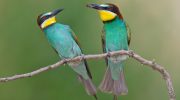
Its plumage is a brilliant blend of colours: a golden-brown crown, emerald green wings, and a striking turquoise underbelly. The bird’s back and rump are a rich chestnut brown, while its tail feathers are tinged with blue. It reaches a length of 27–29 cm, including two elongated central tail feathers that give the bird an elegant, swept look in flight. Males and females look remarkably similar, though females tend to have slightly greener rather than golden shoulder feathers.
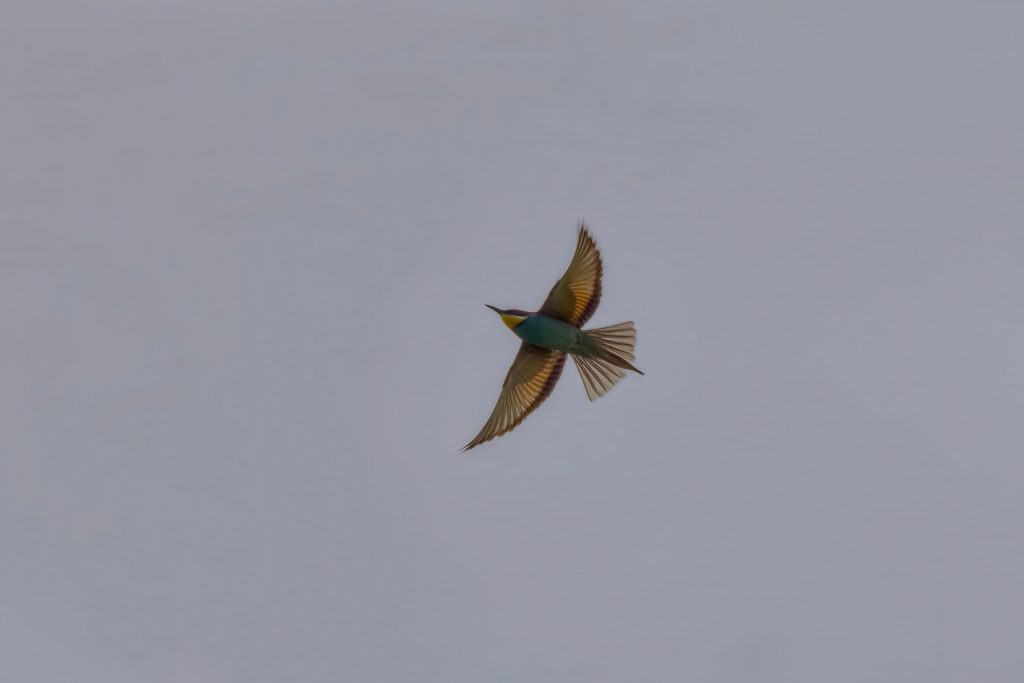
In flight, the Bee-eater is immediately recognisable – it glides on pointed, swept-back wings with a grace more reminiscent of a swallow than a typical perching bird. It is often heard before it is seen: its typical call is a distinctive, mellow, liquid, rolling prreee or prruup – a warm, burbling sound that drifts down from the sky even when the birds themselves are invisible against the blue.
Fun Facts Worth Sharing
- Bee-eaters use their long, specialized beaks to maintain a safe distance while repeatedly ‘whacking’ bees against hard surfaces to disarm them before eating. It can eat around 250 bees in a single day.
- During courtship, the male feeds large insects to the female while eating the smaller ones himself – a romantic offering that researchers call “courtship feeding.”
- The species spends the winter predominantly in central, western, and southern Africa – a round trip migration of thousands of kilometres every single year.
- Nesting tunnels can reach depths of up to two metres, excavated in sandy banks or earthen cliffs, providing a snug, sheltered home for the eggs and chicks within.
- European Bee-eaters are known for cooperative breeding, where non-breeding individuals may assist in the care of the young – a level of social generosity rare among birds.
Where the Sky Fills with Colour: The Bee-eater and Cyprus Today
The Bee-eater passes through Cyprus during migration, but a small number stays here in the summer to breed. It can be seen flying in small flocks or sitting with other Bee-eaters on electricity wires, from which it scans for insects.
In Cyprus, it can be seen all over the island, but it appears in particularly great numbers at Cape Greco and the Akrotiri Peninsula during migration. These two locations – a dramatic rocky headland on the southeastern tip of the island and a salt-flat peninsula near Limassol – act as natural gathering points where thousands of birds funnel through on their way between continents.
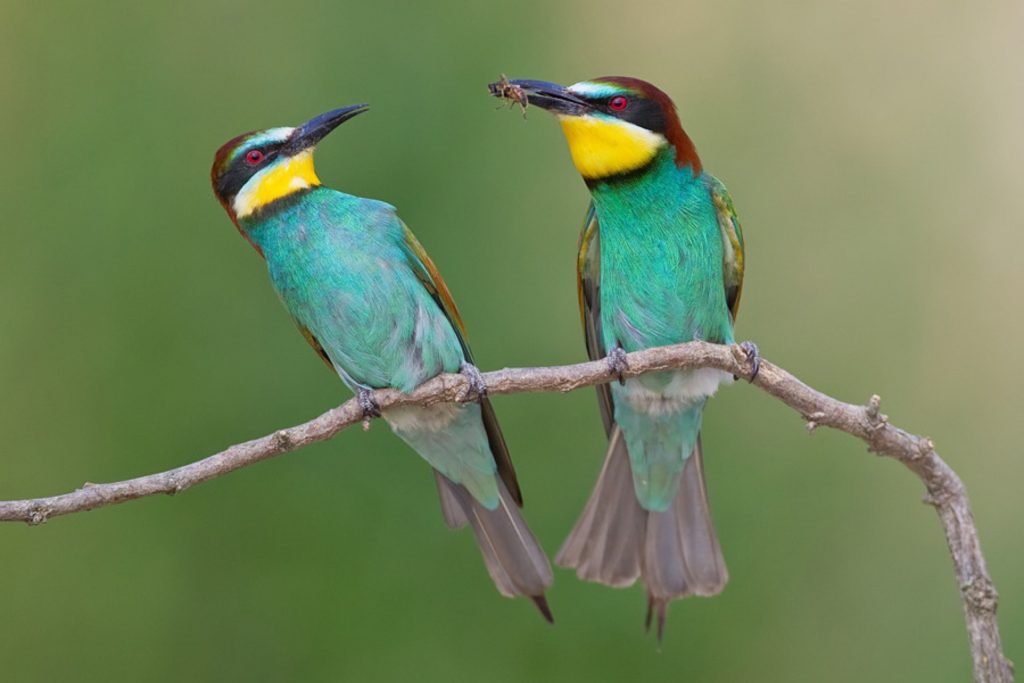
As a species that has expanded its breeding range northward in recent decades, the Bee-eater is increasingly being discussed as a living indicator of climate change – a colourful thermometer suspended in the air, its presence telling us something important about the shifting rhythms of the natural world.
The Cyprus-specific conflict:
The conflict between Bee-eaters and beekeepers has been a recurrent problem for years in Cyprus, and many beekeepers have shot Bee-eaters illegally near their beehives. In the past, the Republic of Cyprus had granted beekeepers licences to use shotguns to intimidate and scare away Bee-eaters, however on many occasions this was abused and birds were illegally shot and killed instead.
The species has been protected in Cyprus since 2003 under Cyprus law (152(I)/2003) and European legislation (2009/147/EC). BirdLife Cyprus organised a workshop in 2011 with experts from Greece and Israel to find non-lethal alternative solutions for the management of areas with beehives.
Bee-eaters have been documented being shot in their hundreds during autumn migration in Cyprus, with their brightly coloured plumage making them an attractive target for poachers. The birds are shot, plucked, and sold to restaurants where they are passed off as thrushes.
The real impact on beekeeping:
A single Bee-eater can consume up to 150 individual insects per day, and studies on honeybees show that Bee-eaters may have noticeably negative impacts on their abundance. Although the effects are probably too low to cause colonies to collapse, Bee-eaters can nevertheless noticeably reduce the survival of honeybee queens and colony weight gain.
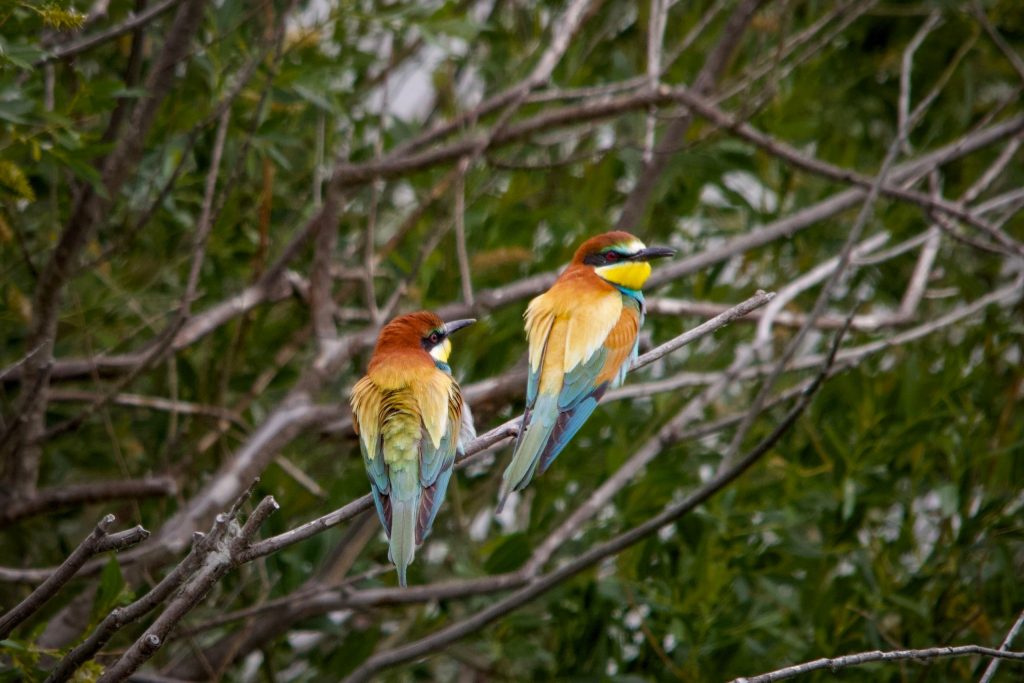
Research found that Bee-eater activity negatively correlated to honey bee activity — the more Bee-eaters present, the fewer resources including honey, pollen, and brood were found in hives — mainly during their migratory season in August. However, there were no negative effects on the overall survival and viability of the hives.
A beehive could also benefit from a Bee-eater’s presence, since it feeds on hornets and wasps as well, which themselves predate on bees.
Where and When to See Them
The best time to witness the Bee-eater spectacle in Cyprus is during spring migration, roughly from late March through May, and again in late August through October as the birds head south for winter. Both periods can produce impressive flocks, but spring is generally more spectacular – the birds are in full breeding plumage, electric with colour.
Cape Greco National Forest Park in the southeast is one of the finest migration-watching spots on the island. Standing on the coastal headland at dawn, with the sea glittering below and clouds of Bee-eaters streaming overhead, calling softly as they fly – it is an experience that stays with you. The Akrotiri Peninsula near Limassol offers a different perspective, with birds often perching on telegraph wires and low scrub at close range, almost close enough to count the feathers.
For those lucky enough to find a breeding colony, typically in areas with eroded sandy banks or earth cliffs – such as parts of the Paphos district or river valleys – watching the birds dive and glide around their nest tunnels in the golden afternoon light is one of nature’s quiet pleasures. No specialist equipment is needed. Just eyes, and patience, and a willingness to look up.
More Than a Pretty Bird
The European Bee-eater is, in every sense, a creature that carries meaning beyond its beauty. It is a reminder that Cyprus sits at the centre of the world’s greatest natural journeys – a crossroads not just of human civilisations but of entire animal populations moving between continents across millennia.
To stand in a Cypriot field in April and hear that liquid prruup sound drifting down from a clear blue sky is to hear something ancient and unhurried. A sound that has accompanied the Mediterranean spring long before any city was built, any road was paved, any border was drawn. In a world that moves faster than ever, the Bee-eater arrives and departs on its own schedule – indifferent to borders, loyal only to sunlight, warmth, and the irresistible pull of wherever the bees are flying.
Cyprus is lucky to be on its route. And all of us who live here, or visit here, are lucky to share the sky with it.