All Articles

Emphasis on Frontalism and Hieratic Scale

Emphasis on Frontalism and Hieratic Scale

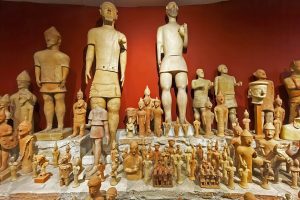
Emphasis on Frontalism and Hieratic Scale in ancient Cypriot art involved depicting figures in direct frontal views, with sizes scaled to reflect spiritual or social significance rather than physical accuracy. This method imbued artworks with a sense of authority and depth, incorporating influences from neighboring cultures to emphasize deities, rulers, or sacred concepts over naturalistic portrayals. The approach created compositions that convey power and divinity through straightforward, impactful forms. A Style Prioritizing Significance Cypriot art from antiquity often avoided precise replication of reality, opting instead for frontalism where subjects face outward directly. Hieratic scale further adjusted proportions, enlarging key elements to denote importance - a deity might dominate over attendants, defying natural dimensions. This was not a limitation but a…

Read more
Cyprus City Kingdoms

Cyprus City Kingdoms

For over 3,000 years, Cyprus was home to powerful independent city-kingdoms that controlled trade routes, mined copper, and blended Greek, Phoenician, and local cultures into something uniquely Cypriot. These ancient cities left behind spectacular ruins - theaters still hosting performances, mosaic-floored villas, and temple foundations - that tell the story of a small island that punched far above its weight in the ancient world. A Patchwork of Powerful Cities Unlike many ancient lands ruled by a single king or empire, Cyprus developed as a collection of independent city-kingdoms. Each coastal city controlled its surrounding territory, built its own temples and palaces, minted its own coins, and conducted its own diplomacy with the great powers of Egypt, Persia, and Greece. At…

Read more
British Colonial Cyprus

British Colonial Cyprus

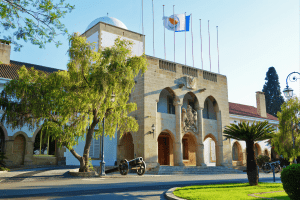
British colonial architecture in Cyprus reflects 82 years of British rule from 1878 to 1960. Unlike other colonies where British builders copied English designs directly, architecture in Cyprus followed a different path. British planners created a local style that combined European ideas with Cypriot building traditions. During this period, around 700 colonial buildings were constructed across the island. These included government offices, hospitals, post offices, courthouses, schools, and police stations. Most of these buildings were planned and built by the Public Works Department, which employed architects and engineers from Britain, other British territories, and Cyprus. Historical Background Cyprus came under British control in 1878 when the Ottoman Empire leased the island to Britain. At that time, the island was economically…

Read more
Cyprus Food Festivals

Cyprus Food Festivals

Culinary festivals in Cyprus are not staged food shows or seasonal attractions created for visitors. They are extensions of village life, shaped by agriculture, memory, and the belief that food is meant to be shared. Across the island, festivals dedicated to wine, halloumi, olives, and everyday cooking traditions offer a way to understand Cyprus through participation rather than observation. Food as a Social Language In Cyprus, food festivals usually revolve around a single local product or a small group of related dishes. These events are organised by municipalities, village councils, or community groups, not private promoters. Their purpose is communal before it is celebratory. Recipes, techniques, and rituals that rarely appear in written form are performed publicly, often by people…

Read more
Kampanopetra Basilica

Kampanopetra Basilica

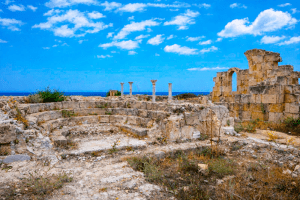
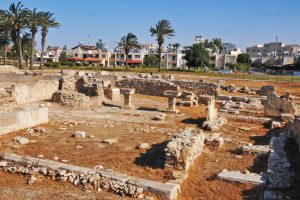
The Basilica of Kampanopetra is an extensive archaeological complex located within the ancient city of Salamis, near modern Famagusta in Cyprus. Dating to the late 5th or early 6th century CE, it represents one of the largest early Byzantine architectural remains on the island. The site formed part of Constantia, the name given to Salamis after major earthquakes in the 4th century CE led to a large scale reconstruction of the city. The complex is arranged in a long, structured sequence of spaces extending along an east west axis. It includes a large courtyard, entrance halls, a monumental three aisled central hall, and an additional eastern courtyard. In total, the structure extends over 150 meters in length, reflecting the scale…

Read more
Ayios Nikolaos Sea Cave

Ayios Nikolaos Sea Cave

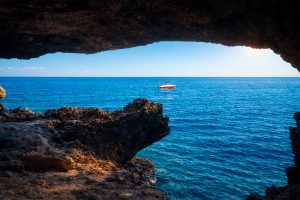
Cape Greco is a headland located between Ayia Napa and Protaras at the southern end of Famagusta Bay. The area covers 385 hectares and was designated as a National Forest Park under the administration of Cyprus's Forestry Department. The coastline here features dramatic limestone cliffs that reach 30 feet (roughly 10 meters) in height and contains numerous sea caves carved by wave action. The caves are formed from layered limestone that was deposited in warm seas millions of years ago. The rock consists of hard and soft layers that erode at different rates. Waves constantly pound against the cliffs and dissolve the softer limestone faster than the harder layers above and below. This differential erosion creates the caves, arches, and…

Read more
Ayia Napa Sea Caves

Ayia Napa Sea Caves

The Ayia Napa Sea Caves represent one of Cyprus's most photographed coastal features. Located just outside the resort town, these caves attract visitors year-round with their combination of geological beauty and recreational opportunities. The sea caves form part of the rugged coastline around Cape Greco National Forest Park, positioned between Ayia Napa and Protaras on the southeastern edge of Cyprus. The caves themselves are carved into limestone cliffs that rise 6 to 12 meters above the sea. Some caves extend up to 80 meters into the rock. The area marks the western boundary of the 385-hectare Cape Greco National Forest Park, designated as protected land in 1993. Historical Background The formation of these caves demonstrates basic geological erosion over thousands…

Read more
Ayia Napa Lover’s Bridge

Ayia Napa Lover’s Bridge

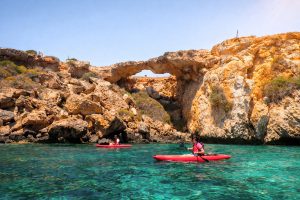
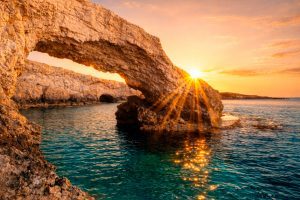
The Lover's Bridge stands as one of Cyprus's most photographed natural landmarks. This limestone arch extends from the coastal cliffs near Ayia Napa, reaching toward the Mediterranean Sea with one end firmly anchored to land while the other dips into crystal-clear turquoise water. The bridge measures approximately 6 meters long and half a meter wide, formed entirely through natural processes without any human construction. Visitors from around the world come to walk across this slender natural formation, particularly during sunset hours when golden light transforms the white limestone and azure water into a scene of remarkable beauty. The bridge takes its name from romantic traditions that have developed around the site. Local legend claims that couples who kiss while standing…

Read more
Avakas Gorge Cave

Avakas Gorge Cave

Avakas Gorge is a 3-kilometer-long limestone canyon located in the Akamas Peninsula, 16 kilometers west of Paphos. The gorge was created by the Avgas River, a seasonal stream that flows only in winter and spring. Over countless thousands of years, this modest river carved through layered limestone and created walls that reach 30 meters high in some sections. The gorge is part of the Natura 2000 protected area network and attracts roughly 100,000 visitors per year according to forestry authorities. What makes it special isn't just the height of the walls but how narrow the passage becomes. In places, the gorge squeezes down to only 4 meters wide with cliffs towering on both sides and a strip of sky visible…

Read more