All Articles

Seasons of Cyprus

Seasons of Cyprus

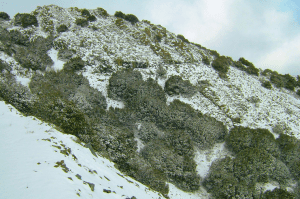
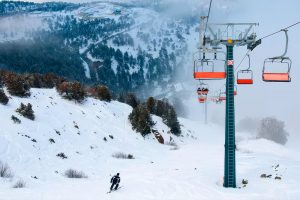
Cyprus experiences four distinct seasons, each with dramatic differences across its varied landscape. The same day that sees snow on Mount Olympus can bring 20-degree sunshine to coastal beaches just an hour away. This climate diversity creates a unique Mediterranean island where visitors can ski in the morning and swim in the afternoon. Understanding these seasonal patterns helps explain both the natural beauty and the agricultural traditions that define Cyprus. The island enjoys roughly 300 days of sunshine annually, with temperatures influenced heavily by elevation. Coastal areas maintain mild winters and hot summers, while the Troodos Mountains create their own weather patterns. Average annual temperature along the coast reaches 26 degrees Celsius during the day and 17 degrees at night.…

Read more
Sanctuary of Aphrodite, Palaepaphos

Sanctuary of Aphrodite, Palaepaphos

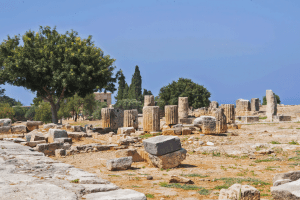
In the village of Kouklia, about 14 kilometers east of Paphos, stand the remains of what was once the most famous shrine dedicated to Aphrodite in the ancient world. For more than 1,600 years, pilgrims traveled from across the Mediterranean to worship at Palaepaphos, the place where the goddess of love was believed to have risen from the sea. Today, the site is a UNESCO World Heritage monument and one of the most important archaeological locations in Cyprus. The Sanctuary of Aphrodite at Palaepaphos was founded around 1200 BC during the Late Bronze Age. It remained in continuous use until 391 AD, when the Roman Emperor Theodosius I banned all pagan religions. Palaepaphos was among the most powerful city-kingdoms of…

Read more
Cyprus Volcanic Rocks

Cyprus Volcanic Rocks

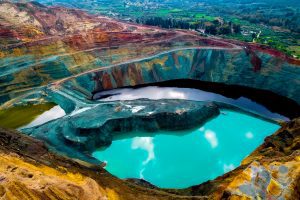
Cyprus holds a unique position in geological science. The island contains Earth's best preserved ophiolite complex, a rare slice of ancient oceanic crust and upper mantle thrust upward onto land. This exceptional geological heritage shaped both the island's dramatic landscapes and its human history, particularly through copper deposits that gave Cyprus its very name. The Troodos Massif formed 90 million years ago during the Upper Cretaceous period at the bottom of the ancient Tethys Ocean. The rocks visible today once existed 8,000 meters below sea level at a mid-ocean ridge spreading center, where new oceanic crust continuously forms as tectonic plates pull apart. Geologists call this complete sequence an ophiolite complex. Troodos was not metamorphosed during uplift, allowing scientists to…

Read more
Diarizos Valley, Cyprus

Diarizos Valley, Cyprus

The Diarizos Valley stretches through the heart of western Cyprus, where ancient traditions meet rare wildlife in one of the island's most important conservation zones. Located east of Paphos and carved by the fourth-longest river in Cyprus (Diarizos River), this valley combines ecological significance with centuries of winemaking heritage across 14 traditional villages. The area covers 8,804 hectares and serves as both a Natura 2000 protected site and an Important Bird Area recognized for its unique biodiversity. The Diarizos River flows for 42 kilometers from two sources on the southeastern slopes of the Paphos Forest near Mount Olympus. Its name derives from the Greek word for two roots, referencing the Platys and Kaminaria tributaries that merge north of the historic…

Read more
Madari Peak

Madari Peak

Madari Peak rises to 1,613 metres in the eastern Troodos Mountains, crowned by a fire lookout tower that watches over one of Cyprus's most popular hiking destinations. Madari forms part of Mount Adelfoi in the vast Adelfoi Forest, a protected area of dense pine, cedar, and oak trees covering over 120 square kilometres. The peak sits between the Nicosia and Limassol districts, accessible from villages like Kyperounta, Spilia, and Chandria that cluster on the lower slopes. Unlike Mount Olympus, which attracts visitors mainly for its summit status, Madari draws hikers for its dramatic rock formations, exceptional viewpoints, and network of interconnected trails that suit different fitness levels. The fire lookout station at the summit provides 360-degree views across the island.…

Read more
Makronissos Beach

Makronissos Beach

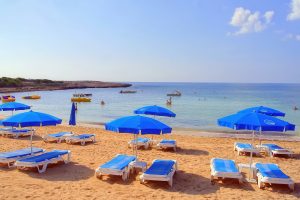
The Makronissos beach takes its name from the small peninsula where it sits. The word Makronissos comes from Greek and means "long island," a reference to the tail-shaped landmass that was once separated from the mainland. The main beach stretches westward, while two smaller bays branch off toward the southwest and southeast. These natural formations create protected swimming areas with calm waters throughout most of the season. The golden sand is fine and soft, without the pebbles or coarse grains common at many Mediterranean beaches. The waters remain shallow for a considerable distance from shore, which allows children to wade and play safely. Parents can relax knowing that the gentle slope of the seabed means their kids can walk quite…

Read more
Makronissos Tombs

Makronissos Tombs

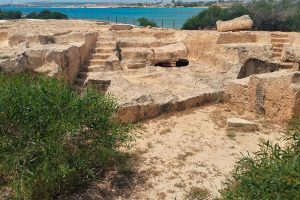
Carved into solid rock on a small peninsula west of Ayia Napa, the Makronissos Tombs are a window into ancient Cyprus. These 19 underground burial chambers date back over 2,000 years and reveal how people lived, died, and honored their dead during the Hellenistic and Roman periods. The Makronissos Tombs form an ancient necropolis, a city of the dead, where families buried their relatives between the 4th century BCE and the 4th century CE. Each tomb consists of a stepped pathway that descends into the rock, leading to a rectangular chamber sealed by stone slabs. Inside, the chambers feature three stone benches carved along the walls and a central rectangular trench slightly lower than the floor. The site also includes…

Read more
Nea Paphos Harbor

Nea Paphos Harbor

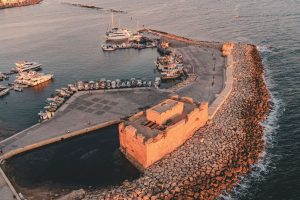
Nea Paphos emerged as one of the most strategically important harbor cities in the ancient Mediterranean. Founded in the late 4th century BC on the southwest coast of Cyprus, this planned city replaced the older settlement of Palaipaphos and quickly became the island's capital. The harbor served dual purposes as both a major naval base and a thriving commercial port, connecting Egypt with the broader Mediterranean world. Today, the archaeological remains spread across 100 hectares near modern Kato Paphos, offering a window into ancient maritime power. Historical Background King Nikokles, the last monarch of Palaipaphos, founded Nea Paphos around 320 BC. After Alexander the Great's death, Cyprus fell under Ptolemaic Egyptian control in 294 BC, where it remained for over…

Read more
Cyprus Ancient Naval Influence

Cyprus Ancient Naval Influence

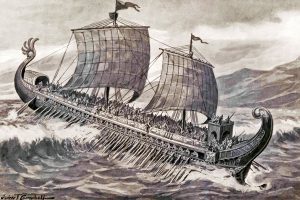
For much of antiquity, Cyprus was less an island on the map and more a working platform of the sea. Positioned between the Aegean, the Levant, and Egypt, it became a testing ground where Phoenician and Greek seafarers refined ships, navigation, and maritime organisation. This article explains how those two cultures approached the sea differently, why Cyprus mattered to both, and how their overlapping naval traditions quietly transformed the island into one of the Mediterranean’s most connected societies. An Island That Made Sense Only from the Water Cyprus’s importance is easiest to understand when viewed from a ship’s deck. Sitting at the eastern edge of the Mediterranean, the island lies directly along the sea lanes linking the Aegean world with…

Read more