Mediterranean Moray Eel – Muraena helena
Beneath the crystal waters of Cyprus, coiled in the dark heart of a rocky crevice, a pair of amber eyes watches the world with ancient, unhurried patience. It is part fish, part serpent in appearance – and entirely its own thing.
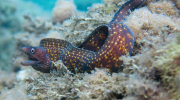
The Mediterranean moray eel has haunted these seas for millions of years, and if you know where to look, you can find it hiding in the very rocks that line the island’s most beautiful coastlines.
A Fish That Does Not Look Like a Fish
The Mediterranean moray eel, known scientifically as Muraena helena and called σμέρνα (smerna) in Greek, is a large, muscular predator that lives in rocky seabeds across the eastern Atlantic and the entire Mediterranean Sea. Despite its writhing, serpentine appearance, it is very much a fish – a highly evolved one that has simply shed most of the features we normally associate with the word. No scales, no pectoral fins, no streamlined body built for open-water speed. Instead, it has developed into a specialist: an ambush hunter perfectly designed to squeeze through narrow crevices, lie motionless for hours, and strike with extraordinary speed when something edible comes within reach.
It belongs to the family Muraenidae – a group of roughly 200 species spread across the tropical and temperate seas of the world. The Mediterranean moray is the most famous and most studied member of this family in European waters, and the only moray widely encountered by divers and fishermen throughout Cyprus.
Named for a Goddess, Feasted Upon by Emperors
The name Muraena helena carries a remarkable amount of history within just two words. The genus name Muraena comes directly from the Latin word for moray eel, which itself was borrowed from the ancient Greek μύραινα (myraena). The species name helena is believed to be a reference to Helen of Troy – the legendary Greek beauty whose name became synonymous with timeless allure. Whether Linnaeus chose this name for the eel’s mesmerising, undulating motion or simply as a classical flourish, the association between this creature and the ancient world could hardly be more fitting.
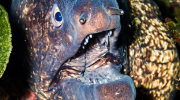
The Romans were utterly captivated by the moray. Wealthy nobles built elaborate stone pools along the Mediterranean coastline – called piscinae – specifically to raise morays as living ornaments and as a luxury food. Some Roman aristocrats reportedly became so attached to individual morays that they adorned them with jewelled earrings and trained them to come to the surface when called. The gourmet Gaius Asinius Pollio is said to have wept more openly for a beloved moray that died than for any of his human losses. Whether true or embellished by later writers, the story tells us something important: this animal has always provoked an outsized emotional response in those who encounter it.
“The Romans built pools along the coast just to keep morays – adorning their favourites with golden earrings and feeding them by hand. For two thousand years, this creature has lived in the gap between fear and fascination.”
In Cyprus, whose rocky coastline and warm, clear waters are practically ideal moray habitat, the eel would have been a familiar sight to every generation of fishermen since the earliest Neolithic settlers arrived on the island more than ten thousand years ago. The ancient port cities of Kition (modern Larnaka), Amathus, and Paphos all sat on rocky shores where morays still live today – and the creature would have appeared regularly in fish markets, cooking pots, and very likely in local mythology as well.
Coils, Teeth, and a Secret Second Jaw
- 1.5m MAX LENGTH
- 15 kg MAX WEIGHT
- 800m DEPTH RANGE
- 12–15 yr LIFESPAN
At first glance, the Mediterranean moray looks almost impossibly simple: a long, thick, muscular tube of a body, tapered at both ends, covered in smooth, scaleless skin coated in a slippery mucus. Its colouration shifts between individuals but tends toward dark brownish-grey, scattered with pale yellowish spots and speckles arranged loosely – not quite leopard spots, not quite a reticulated net, but something in between that makes it almost disappear against a sunlit, barnacled rock face.
The dorsal fin runs the entire length of the back and continues around the tail, merging with the anal fin in one long, continuous ribbon. There are no pectoral fins – no “arms” of any kind. The moray moves entirely by sinuous, wave-like contractions of its body, rippling forward with a motion that is almost hypnotic to watch. The gill opening is reduced to a small, round hole on each side of the head – a simple port for water to exit after passing over the gills.
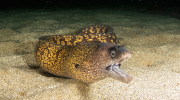
And then there is the mouth. The moray keeps it slightly open at almost all times, revealing two rows of long, curved, needle-sharp teeth angled slightly backwards so that prey – once seized – cannot easily pull free. This permanently gaping expression is why the moray so reliably unsettles people who encounter it. But there is no aggression implied in that open mouth. It is simply breathing: the moray must actively pump water across its gills, and keeping the mouth gently agape is part of that process.
The truly remarkable feature is hidden inside: a second, fully functional set of jaws – the pharyngeal jaw – located further back in the throat. When the moray bites, its primary jaws grip the prey, and then this inner jaw lunges forward, seizes the prey with its own teeth, and drags it backward toward the stomach. It is a mechanism that appears in other fish, but the moray is unique in using it this way – it is the only known animal to use a second jaw for actively pulling prey inward. Scientists discovered this mechanism in 2007 using high-speed X-ray film, and it promptly went viral as one of nature’s genuine surprises. Divers and snorkellers in Cyprus waters occasionally find a moray tugging at something with a strange, repeated jerking motion – now you know why.
Remarkable & Often Overlooked
- The second jaw made headlines. The pharyngeal jaw of Muraena helena was compared by scientists to the creature in the Alien films – a hidden jaw that shoots forward independently. It was formally described in the journal Nature in 2007 and remains one of the most striking feeding mechanisms ever filmed.
- It is the only known fish to use a pharyngeal jaw for forward prey capture. Other fish have pharyngeal jaws, but they use them to grind food. The moray uses its to actively lunge and grab.
- Morays go to the dentist. After eating, a moray will often position itself at a “cleaning station” – a spot on the reef where small cleaner shrimps, will enter the open mouth and pick parasites and food debris from between its teeth. The moray holds perfectly still for the duration.
- It cooperates with groupers. In the Mediterranean and elsewhere, moray eels have been observed hunting cooperatively with large groupers (Epinephelus sp). The grouper chases fish into rocky crevices; the moray, with its flexible body, can follow them in. Neither species eats the other. It is one of the very few documented examples of interspecies cooperative hunting in fish.
- Females vastly outnumber males. In scientific samples from the Adriatic, females outnumbered males by nearly three to one – an imbalance thought to reflect sexual segregation by depth rather than a true biological skew, with males preferring deeper, harder-to-sample waters.
- Its skin can make you mildly ill. The slime coating Muraena helena is mildly toxic. A bite that gets infected – or contact between the moray’s blood and an open wound – can cause a reaction. Treat moray encounters with the same quiet respect you would extend to any wild predator of this size.
A Life in the Dark: Ecology and Behaviour
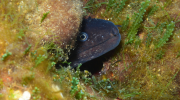
The Mediterranean moray is, above all, a creature of rock and shadow. During the day, it retreats entirely into crevices, caves, and gaps between boulders – sometimes with just the head protruding, slowly scanning the water with its poor but serviceable vision. It is the smell, not the sight, that guides it. The tubular posterior nostrils visible on its snout are particularly sensitive, and in the dark of night, when the moray leaves its shelter to hunt, it navigates almost entirely by scent.
Its diet, as confirmed by stomach-content studies from Tunisia and Croatia, is dominated overwhelmingly by fish – particularly species of sea bream (Diplodus spp.) and comber (Serranus spp.) that are common throughout Cypriot coastal waters. Cephalopods – octopus, cuttlefish, squid – and crustaceans make up a smaller but consistent part of the diet. Researchers calculating its position in the food web have assigned it a trophic level of approximately 4.27, placing it firmly among the top predators of the rocky reef community.
Reproduction in Muraena helena is one of the least-observed aspects of its biology. Mature adults appear to leave their coastal territories in summer and migrate to considerably deeper water – possibly beyond 600 metres in some regions – to spawn. Females develop large orange eggs that are released into open water; the resulting larvae are transparent, leaf-shaped creatures called leptocephali that drift in the plankton for up to a year or more before settling to the seafloor as juveniles. The peak of spawning, based on gonad analysis, appears to fall in July and August – the height of the Cypriot summer tourist season, when the sea above is crowded with swimmers and snorkellers who have no idea that this ancient courtship is taking place in the dark far below.
Growth is slow and steady. Studies using growth rings in the ear bones (otoliths) show that a typical Mediterranean moray reaches sexual maturity at around 75–79 centimetres in length – which takes between six and eight years. The oldest individuals recorded in the scientific literature were twelve years old, though theoretical calculations suggest the species may be capable of living for thirty-five years or more under ideal conditions.
Between Fear and Fascination: The Moray Today
The Mediterranean moray occupies an interesting and slightly uncomfortable position in modern Cypriot life. It is well known – almost every fisherman on the island has either caught one accidentally on a line or knows someone who has – yet it remains largely invisible to the wider public, hidden as it is beneath the surface and active only after dark.
Among local fishermen, the moray has a reputation for being a nuisance: it steals bait, gets tangled in nets, and delivers a genuinely painful bite when handled incorrectly. Its low commercial value means it is rarely targeted deliberately, and when caught as by-catch, it is more often discarded than sold. In some Cypriot coastal villages there are older traditions of eating moray – it can be baked or stewed, and its dense, flavourful flesh is considered a delicacy in parts of Greece – but these habits are rare today.
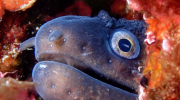
For the growing community of divers and underwater photographers in Cyprus, the moray is something rather different: a prize sighting, a subject of endless fascination, an indicator that a reef is healthy and undisturbed. The presence of a large moray at a dive site is generally taken as a good sign – these animals do not thrive in degraded or polluted environments. From this perspective, the moray has become, quietly and without fanfare, something of an unofficial ambassador for the health of Cyprus’s coastal waters.
Ecologically, its role is significant. As a top predator in the rocky benthic community, the moray helps regulate populations of smaller fish and invertebrates. Remove the moray – or diminish it – and the reef community shifts in ways that can be difficult to reverse. This is a lesson marine biologists are still learning from reef systems around the world, and Cyprus’s own coastal ecology is not immune to it.
Finding The Moray In Cyprus Waters
- Where: The Mediterranean moray inhabits rocky reef habitats all around the Cypriot coastline, but sightings are most reliable at established dive sites. The waters around Akrotiri, the Cape Greco marine reserve, and the rocky shoals off Latchi and Polis on the northwest coast are all well regarded for moray encounters. The famous wrecks of Cyprus – particularly the Zenobia off Larnaka – attract large morays that shelter in the wreck’s chambers and corridors.
- When: Morays can be encountered year-round. Daytime dives and snorkelling trips in summer regularly produce sightings of morays resting in shallow crevices. Night dives between May and October are particularly rewarding – this is when the moray is actively hunting, often fully visible as it moves across open rocky ground in search of prey.
- How to snorkel or dive responsibly: A moray at rest in its hole is not a threat. It will often allow prolonged, close observation as long as no attempt is made to touch it or block its exit. Never approach a feeding moray, never reach into crevices blindly, and never attempt to handle one. Moray bites are ragged wounds that heal poorly and can become infected. Enjoy the encounter at respectful distance – it will be all the more memorable for it.
- Equipment tip: A small torch or dive light, even during daylight hours, will reveal morays in their crevices that would otherwise be completely invisible. The reflected amber glint of their eyes in the beam is one of those underwater moments that stays with you.
The Mediterranean moray eel has been part of the story of this sea – and of Cyprus in particular – for longer than recorded human history. It was here when the first settlers arrived, when the great Bronze Age copper trade made the island famous, when Aphrodite rose from the waves nearby. It still inhabits the same rocks where Roman nobles once reached their hands into the water to feed their jewelled pets. It is a creature that demands nothing of us except the wisdom to leave it alone and the humility to recognise that the sea has its own architects – and the moray is one of the most ancient of them.