The basilica mosaics of Nea Paphos show how Cyprus shifted from Roman myth culture to Christian worship without abandoning its strongest visual craft. Using familiar techniques, artists replaced narrative gods and heroes with symbols, vines, animals, and geometry that guided movement and reinforced theology inside new communal basilicas. This article explains how the change happened across key churches in Kato Paphos, what motifs were repurposed, and why these floors remain one of the clearest records of cultural adaptation on the island.
Mosaics You Miss at First
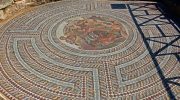
Long before Christianity reached Cyprus, Nea Paphos was already a city of mosaics. As the island’s administrative capital during the Hellenistic and Roman periods, it developed a strong tradition of floor decoration in elite houses and public buildings. Mythological scenes, hunting imagery, marine creatures, and geometric borders filled the villas of wealthy residents.
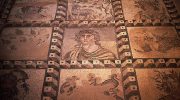
This matters because the Christian mosaics did not appear in isolation. The artisans, materials, and techniques were already present. What changed was not the craft, but the message. When Christianity began to take hold in the 4th century, the language of mosaics was repurposed rather than replaced.
Paphos Already Knew Mosaic Luxury
The most dramatic shift brought by Christianity was not stylistic, but spatial. Pagan mosaics belonged largely to private homes, where they reinforced status, education, and cultural identity. Christian mosaics moved into basilicas, spaces designed for communal worship and shared ritual.
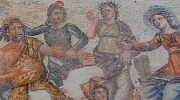
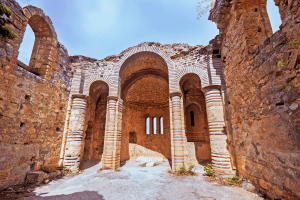
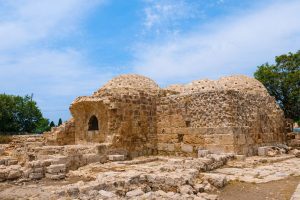
At Nea Paphos, this transformation is most clearly visible in the basilicas of Panagia Chrysopolitissa and Panagia Limeniotissa. These churches were built on or near earlier Roman structures, quite literally layering the new faith over the old city.
The floors were no longer meant to impress guests reclining at banquets. They were designed to guide worshippers, organise movement, and reinforce theological ideas through repetition and symbolism.
Why Christian Mosaics Avoid Myth
One of the most striking features of the basilica mosaics is what they do not show. Gone are the gods, heroes, and dramatic narratives that dominate nearby Roman houses. In their place appear geometric patterns, vines, animals, and symbolic scenes drawn from scripture.
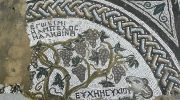
This absence is intentional. Early Christian communities were cautious about figural imagery that could echo pagan worship. Instead of narrative drama, mosaics communicated through suggestion and reference. Symbols carried meaning without depicting divine figures directly, encouraging contemplation rather than spectacle.
The visual language that emerged is restrained, but not empty. Every motif is chosen with care, and meaning unfolds gradually as the viewer moves through the space.
Deer, Water, Baptism Movement
Among the most recognisable motifs in the mosaics of Panagia Chrysopolitissa is the image of a deer drinking from flowing water. In pagan art, animals often appeared as part of hunting scenes or pastoral abundance. Here, the image is transformed, echoing the biblical line, “As the deer longs for streams of water, so my soul longs for you, O God.”
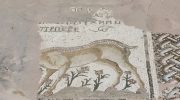
Its placement is as important as its form. Located near areas associated with baptism and entry, the image links physical movement with spiritual transition. Worshippers crossing the floor enacted the symbolism with their own bodies, moving from the secular world into sacred space.
Vine and grape motifs function in a similar way. Once associated with Dionysian imagery and earthly pleasure, they are reinterpreted to reflect the Eucharist and Christ’s description of himself as the “true vine.” The familiarity of the image eases the shift in meaning, allowing older visual habits to carry new theological weight.
Geometry as Sacred Order
Geometric patterns dominate much of the basilica flooring, filling large areas with interlocking circles, wave motifs, and carefully measured borders. These designs are not merely decorative. They serve as tools of organisation, marking pathways, defining liturgical zones, and visually anchoring the altar within the broader space.
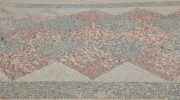
At the same time, geometry carries symbolic resonance. Repetition and balance suggest order and permanence, qualities that mattered deeply during a period of religious and social transformation. Abstract patterning avoided theological ambiguity while reinforcing the idea of a divinely ordered world.
In this context, restraint becomes a form of clarity. Geometry provides stability where narrative might invite confusion.
The Port Basilica and a Changing World
The Basilica of Panagia Limeniotissa, positioned closer to the ancient harbour, reflects a more unsettled environment. Serving a community shaped by travel, trade, and exposure to the wider Mediterranean, its mosaics are simpler and more conservative in design.
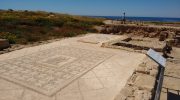
Damage from Arab raids in the 7th century left visible traces on the site, yet the mosaic tradition did not disappear. Floors were repaired, reused, and adapted as circumstances demanded. The continuity of these surfaces speaks to resilience rather than grandeur, showing how sacred art persisted even as political and economic conditions shifted.
Old Skills, New Meanings
What gives the Nea Paphos mosaics their lasting power is their refusal to sever ties with the past. Techniques perfected in pagan villas were carried into Christian basilicas. Familiar motifs were retained, but their meanings adjusted. Even the craftsmen themselves may have moved between private and sacred commissions within the same lifetime.
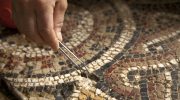
This gradual transformation reveals a human process rather than an ideological rupture. Belief changed, but daily life, skills, and visual memory continued. The mosaics capture that negotiation in stone and colour, preserving a moment of cultural adaptation rather than replacement.
Visiting the Mosaics Today
Today, visitors encounter these mosaics within the Kato Paphos Archaeological Park, where raised walkways protect the fragile surfaces while allowing close viewing. Seeing the mosaics in their original context is essential. Their meaning depends on scale, orientation, and movement through space.
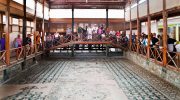
Early morning and late afternoon light reveal subtle colour shifts and fine details that are easily missed at midday. Taking time to pause and observe allows the floors to communicate their layered history more fully.
What These Floors Teach
The basilica mosaics of Nea Paphos matter because they show how societies learn to see differently. They document a transition not through destruction, but through reinterpretation. Pagan forms were not erased. They were reshaped to express new beliefs within familiar visual frameworks.
In their quiet patterns and deliberate restraint, these floors preserve a moment when Cyprus redefined its sacred spaces without abandoning its artistic inheritance. Stone by stone, image by image, belief was woven into everyday movement, leaving a record beneath the feet of generations who walked, worshipped, and believed.