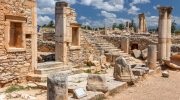
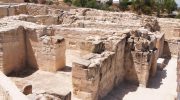
The Roman mosaics of Nea Paphos, especially in the House of Dionysos and the House of Theseus, were designed to do more than decorate elite homes: they signalled status, shaped movement, and communicated authority through myth. In the island’s administrative capital, these floors turned private reception rooms and official spaces into visual statements about leisure, order, and governance. This article explains how the two houses use different mosaic programs, what the imagery was meant to achieve, and why Paphos remains one of the clearest places to read Roman power at ground level.
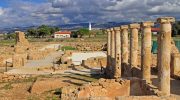
Nea Paphos, Built for Rule
Nea Paphos rose to prominence because of its political role. From the late Hellenistic period onward, the city served as the administrative capital of Cyprus, first under the Ptolemies and later under Roman rule. When Rome formally annexed the island in the first century BCE, Paphos retained its status as the seat of the proconsul, making it the centre of imperial authority on the island.
This political importance shaped the city’s architecture. Elite residences were not hidden private retreats. They were positioned close to public spaces, built on a grand scale, and designed to receive visitors. In this context, the floors mattered. Mosaics were among the most visible and expensive features of a Roman house, and in Paphos, they became tools for communicating power.
Triumph Scenes and Cultivated Taste
The House of Dionysos represents the refined, private side of elite Roman life. Built in the late second century CE, the house was arranged around a central courtyard, with richly decorated rooms opening onto shared spaces used for dining, entertaining, and ritual hospitality.
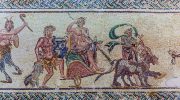
The mosaics here revolve around Dionysos, the god of wine, celebration, and transformation. Scenes such as the Triumph of Dionysos, where the god rides in procession surrounded by satyrs and musicians, were not chosen at random. They reflected Roman ideals of otium, a concept of cultivated leisure that balanced pleasure with education and self-control.
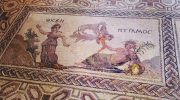
Other panels deepen this message. The story of Icarus and the first wine drinkers, for example, illustrates both the gift and the danger of excess. Mythological love stories such as Phaedra and Hippolytos or Narcissus introduce moral tension and emotional complexity, signalling that the household was engaged with literature, theatre, and philosophical ideas.
Together, these images transformed the house into a space where guests were reminded of the owner’s cultural sophistication. To walk across these floors was to participate in a conversation about taste, restraint, and belonging within the Roman world.
Theseus: The Proconsul’s House
The House of Theseus tells a very different story. This vast complex, the largest Roman residence discovered in Cyprus, is widely understood to have served as the official residence of the Roman proconsul. Its scale alone sets it apart, but its mosaics make its purpose unmistakable.
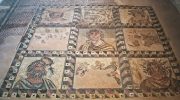
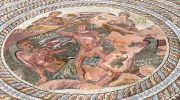
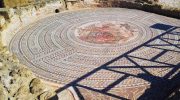
The central image of Theseus slaying the Minotaur is a statement of governance. Theseus was not just a hero, but a founder figure associated with order, law, and the unification of the state. Depicted at the heart of the residence, his victory over chaos became a visual metaphor for Roman rule in Cyprus.
Later mosaics reinforce this message. Scenes linked to Achilles emphasise divine ancestry, destiny, and heroic obligation. These images align the proconsul with legendary figures whose authority was portrayed as both earned and inevitable. Even the surrounding geometric patterns play a role, echoing ideas of structure, discipline, and control.
Unlike the intimate storytelling of the House of Dionysos, the House of Theseus speaks in a public voice. Its floors were designed to impress visitors, officials, and petitioners, reminding them that they were standing in the space where imperial power was exercised.
Techniques That Rival the Capitals
The impact of the Paphos mosaics is not limited to their subject matter. Their technical execution reveals a level of craftsmanship that places them among the finest mosaic traditions of the Roman Mediterranean. These floors were produced by highly skilled artisans who understood both the artistic and symbolic demands of elite patrons.
Mosaicists combined large-scale opus tessellatum with delicate passages of opus vermiculatum, allowing scenes to shift seamlessly from bold composition to fine detail. Faces show controlled expression. Drapery suggests movement. Shadows give figures weight and presence, even when viewed from above.
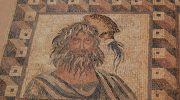
Much of the colour palette came from local stone, grounding the mosaics in the Cypriot landscape itself. Glass tesserae were used sparingly but strategically, catching the light in eyes, jewellery, and divine attributes. This selective brilliance guided the viewer’s attention and reinforced the hierarchy of figures within each scene.
These were not decorative afterthoughts. They were carefully planned commissions, executed over long periods, designed to endure both physical wear and cultural change.
Spatial Design and Social Meaning
In Roman Paphos, mosaics did more than decorate interiors. They shaped how space was used and understood. Floors directed movement, marked thresholds, and signalled where one was permitted to stand, linger, or speak.
Reception rooms carried the most complex mythological scenes, ensuring that guests encountered stories of power, virtue, and identity as soon as they entered. Private areas were more restrained. Service spaces were often left plain. In this way, the mosaic program mirrored the social structure of the household itself.
The House of Dionysos invited reflection and conversation, encouraging guests to read myth as metaphor and pleasure as cultivated behaviour. The House of Theseus imposed a different atmosphere altogether. Its floors reminded visitors that they were moving within a space governed by authority, order, and imperial responsibility.
Buried, Found, Reframed
For centuries, these mosaics lay hidden beneath collapsed walls and shifting soil. Their rediscovery in the twentieth century transformed modern understanding of Roman Cyprus, revealing a society deeply engaged with artistic expression and imperial symbolism rather than a distant provincial outpost.
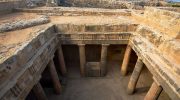
Archaeological excavations brought entire rooms back into view, allowing scholars to reconstruct not only individual scenes but entire visual programs. Today, protective shelters and raised walkways allow visitors to experience these spaces much as ancient guests once did, looking down rather than up to read the story of power and identity.
Conservation remains an ongoing effort. Stone, mortar, and colour respond differently to exposure and time. Yet preserving these mosaics in situ ensures that they remain part of the landscape and memory of Paphos, rather than isolated objects behind glass.
What Paphos Proves About Power
The Roman mosaics of Paphos endure because they reveal how power once operated at ground level. Authority was not expressed only through decrees or monuments, but through daily movement across images that reinforced order, hierarchy, and belonging.
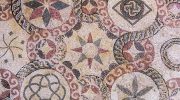
In the House of Dionysos, art framed private life as a performance of culture and restraint. In the House of Theseus, it asserted governance through myth and architectural scale. Together, they show how Cyprus balanced its Greek heritage with Roman political reality.
These floors were meant to be walked on, lived with, and understood slowly over time. In Paphos, history was not confined to walls or texts. It was set into stone beneath the feet of those who ruled, visited, and served. And in many ways, it still is.