6. Byzantine era

Panagia Kanakaria Monastery Cyprus

Panagia Kanakaria Monastery Cyprus

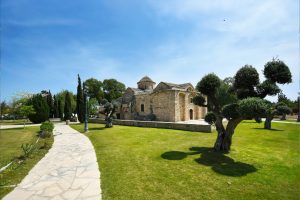
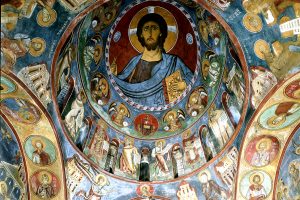
Panagia Kanakaria Church is an early Byzantine-era religious structure located in the village of Lythrangomi on the Karpas Peninsula in northeastern Cyprus. The site is widely recognized as one of the most important surviving examples of early Byzantine ecclesiastical architecture and decorative art on the island. Constructed originally in the 5th or 6th century AD, the church reflects the early development of basilica-style architecture in Cyprus during the Byzantine period. It was built within a settlement that was connected to nearby ancient urban and rural communities, some of which date back to the Hellenistic and Roman eras. Historical Background The earliest phase of the structure is believed to date to the 5th century AD, when a simple wooden-roofed basilica was…

Read more
Nea Paphos Basilica Mosaics

Nea Paphos Basilica Mosaics

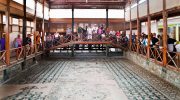
The basilica mosaics of Nea Paphos show how Cyprus shifted from Roman myth culture to Christian worship without abandoning its strongest visual craft. Using familiar techniques, artists replaced narrative gods and heroes with symbols, vines, animals, and geometry that guided movement and reinforced theology inside new communal basilicas. This article explains how the change happened across key churches in Kato Paphos, what motifs were repurposed, and why these floors remain one of the clearest records of cultural adaptation on the island. Mosaics You Miss at First Long before Christianity reached Cyprus, Nea Paphos was already a city of mosaics. As the island’s administrative capital during the Hellenistic and Roman periods, it developed a strong tradition of floor decoration in elite…

Read more
St. Hilarion Castle

St. Hilarion Castle

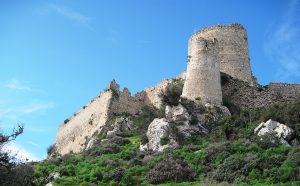
St. Hilarion Castle stands 732 meters above sea level in the Kyrenia mountain range of Cyprus. This medieval fortress features stone walls and towers that appear to grow directly from the rocky peaks. Located just off the main Kyrenia to Nicosia highway, the castle commands the mountain pass between the coast and the central plain. The castle is the best preserved of three Byzantine strongholds built along the Kyrenia mountain range, the others being Kantara to the east and Buffavento further west. The fortress consists of three main sections built at different elevations on the mountainside. The lower ward contained stables and living quarters for soldiers. The middle ward housed royal apartments, kitchens, a church, and a large cistern for…

Read more
Basilica of Chrysopolitissa Paphos

Basilica of Chrysopolitissa Paphos

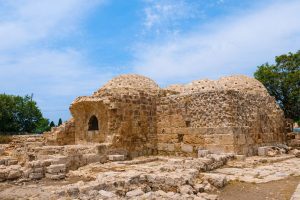
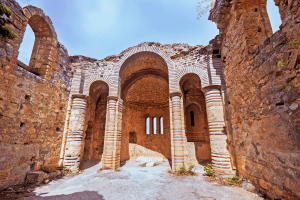
In the heart of Paphos lies one of Cyprus’s most significant archaeological landscapes, where over 1,600 years of urban and architectural history remain visible. The Chrysopolitissa site preserves the remains of a large late Roman basilica, along with later medieval and Ottoman-period structures, offering a layered record of continuous settlement and rebuilding. Today, the complex includes the ruins of the basilica, a later parish church (Agia Kyriaki), fragments of a medieval Franciscan structure, and the remains of Roman and Byzantine-era installations. Historical Background Archaeological evidence confirms that the basilica was constructed in the second half of the 4th century AD, during a period when Cyprus was integrated into the administrative and cultural systems of the late Roman Empire. Paphos served…

Read more
Panagia Angeloktisti Church Kiti

Panagia Angeloktisti Church Kiti

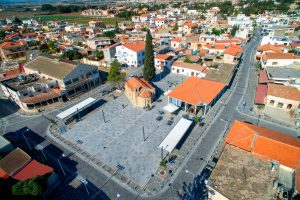
Panagia Angeloktisti Church stands in the village of Kiti, roughly 12 kilometers southwest of Larnaca. The church dates to the 11th century and was built over the ruins of a 5th century early Christian basilica. The name Angeloktisti translates to "Built by Angels" in Greek. The original apse of the basilica survived along with one of the finest pieces of Byzantine art on the island, a rare 6th century mosaic of the Virgin Mary and Child between the Archangels Michael and Gabriel. This stone church preserves multiple layers of Cyprus's religious history, from early Christian times through Byzantine and Frankish periods. The building serves as an active place of worship while housing artistic treasures that connect directly to the Byzantine…

Read more
Agios Lazaros Church Larnaca

Agios Lazaros Church Larnaca

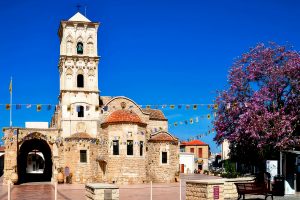
Agios Lazaros Church, located in central Larnaca, is one of the most prominent medieval landmarks in Cyprus. The structure was built in the late 9th or early 10th century over a site traditionally associated with an ancient burial chamber linked to the historical figure Lazarus, a name widely referenced in early Mediterranean religious texts. The building is considered an important example of Byzantine-era architecture on the island and continues to attract interest for its historical, artistic, and archaeological significance. Historical Background According to long-standing tradition, the site is connected to Lazarus, a figure mentioned in early religious writings from the eastern Mediterranean. These traditions describe his arrival in Cyprus during the early centuries AD and his association with the ancient…

Read more
Panagia Angeloktisti Church

Panagia Angeloktisti Church

Panagia Angeloktisti Church stands in the village of Kiti, roughly 12 kilometers southwest of Larnaca. The church dates to the 11th century and was built over the ruins of a 5th century early Christian basilica. The name Angeloktisti translates to "Built by Angels" in Greek. The original apse of the basilica survived along with one of the finest pieces of Byzantine art on the island, a rare 6th century mosaic of the Virgin Mary and Child between the Archangels Michael and Gabriel. This stone church preserves multiple layers of Cyprus's religious history, from early Christian times through Byzantine and Frankish periods. The building serves as an active place of worship while housing artistic treasures that connect directly to the Byzantine…

Read more
Byzantine Cyprus: Eastern Mediterranean Defense

Byzantine Cyprus: Eastern Mediterranean Defense

Cyprus was never a distant outpost of the Byzantine Empire. From late antiquity through the Middle Ages, it functioned as a frontline maritime shield, protecting the sea lanes that connected Anatolia, the Levant, and the Aegean. Byzantine naval defense on Cyprus was not limited to fleets and battles. It was a layered system combining geography, coastal fortifications, mountain surveillance, communication networks, and naval presence. Together, these elements allowed the empire to detect threats early, control movement at sea, and preserve stability in one of the Mediterranean’s most contested regions. An Island Positioned to Watch the Sea Cyprus sits at a natural crossroads of the Eastern Mediterranean. From its shores, routes radiate toward southern Anatolia, Syria and Palestine, Egypt, and the…

Read more
Painted Churches In the Troodos Region

Painted Churches In the Troodos Region

Ten small medieval churches scattered across the Troodos Mountains preserve some of the finest surviving examples of wall painting traditions in the Eastern Mediterranean. These UNESCO World Heritage sites document around 500 years of artistic development through richly decorated interior fresco cycles. Nine of the ten structures are located in the Nicosia District, while one, Timios Stavros in Pelendri, is situated in the Limassol District. The buildings date from the 11th to the 16th centuries and reflect a combination of high-quality metropolitan artistic styles and strong local artistic identity. These structures range from small rural chapels to larger monastic complexes such as Agios Ioannis Lampadistis. Their external simplicity contrasts sharply with their richly decorated interiors, where walls are covered with…

Read more