
Cyprus operates two international airports that serve as the island’s primary gateways for tourism and business travel. Larnaca International Airport handles approximately 70 percent of total passenger traffic, while Paphos International Airport serves the remaining 30 percent.

Together, these facilities processed over 13 million passengers in 2025, representing a 12 percent increase from 2024 and significantly exceeding pre-pandemic levels from 2019. Hermes Airports operates both facilities under a concession agreement with the Cyprus government that has been extended until 2033. The company has committed 170 million euros to Phase 2 expansion projects that began in March 2025, with completion expected by 2027.
When finished, Larnaca will handle 12.4 million passengers annually while Paphos will accommodate 5 million, bringing combined capacity to 17.4 million passengers per year. These expansions reflect Cyprus’s growing importance as a Mediterranean travel hub and the government’s strategy to strengthen tourism infrastructure.
How Larnaca Dominates Passenger Traffic
Larnaca International Airport processed 9.37 million passengers between January and November 2025, accounting for approximately 72 percent of Cyprus’s total air traffic. The airport serves as the main entry point for visitors from the United Kingdom, Greece, Israel, Poland, and Germany, which collectively represent 64 percent of all arrivals. London and Athens each generate approximately 1.4 million passengers annually, while Tel Aviv contributes close to one million.

The facility operates with a single terminal that handles both arrivals and departures. Larnaca offers superior connectivity with more frequent flights to major European cities compared to Paphos. The airport’s location just six kilometers from Larnaca city center and its proximity to Nicosia, located 50 kilometers away, makes it the preferred choice for business travelers and tourists heading to the capital region or the eastern and southern coasts. The government began marketing Larnaca as the island’s primary gateway when the airport opened in 1975 following the loss of Nicosia International Airport during the 1974 Turkish invasion.

Larnaca’s advantages include more parking capacity, with 3,500 spaces following a 500-space expansion in late 2025. The airport features longer operating hours to accommodate early morning and late evening flights from European destinations.

Hermes Airports has warned that landside congestion is becoming a concern despite recent parking additions, urging travelers to pre-book spaces online during peak periods.
The 95 million euro expansion currently under construction will add approximately 20,000 square meters of terminal space, including new departure and arrival gates, additional baggage claim belts, expanded passport control and security areas, and increased commercial space.

Why Paphos Appeals to Western Tourists
Paphos International Airport handled 3.64 million passengers between January and November 2025, representing approximately 28 percent of Cyprus’s total traffic. The airport experienced mixed performance during 2025, with a 1.36 percent decrease in May compared to 2024 but strong growth in other months. August 2025 saw 501,100 passengers pass through Paphos, a significant increase from 439,900 in August 2024 and well above the 376,100 recorded in pre-pandemic August 2019.

Paphos serves predominantly leisure travelers, particularly British and European tourists visiting the western and southwestern resort areas. The airport’s location just 15 kilometers from Paphos city center and proximity to popular destinations like Coral Bay, Latchi, and the Akamas Peninsula makes it ideal for beach holidays. Package tour operators including Jet2, TUI, and Ryanair operate substantial seasonal capacity to Paphos. Jet2 announced plans to introduce year-round Gatwick to Paphos service starting March 2026, reflecting confidence in sustained demand.

The airport operates with a smaller terminal than Larnaca but offers a more relaxed atmosphere with shorter security lines during off-peak periods. Paphos provides easier access to the Troodos Mountains for visitors combining beach holidays with mountain excursions. The 75 million euro expansion will increase terminal capacity by approximately 30 percent while extending the southern parallel taxiway to improve operational efficiency. Construction work proceeds during nighttime hours to avoid disrupting daytime operations, with crews working between the last 23:30 departure and first 06:00 arrival.
The Expansion Projects That Will Transform Both Airports
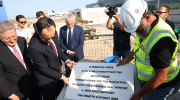
Phase 2 development works officially launched in June 2025 when President Nicos Christodoulides laid the foundation stone at Larnaca Airport. The ceremony included a time capsule containing project documentation and newspaper clippings. Construction began in March 2025 following completion of financing agreements between Hermes Airports and participating banks. The joint venture of Bouygues Batiment International and Iacovou Brothers has undertaken construction responsibilities.
At Larnaca, the expansion extends the terminal both eastward and westward. The eastern extension will house new departure passport control and security functions, while existing passport areas will convert to commercial space. A new western wing will provide departure gates at ground level connected to the main building. The project includes advanced heating, ventilation, and air conditioning technology designed for energy efficiency. Larnaca’s expansion is designed to demonstrate how the terminal can operate in a Schengen environment while maintaining service levels for both Schengen and non-Schengen passengers separately.

Paphos expansion focuses on extending the southern parallel taxiway with necessary lighting and safety requirements. The terminal will grow eastward with new immigration functions and at least three baggage claim units with provision for a fourth. Existing arrival areas will convert to security screening and additional gates. Rapid-exit taxiways will reduce runway occupancy by 45 seconds per aircraft, creating additional slots for low-cost carriers. When complete, Paphos peak-hour aircraft movements will increase from 12 to 18.
The Department of Environment approved both projects in February 2025 following ecological assessments addressing concerns about the Natura 2000 protected areas near both airports. Larnaca’s expansion includes oil separators to prevent pollution at the nearby salt flats. Community consultation revealed concerns about aircraft noise and air quality. Proposed mitigation measures include encouraging quieter fuel-efficient aircraft, enhanced air quality monitoring, and operational restrictions during peak residential hours.
How The Two Airports Serve Different Needs
Larnaca and Paphos have developed complementary roles rather than competing directly. Larnaca functions as the business gateway and primary connection point for visitors to Nicosia, the eastern coast, and Ayia Napa. Its superior frequency on routes to major European hubs makes it essential for time-sensitive business travel. The airport handles more cargo operations and serves as the base for Cyprus Airways Flying Academy, which opened in 2024.
Paphos specializes in leisure tourism, particularly package holidays to western coastal resorts. The airport’s smaller size and less congested facilities appeal to families and retirees seeking stress-free arrivals. Lower landing fees at Paphos compared to Larnaca have attracted budget carriers looking to minimize costs. Ryanair and Wizz Air have established year-round schedules to Paphos after previously operating only seasonal routes.
The government’s airline incentive schemes, which began in 2012, have driven growth at both facilities by subsidizing new routes and increased frequencies. These programs helped Cyprus achieve record passenger numbers in 2024 and sustain growth through 2025 despite regional instability affecting some source markets. Transport Minister Alexis Vafeades credits the incentives with making Cyprus competitive against Mediterranean destinations with larger populations and more diverse economies.
Why Both Airports Matter for Cyprus’s Future
Cyprus’s airports represent critical infrastructure for an economy where tourism contributes approximately 15 percent of GDP. The 170 million euro expansion ensures capacity will meet demand through the 2030s while positioning Cyprus to benefit from projected Mediterranean tourism growth. The investments also prepare for Cyprus’s planned Schengen Zone accession, which will require reconfigured terminals to separate Schengen and non-Schengen flows.

By expanding both facilities simultaneously, Cyprus avoids bottlenecks that could limit tourism sector growth and maintains redundancy if either airport faces temporary capacity constraints. The dual-airport strategy provides flexibility while ensuring all regions of the small island maintain international connectivity.