Across the rivers, reservoirs, and quiet wetlands of Cyprus, a remarkable migratory fish still moves almost unseen.
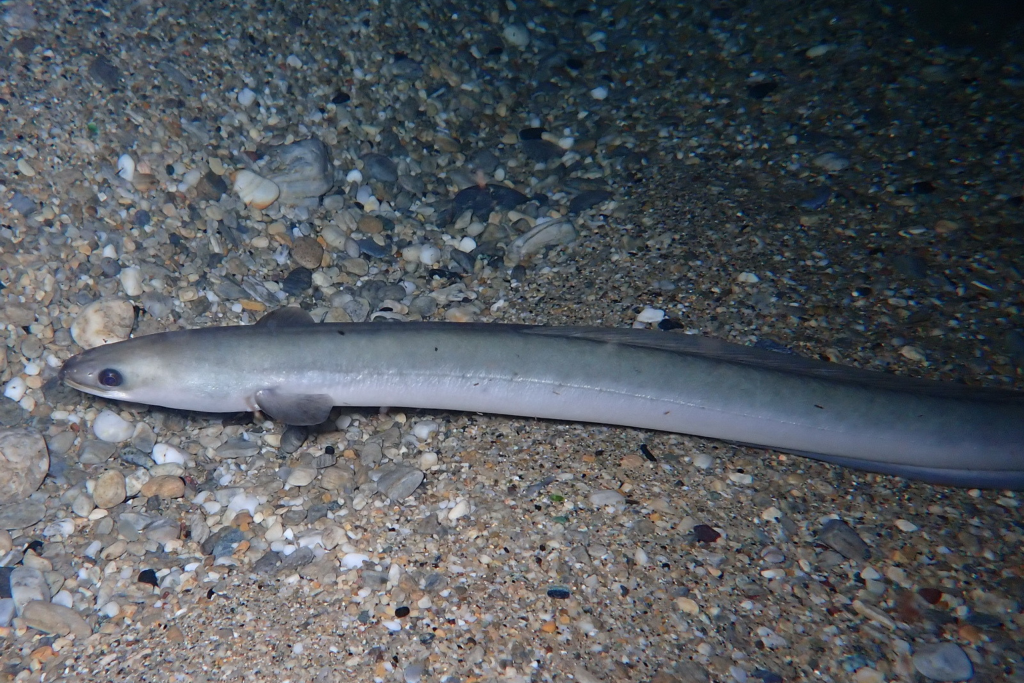
The European eel (Anguilla anguilla) is one of the island’s most mysterious freshwater inhabitants – a species whose life connects Cyprus not only to the Mediterranean, but to the distant Atlantic Ocean and the legendary Sargasso Sea. Its story is one of endurance, disruption, and surprising rediscovery.
- A Journey Across Oceans and Islands
- Cyprus Waters: A Fragmented but Living Network
- A Scientific Surprise: Eels Were Always Here
- Silver Travellers: The First Confirmed Migrants
- Fun Facts About the Cyprus Eel
- Life Between Barriers and Refuges
- Why It Matters Today
- Seeing the Invisible River Nomad
- Closing Reflection
A Journey Across Oceans and Islands
The European eel belongs to a group of fish known as catadromous species – animals that grow in freshwater but return to the sea to reproduce. After hatching in the Sargasso Sea, tiny transparent larvae drift for thousands of kilometres before reaching European and North African coasts.
Cyprus sits at the very eastern edge of this distribution. For many years, it was assumed that eels were rare or even absent from the island’s inland waters, mainly due to the dry climate and heavily modified rivers. As a result, Cyprus was exempt from European eel conservation planning under EU regulation 1100/2007. But recent research has rewritten this assumption.
Cyprus Waters: A Fragmented but Living Network
Cyprus today is a land of contrasts for freshwater life. Many rivers are intermittent, flowing only in winter rains before drying in summer. At the same time, the island contains one of the highest densities of dams in Europe, with over a hundred reservoirs reshaping natural river systems.
These changes create a patchwork of habitats – some suitable for fish movement, others acting as barriers. Yet within this fragmented system, eels have persisted.
Studies using environmental DNA and long-term fish surveys revealed that European eels are present across multiple lowland catchments, especially in the western part of the island.
They are most commonly found in lower elevations, closer to the coast, where connectivity between sea and freshwater still exists.
A Scientific Surprise: Eels Were Always Here
For a long time, the true status of eels in Cyprus remained uncertain. Traditional surveys recorded only scattered individuals, and many believed that stable populations could not survive in such a dry and fragmented landscape.
However, integrated monitoring changed this picture completely. Over a decade of surveys, more than 350 individual eels were recorded, alongside widespread detections in environmental DNA samples.
Even more surprising, eels were found in different habitat types – rivers, reservoirs, wetlands, and spring-fed streams – proving they are far more adaptable than previously thought.
Silver Travellers: The First Confirmed Migrants
Perhaps the most remarkable discovery came recently: the first confirmed silver eels in inland Cyprus – the mature life stage preparing for oceanic migration.
These silver eels were captured during attempts to move downstream towards the sea, showing that at least some individuals complete their long freshwater growth phase on the island.
This finding changed everything. It demonstrated not only presence, but also successful development and migration potential within Cypriot freshwater systems.
Fun Facts About the Cyprus Eel
- The European eel can travel over 5,000 km between spawning and growth habitats.
- Some eels in Cyprus have been recorded at over 60 cm in length before migrating.
- They can survive in both clear mountain streams and turbid, lowland reservoirs.
- Their body shape transforms dramatically during “silvering,” preparing them for life at sea.
- Despite their snake-like appearance, they are true fish with a fascinating metamorphic life cycle.
Life Between Barriers and Refuges
One of the most important insights from recent studies is how strongly eels depend on connectivity. In Cyprus, dams and dry river sections often block movement, forcing eels into isolated lowland refuges.
Where water remains year-round – in springs, wetlands, or reservoir outlets – eels can survive and grow. But access to these refuges determines their long-term survival.
Researchers suggest that improving river connectivity could significantly increase their chances of reaching maturity and successfully migrating back to the sea.
Why It Matters Today
The European eel is listed as Critically Endangered across its entire range. Cyprus, once thought peripheral to its conservation, is now recognised as an important eastern frontier for the species.
The island’s freshwater systems may act as hidden refuges, supporting populations that could contribute to the broader Mediterranean recovery. At the same time, they highlight how human infrastructure – dams, channels, and water abstraction – can reshape even remote ecological stories.
Protecting these pathways is not only about Cyprus; it is about preserving one of Europe’s most extraordinary migratory species.
Seeing the Invisible River Nomad
Although rarely observed, eels can still be encountered in Cyprus. They are most likely to be found at night in lowland streams, irrigation channels, and reservoir margins – especially in western catchments.
For those who search carefully, a glimpse of a moving eel is like witnessing a piece of deep evolutionary history still in motion: an animal that begins its life in the open ocean and spends years hidden in the island’s inland waters.
Closing Reflection
The European eel in Cyprus is more than a fish – it is a traveller between worlds. Its presence links the island’s fragmented rivers to an ocean thousands of kilometres away, reminding us that even heavily altered landscapes can still hold unexpected life.
In understanding and protecting this quiet migrant, we also learn something larger about Cyprus itself: that its waters, though small and often overlooked, are part of a far wider ecological story still unfolding today.