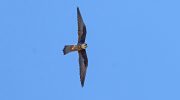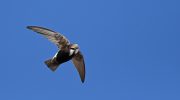
Every evening in late spring, as the light over Cyprus turns golden and the air begins to cool, the sky fills with a sound that stops you mid-step. A wild, piercing scream – not one bird, but ten, twenty, fifty – tearing between the church towers and old stone walls of village after village. If you’ve heard it, you’ll never forget it. And if you look carefully, you may realise that not all these dark, boomerang-winged shapes above you are the same bird at all.
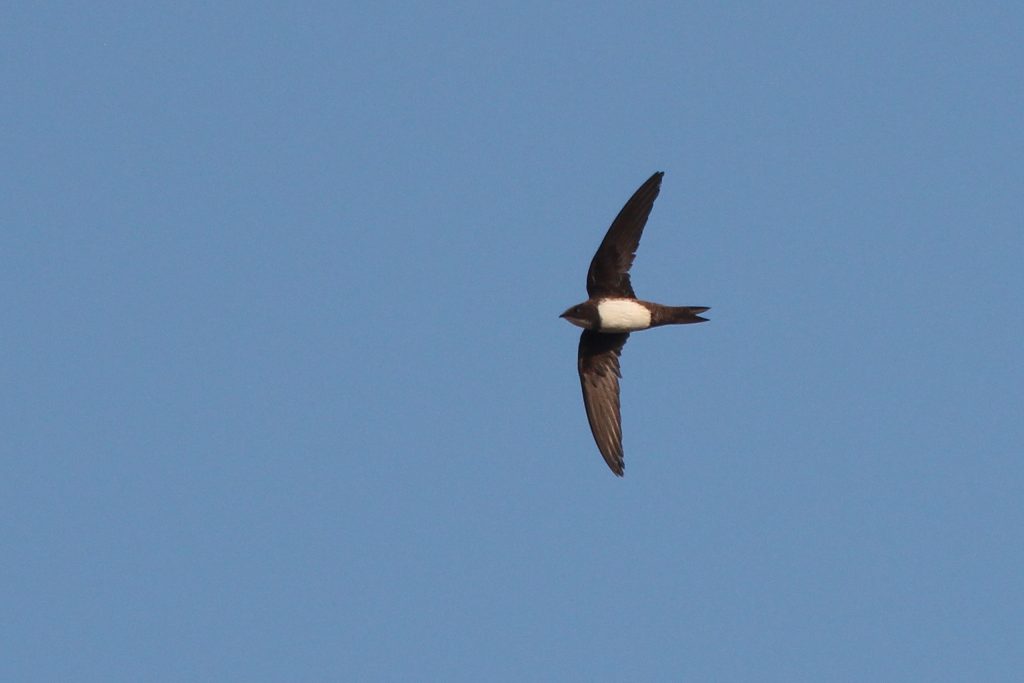
Cyprus is home to four recorded species of swift. Together, they form a living mosaic in the island’s skies – each one a different chapter of the same remarkable story.
What Is a Swift?
Swifts belong to the family Apodidae, within the order Apodiformes – a group whose nearest living relatives are not swallows, not martins, but hummingbirds. The family name, Apodidae, is derived from the Greek ἄπους (ápous), meaning “footless” – a reference to the small, weak legs of these most aerial of birds. The ancient Greeks genuinely believed the swift had no feet at all. They were not entirely wrong. Swifts have legs so reduced that they are almost invisible in flight, used only to cling to vertical surfaces. The tradition of depicting swifts without feet continued into the Middle Ages, as seen in the heraldic martlet.
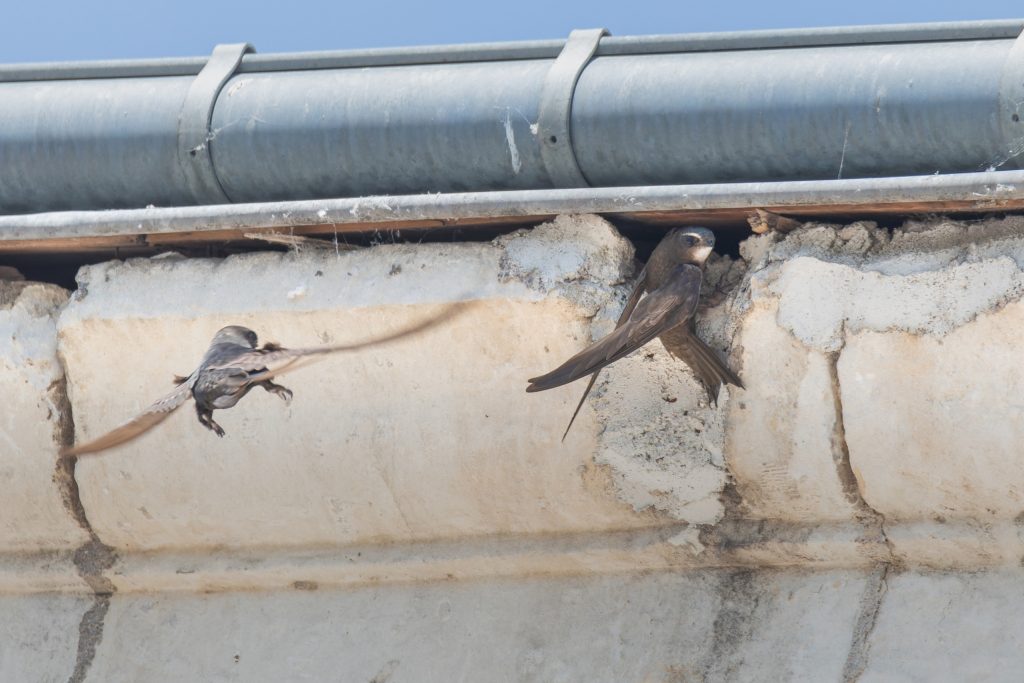
What makes swifts extraordinary is not what they look like, but how they live. They have committed more completely to life in the air than almost any other creature with wings. They eat in the air, drink in the air, mate and sleep in the air. Some species may spend up to ten months without touching the ground.
Born of Myth – A Name From Ancient Greece
In Cyprus, the folk tradition gave swifts the name σταχτάρα from στάχτη (ash), referring to the bird’s ashy-brown colour. Their arrival in late February and March coincides with the final rains of the season, and their departure by midsummer marks the beginning of the long dry silence. To Cypriot farmers across generations, a sky full of screaming swifts meant weather was changing. It was a living forecast written overhead.
The Four Swifts of Cyprus
Cyprus sits on one of the major bird migration routes across the eastern Mediterranean, making it a crossroads for multiple swift species. Four swift species are recorded for Cyprus: the Alpine Swift, Common Swift, Pallid Swift, and Little Swift. Each one plays a different role in the island’s skies – resident breeder, summer visitor, passage migrant, and rare wanderer.
The Common Swift – Apus apus Μαυροσταχτάρα
The Common Swift is the swift most people in Cyprus know best, even if they don’t know its name. It is the one screaming over rooftops in May and June, nesting in the walls of village churches, under the terracotta roof tiles of old houses, filling the evening air with its shrill cries.
Common Swifts start arriving in Cyprus by end of February and they are one of the first migrants to set off for Africa, as early as July. They nest exclusively in cities and villages, under roof tiles or in holes in buildings. They eat, drink, sleep and mate in the air. It is one of the fastest birds in the world.
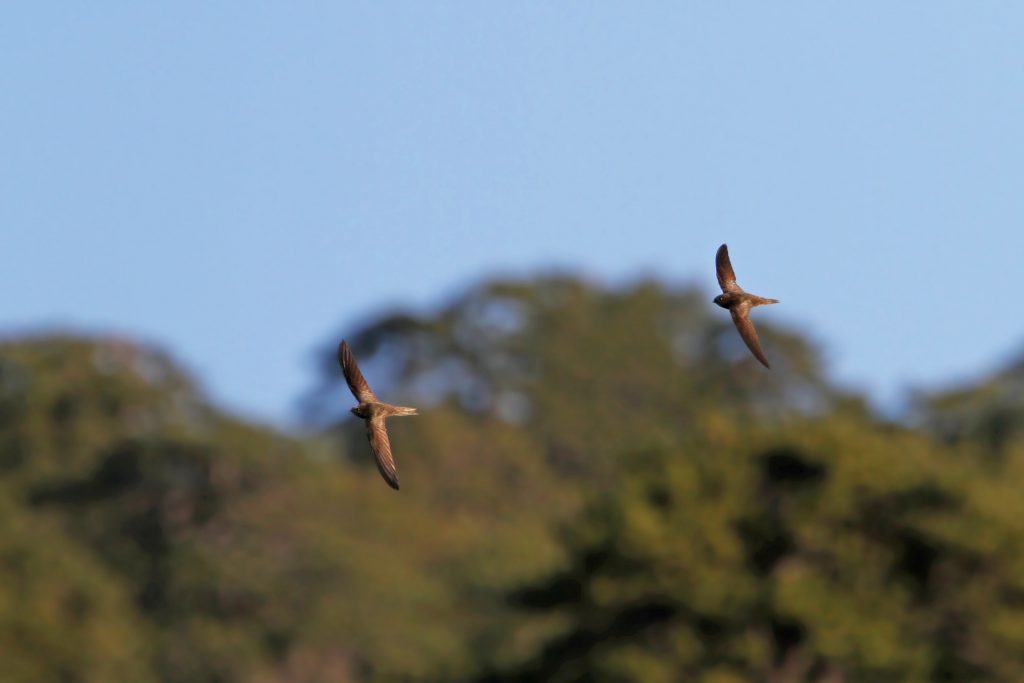
Common Swifts are 16–17 cm long with a wingspan of 38–40 cm, and are entirely blackish-brown except for a small white or pale grey patch on their chins, which is not visible from a distance. They have a short forked tail and very long swept-back wings that resemble a crescent or a boomerang.
Their call is a loud scream in two different tone pitches. They often form “screaming parties” during summer evenings, when 10 to 20 swifts gather in flight around their nesting area, calling out and being answered by nesting swifts. Their maximum flying speed reaches 111.6 km/h. Some individuals go ten months without landing. No other bird spends as much of its life in flight.
The Pallid Swift – Apus pallidus Ωχροσταχτάρα
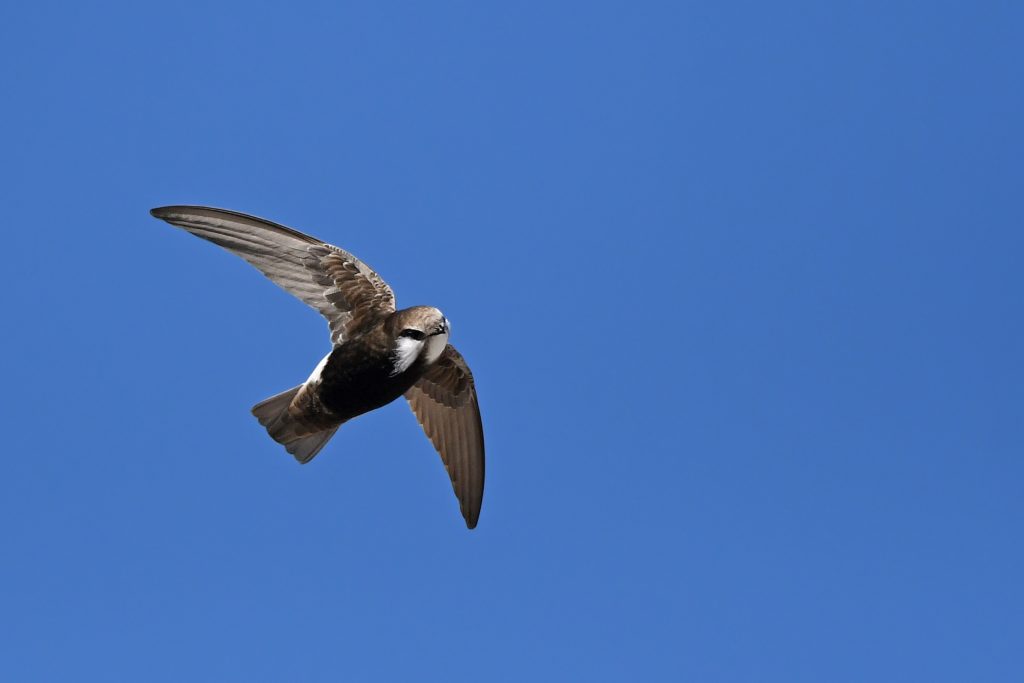
The Pallid Swift is a Mediterranean soul – warmer, slower to leave, and far more attached to the rocky coastlines and sun-baked cliffs of the southern European world than its darker cousin. These birds nest on cliffs, in caves, and increasingly on buildings in towns and cities. During the breeding season, they are common in Mediterranean countries.
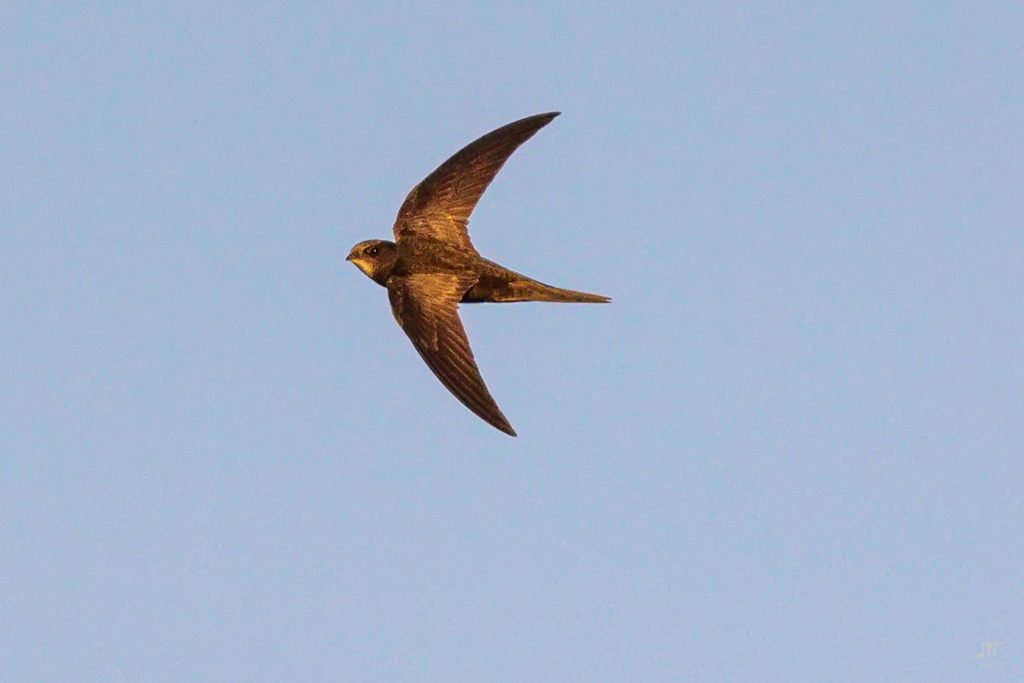
At first glance, the Pallid Swift and the Common Swift are almost impossible to tell apart. Even experienced birdwatchers hesitate. With a body length of 16–17 cm, the Pallid Swift can be a challenge to distinguish from the Common Swift. However, with keen observation, one can note its chunkier build and browner plumage. The white throat patch is a distinctive feature, often visible from afar, and the belly appears scalier.
The real difference is in their calendar. Unlike the Common Swift, the Pallid Swift does two broods per year. It arrives earlier in spring and lingers well into autumn – a true Mediterranean resident, unhurried, shaped by the same warm air and long evenings as the island itself. In Cyprus, it can often be found alongside Common Swifts during spring migration, and the two species may nest in the same building without the human occupants ever noticing either one.
The Alpine Swift – Tachymarptis melba Βουνοσταχτάρα
If the Common Swift is impressive, the Alpine Swift is breathtaking. It is roughly twice the size, with a wingspan reaching 57 cm – more like a small falcon than a swift, yet every bit as aerial.
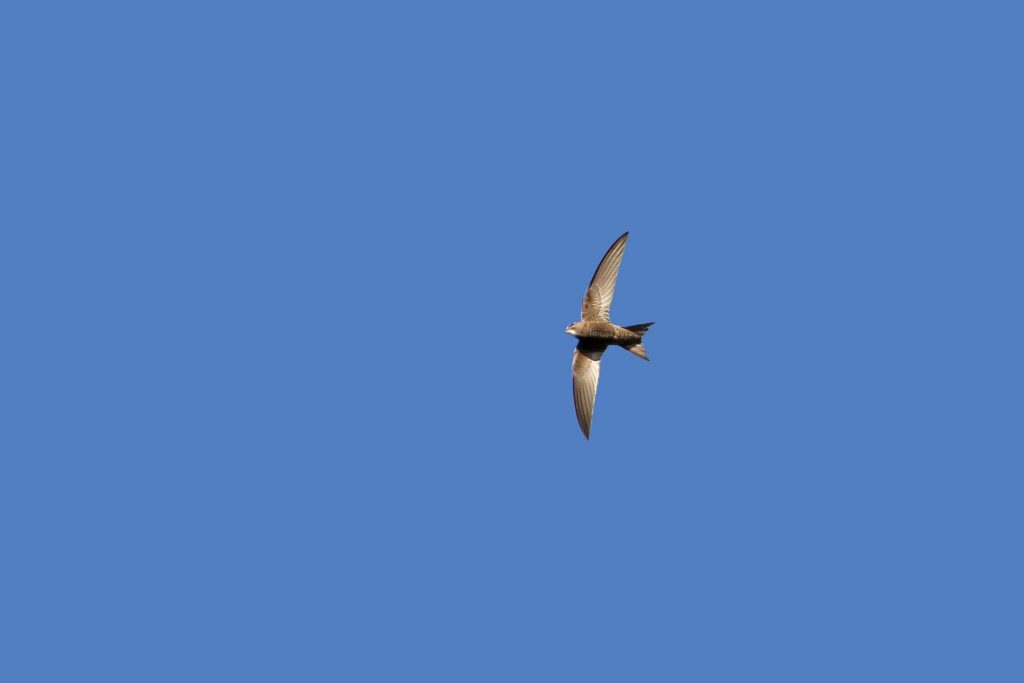
Alpine swifts are readily distinguished from the common swifts by their larger size and their white belly and throat. They are around twice as big as most other swifts in their range, about 20 to 23 cm in length. They’re largely dark brown in colour with a dark neck band that separates the white throat from the white belly. Seen overhead, a flock of Alpine Swifts looks like sheets of pale light wheeling against the sky – brown on top, strikingly white below.
Alpine swifts breed in mountains from southern Europe to the Himalaya. Like common swifts, they are strongly migratory, and winter much further south in southern Africa. They wander widely on migration and are regularly seen in much of southern Europe and Asia.
In Cyprus, the Alpine Swift is a passage migrant – a visitor passing through on its long journey between Africa and the mountains of Europe. It appears mainly in spring and autumn, sometimes in small flocks, sometimes as solitary individuals drifting over the Troodos peaks or the coastal cliffs of the Akamas. For a birdwatcher, encountering an Alpine Swift for the first time is a genuine moment. There is nothing else quite like it.
The Little Swift – Apus affinis Μικροσταχτάρα
The Little Swift is the surprise of the group – small, compact, and entirely charming. The little swift is a small species of swift found in Africa and southwestern Asia, and is a vagrant and local breeder in southern Europe. It is a bird of the warmer latitudes, more comfortable over the rooftops of the Middle East and sub-Saharan Africa than over the temperate skies of Europe.
Its wingspan of just 33 cm is a stark contrast to the 42 cm span of the Common Swift. What makes it distinctive is a striking broad white rump patch and a square tail – making it look quite different in silhouette from its relatives once you know what to look for. Its plumage is predominantly black, save for a striking white throat and a rump patch that extends onto the flanks. The bird’s tail is short and square.
In Cyprus, the Little Swift is a rare and exciting visitor – a species on the very edge of its European range, appearing occasionally as a passage migrant or vagrant. Every sighting is logged with interest. Its presence on the island speaks to Cyprus’s unique position as a bridge between the European and African-Asian worlds, sitting just 100 km from the Levantine coast where Little Swifts nest in colonies along cliff faces and ancient ruins.
Fun Facts Worth Sharing
- In a single year the Common Swift can cover at least 200,000 km, and in a lifetime, about two million kilometres.
- The nearest living relatives of all swifts are hummingbirds – a fact that surprises almost everyone.
- Swifts form pairs that may couple for years, and often return to the same nesting site and partner year after year.
- Young nesting swifts are able to survive for a few days without food by dropping their body temperature and metabolic rate, entering a torpid state.
- The Pallid Swift can raise two families per breeding season – something the Common Swift, in its rush to leave for Africa, never has time to do.
- Despite looking nearly identical, Common and Pallid Swifts have different calls – the Pallid Swift’s scream is slightly deeper and sometimes ends with a faint hiccup-like drop in pitch.
- Alpine Swifts have adapted well to urban conditions, frequently nesting in old buildings in towns around the Mediterranean. Some colonies have used the same building for decades.
A Nest Made of Air and Saliva
Swifts build their nests of air-borne material caught in flight, bonded with their saliva, in suitable building hollows – such as under tiles, in gaps beneath window sills, and most typically under eaves and within gables. The Alpine Swift, being larger, tends to prefer cliff ledges and the high facades of ancient stone buildings and fortresses – places not unlike the mountain walls of its original habitat.
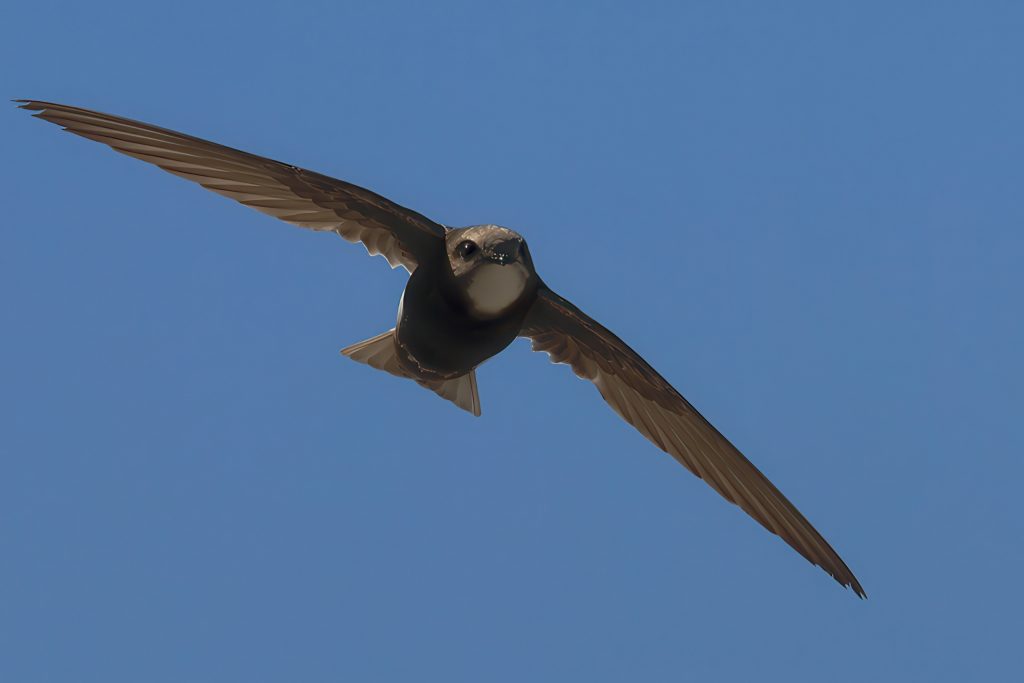
All four species share one defining trait: they are invisible in a modern building. New construction, sealed facades, and renovated roofs leave no gaps for a swift to squeeze through. In Cyprus, as in much of the Mediterranean, the old buildings that swifts depend on are disappearing one by one.
Why Today Matters – A Family Under Pressure
Despite their ancient presence, swifts are quietly declining across Europe. The greatest threats are the loss of nesting cavities through building renovation and the collapse of flying insect populations due to pesticide use. For Cyprus specifically, the current estimated population of Common Swifts is 15,000 to 60,000 pairs – but this is already a decreased number, with a population estimated to have declined between 25 and 75% since 2006.
In response, BirdLife Cyprus started a Swift Project, placing nest boxes on buildings of the Municipality of Aradippou and at elementary schools, and later expanding with new nests installed at Cyta buildings in Nicosia, Larnaka, and Limassol. Something as simple as a small wooden box with a hole can bring an entire colony back to a village that has gone quiet for years.
The Pallid Swift, the Alpine Swift, and the Little Swift face their own challenges too – habitat loss along migration routes, declining insect abundance, and the continued degradation of the coastal cliffs and ancient ruins that have served as their nesting sites for thousands of years.
Where and When to Experience All Four
You don’t need binoculars or a forest trail. You need a warm evening and an old town.
The Common Swift and Pallid Swift are best seen from late February through September, screaming in mixed flocks over Nicosia’s walled city, the harbours of Larnaka and Limassol, and the stone villages of the Troodos foothills. Watch at dusk when the “screaming parties” reach their peak.
The Alpine Swift passes through in spring (March–May) and again in autumn, sometimes lingering for days near coastal cliffs or mountain areas. Look for its larger size, slower wingbeats, and that unmistakeable white belly.
The Little Swift is a rarity – but Cyprus birdwatchers scan their swift flocks carefully, because a sighting is always possible. Look for the squared tail and the bold white rump against the dark body.
All four species have been recorded on iNaturalist Cyprus. If you see a swift, photograph it and upload your observation – every record matters.
A Screaming Silence We Should Not Allow
The swifts of Cyprus are not rare curiosities. They are pieces of the island’s summer soundtrack – as much a part of the season as the cicada, the church bell, and the smell of dry earth. But the everyday can disappear quietly, and when it does, the loss is only felt in full once the sky has gone silent.
To stand in a Cypriot village at dusk and hear the swifts scream overhead is to feel connected to something ancient – to the Greeks who watched them and named them “footless,” to the farmers who read their arrival as a sign of rain, to every summer the island has ever known. Four species, four chapters of one story – and Cyprus has all of them.
For more on swift conservation in Cyprus, visit BirdLife Cyprus https://birdlifecyprus.org and their Swift Project. Swift populations can be supported by installing nest boxes on old and new buildings – contact BirdLife Cyprus for guidance.