The Church of Archangel Michael in Pedoulas contains one of Cyprus’s most complete late-medieval fresco cycles. Painted in 1474 and signed by the artist Minas, the interior preserves an extraordinary collection of wall paintings that provide insight into the artistic traditions, social realities, and cultural identity of mountain communities during the late Byzantine period.
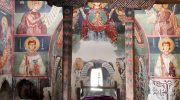
Within a modest timber-roofed church, the frescoes combine religious imagery with details drawn from contemporary life. Elements such as Western-style armour appearing in key scenes reveal the political and cultural influences that shaped Cyprus during the fifteenth century.
This article explores how the church was adapted to the Troodos climate, how its fresco program was designed to be viewed and understood, and why its artwork remains an important record of local identity, patronage, and historical continuity.
A Church Built for Mountain Conditions
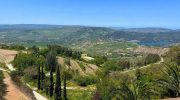
Pedoulas lies in the Marathasa Valley at an elevation of approximately 1,100 meters. The region experiences cold winters, heavy snowfall, and long periods of isolation from the coastal areas. The church’s architecture reflects these environmental conditions.
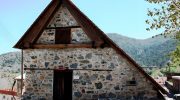
Its steep timber roof protects the stone structure from rain, snow, and moisture, while the compact interior helps preserve warmth and structural stability. Rather than emphasizing size or grandeur, the building was designed to serve the practical needs of a mountain community.
The contrast between the plain exterior and richly decorated interior is particularly striking. Throughout the Troodos region, artistic investment often focused on interior spaces. Wall paintings served as visual records of religious traditions, historical narratives, and cultural values for communities where written texts were not widely accessible.
An Artist Known by Name
The Pedoulas frescoes are especially significant because their creator is known. The artist Minas signed his work, an uncommon practice in a tradition where painters frequently remained anonymous.
Minas was likely active within the Marathasa region and demonstrated a strong command of Byzantine artistic conventions while incorporating selected influences from other artistic traditions.
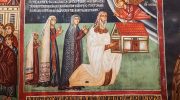
His figures are solid and carefully structured. Drapery emphasizes form and weight, while facial expressions remain restrained and direct. This approach prioritizes clarity and readability, ensuring that viewers could easily understand the scenes represented on the walls.
At the same time, Minas was not isolated from wider artistic developments. His work reveals familiarity with late Byzantine painting traditions and selected Western influences, particularly in scenes depicting authority, conflict, or military activity. These details suggest an artist responding to both local traditions and broader cultural changes occurring across the eastern Mediterranean.
A Visual Language Designed for Understanding
The interior follows a carefully organized arrangement. The upper sections contain major episodes drawn from religious literature and tradition, while lower areas feature important historical and religious figures associated with protection, teaching, and moral example.
This structure guides visitors through a visual narrative, moving from broader historical themes to figures more closely connected with everyday life and local devotion.
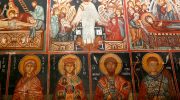
Scenes represented within the church include the Annunciation, Nativity, Baptism, Betrayal, Lamentation, Resurrection, and Dormition. Each composition is adapted to the limited space available inside the church.
Figures are positioned closely together, gestures remain controlled, and facial expressions are easily recognizable. The paintings were designed to communicate clearly within a small interior illuminated primarily by natural light and candles.
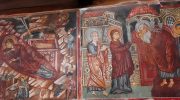
Several scenes reveal distinctive artistic choices. The Annunciation emphasizes written dialogue and communication. The Nativity contains unusually warm human expressions, while the Lamentation conveys emotion through posture and composition rather than dramatic movement. The result is an artistic program that encourages observation and reflection rather than visual spectacle.
History on the Walls
As viewers move through the narrative sequence, references to the contemporary world become increasingly visible.
In scenes such as the Betrayal, soldiers are depicted wearing Western-style armour and helmets associated with Latin and Crusader military traditions rather than Byzantine military dress.
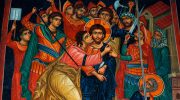
These details are historically significant. During the fifteenth century, Cyprus was governed by Latin rulers, and Orthodox communities operated within a political system dominated by foreign elites.
By presenting historical and religious narratives through the visual language of the contemporary world, the frescoes connect past events with the experiences of local communities. Rather than depicting distant history in isolation, the paintings incorporate elements familiar to those who viewed them.
This approach demonstrates how artists adapted traditional subjects to reflect the realities of their own time while maintaining established artistic conventions.
The Prominence of Archangel Michael
Near the north entrance, the figure of Archangel Michael occupies a prominent position within the church.
Larger than many surrounding figures, he is depicted standing firmly and confidently. His posture communicates vigilance and authority, while his direct gaze establishes an immediate connection with visitors entering the building.
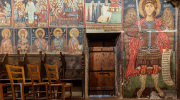
For a mountain community facing isolation, harsh winters, and political uncertainty, such imagery likely carried particular significance. Michael appears not as a distant symbolic figure but as a visible representation of protection, order, and security.
His image serves as an important visual anchor within the church and reflects the themes of endurance and continuity that characterize much of the building’s artistic program.
Patronage and Community Identity
The fresco cycle was commissioned by a local priest named Vasilios Chamados. A donor portrait depicts him and members of his family presenting a model of the church to Archangel Michael.
This image provides valuable evidence about village society during the late medieval period.
The figures are portrayed with confidence and dignity, emphasizing their role within the community. The donor portrait was not merely a personal commemoration but also a statement about responsibility, leadership, and the preservation of local institutions.
Such commissions demonstrate that communities in the Troodos Mountains actively invested in artistic and cultural projects despite their geographic isolation.
The frescoes represent a commitment to continuity, memory, and communal identity rather than displays of wealth alone.
A Living Historic Monument
Unlike many historic monuments that function exclusively as museums, the Church of Archangel Michael remains connected to village life while also benefiting from conservation efforts and UNESCO recognition.
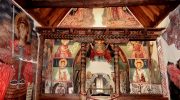
Some areas of the frescoes have suffered damage from moisture over the centuries, leaving sections incomplete. However, these losses also reveal the long history of the building and the ongoing challenges involved in preserving historic artworks.
The surviving paintings reward careful observation, revealing details that are often overlooked during brief visits.
The church was created as a space intended to be experienced repeatedly over generations rather than viewed quickly as a tourist attraction.
Visiting Pedoulas
The village of Pedoulas retains much of its traditional mountain character. Surrounded by orchards and forests, it offers visitors a setting that complements the atmosphere of the church itself.
The Church of Archangel Michael is open during designated visiting hours and follows guidelines intended to protect both the building and its artwork.
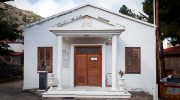
Nearby, the Byzantine Museum provides additional context and displays works associated with Minas and other regional artists. Together, the church and museum offer valuable insight into the artistic traditions of medieval Cyprus.
Why the Frescoes Matter
The frescoes of Pedoulas remain important because they combine art, history, and local identity within a single space.
They reveal how a mountain community used visual culture to preserve traditions, record contemporary realities, and express continuity during a period of political and cultural change.
The paintings do not attempt to separate themselves from history. Instead, they incorporate the influences, challenges, and experiences of the world in which they were created.
Today, the Church of Archangel Michael stands not only as an artistic achievement but also as a remarkable historical document. Its walls preserve evidence of how fifteenth-century Cypriots understood their society, their traditions, and their place within a changing world.