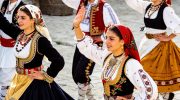
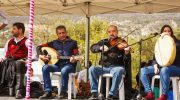
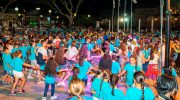
Cyprus folk dances represent living traditions that connect modern Cypriots to Byzantine heritage through choreographed movements, traditional costumes, and communal participation. These dances appear at weddings, religious festivals, harvest celebrations, and family gatherings, serving social functions beyond entertainment by reinforcing community bonds, facilitating courtship under supervision, and displaying cultural identity.
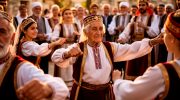
The basic repertoire includes syrtos and kartzilaumas, performed as paired confrontational dances or circle formations, alongside specialty performances like tatsia where dancers balance wine-filled glasses on sieves, and drepani, the sickle dance demonstrating agricultural skills.
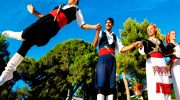
Men and women traditionally danced separately, with social conventions restricting female dancing primarily to weddings while men performed at coffee shops, threshing floors, and festivals. The movements emphasize improvisation within communal constraints, with dancers competing to display skill while adhering to strict local standards that discourage excess or showiness that would violate collective norms.
The Kartzilaumas Confrontational Tradition
Kartzilaumas, the fundamental Cypriot dance from approximately 1910 through the 1970s, consists of six parts performed by confronted pairs of dancers, either two men or two women. The name derives from the Turkish word karşılama meaning greeting, reflecting the face-to-face positioning where dancers mirror and respond to each other’s movements. The suite progresses through first, second, third, fourth, fifth or balos stages, with each part featuring slight variations in steps, tempo, and intensity. Between the third and fourth stages, performers traditionally recite tsiattista verses, the improvisational poetry unique to Cyprus.
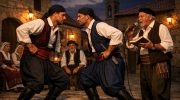
The dance emphasizes individual skill within paired format, creating inherent competition as dancers demonstrate agility, creativity, and mastery. Improvisation characterizes Cypriot performance, with experienced dancers adding personal flourishes while maintaining recognizable core patterns. Community standards strictly regulate acceptable improvisation, with excessive showiness earning disapproval rather than admiration. Inward-looking villages impose more rigorous restraints, demonstrating how social cohesion requires balancing individual expression against collective conformity.
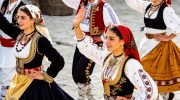
The arm positions in kartzilaumas distinguish Cyprus versions from similar Greek dances. Arms extend to the sides rather than connecting to other dancers, with specific gestures indicating regional variations. Some localities feature distinctive footwork including stamping in one spot with feet crossed alternately in front, particularly during the second and third stages. These local variations create identifiable dance dialects that announce performers’ village origins to knowledgeable observers.
The Syrtos Circle Dance
Syrtos represents Cyprus’s most popular group dance, performed by men and women together in circular or serpentine formations with participants holding hands or wrists. The name derives from the Greek word syro meaning to drag or lead, referencing the smooth gliding steps characteristic of the dance. Syrtos uses 4/4 time signature, distinguishing it from the related kalamatianos which employs 7/8 rhythm organized in slow three-beat, quick two-beat, quick two-beat patterns.
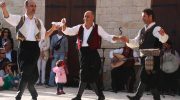
The circle formation symbolizes community unity and equality, with all participants occupying equivalent positions without hierarchy. The dancer at the right end serves as leader who may improvise showy moves while others maintain basic steps. The second dancer holds the leader with a twisted handkerchief linking their hands, providing support during turns and preventing falls during complex maneuvers. This partnership creates focal points within the collective formation.

Musicians play violin, laouto lute, and tambourine to accompany dancers, with melodies setting festive atmospheres at weddings, panigyria religious festivals, and social gatherings. The music structure dictates dance pace and progression, ensuring synchronized movement across large participant groups. Syrtos appears at celebrations year-round, functioning as the default dance that brings communities together through coordinated physical movement.
Specialty Dances Displaying Individual Skill
The tatsia dance challenges performers to balance wine-filled glasses centrifugally turned in circular sieves while executing complex footwork. Traditionally performed by men at social gatherings and weddings, the dance demonstrates both agility and wine-balancing skill that requires years of practice. Some accomplished dancers manage up to 20 tumblers simultaneously without spilling, earning admiration for technical mastery. The performance combines entertainment with displays of masculine prowess valued in traditional village culture.
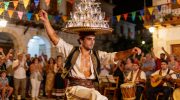
The drepani or sickle dance emerged from harvest traditions where the best reapers would play the sickle while working, cutting swathes in the air and making swift passes around their bodies without ceasing to mow. The dance translates agricultural skill into performance art, with dancers wielding sharp sickles through choreographed movements that demonstrate harvest prowess. The potherka harvest celebration when reapers finished the last fields included sickle games, threats made in jest against landowners, and harvest suppers. The sickle dance appeared at Kataklysmos Pentecost festivals until recently, particularly in the Karpasia region where elderly locals remembered the tradition.

The kouza dance features performers balancing clay pots on their heads while moving to traditional music. Precision and grace prove essential as dancers execute intricate steps without dropping vessels. The performance begins with slow deliberate movements that accelerate, showcasing skill development. The dance appears primarily at weddings and festive gatherings, reflecting resilience and celebration within Cypriot heritage.
Gender Separation and Social Functions
Social conventions from 1910 through the 1970s strictly restricted women’s dancing to weddings, while men performed at wedding festivities, festivals, coffee shops in evenings, threshing floors, and wherever men gathered. This gender segregation reflected broader Mediterranean patterns where public space belonged primarily to men while women’s activities concentrated in domestic and family contexts. Women danced in pairs performing kartzilaumas with restraint and gravity, many barely moving from single spots as they marked out personal space.
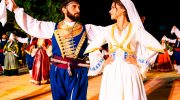
Women’s arm positions varied from both hands held against hips with free hands hanging down or gently flourishing at shoulder height. The restrained movements demonstrated humility and grace while displaying needle work abilities through delicate hand gestures. The contrast with men’s more vigorous performances reinforced cultural expectations about appropriate gendered behavior and physical expression.
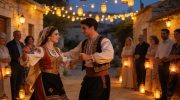
The dances facilitated courtship under community supervision, allowing young people to meet potential marriage partners in controlled settings. Performance skill signaled desirable qualities including physical coordination, cultural knowledge, and social status. Families observed young adults dancing to assess suitability for marriage alliances, with dance competency functioning as proxy for broader life capabilities valued in agricultural communities.
Contemporary Practice and Cultural Preservation
Modern Cyprus maintains folk dance traditions through dedicated groups that perform at Easter, weddings, christenings, and hotel theme nights organized for tourists. Amateur dancers take up folk dancing as hobbies, earning modest income through public performances while preserving cultural heritage. Dance schools teach traditional choreography to children, ensuring knowledge transmission to younger generations who might otherwise lose connection to ancestral practices.
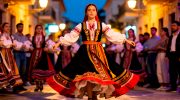
The annual Folk Dance International Festival in Trikomo, in the Turkish-occupied part of Cyprus, attracts groups from around the world, providing international exposure for Cypriot traditions while facilitating cultural exchange. Turkish Cypriot folk dance groups routinely represent Cyprus at international festivals, earning acclaim for performances that demonstrate the island’s complex cultural heritage blending Greek, Turkish, and indigenous elements.
Despite preservation efforts, traditional dance faces challenges from modernization, urban migration, and changing entertainment preferences. Young Cypriots increasingly favor contemporary music and dance styles over folk traditions their grandparents practiced regularly. The decline in agricultural work eliminates contexts like harvest celebrations where dances originally emerged organically from work rhythms. The transition from living tradition to conscious cultural performance marks fundamental shift in dance’s social function and meaning within contemporary Cypriot society.