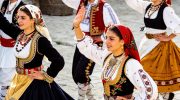
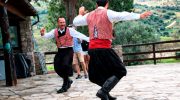
Traditional music in Cyprus is not preserved behind glass or confined to concert halls. It lives in village squares, wedding courtyards, seaside festivals, and family celebrations. Shaped by centuries of cultural crossings and daily communal life, Cypriot music functions less as performance and more as participation.

Its melodies carry memory, its rhythms organise social moments, and its lyrics preserve stories that were never written down. To understand Cypriot music is to understand how the island listens to itself. This article explores how Cypriot musical traditions developed, how they function socially, and why they continue to matter today, not as heritage displays, but as living practice.
An Island That Learned to Sing in Layers
Cyprus sits at the crossroads of the eastern Mediterranean, and its music reflects that position clearly. Over centuries, Byzantine, Anatolian, Levantine, Venetian, and Ottoman influences filtered into local sound, not as replacements, but as layers. Instead of erasing earlier forms, new elements were absorbed and adapted into an island-specific style.
The result is music that feels familiar yet difficult to categorise. It shares roots with Greek island traditions, echoes Turkish makam systems, and carries traces of medieval Western Europe. What binds these influences together is not theory, but use. Songs evolved through weddings, agricultural work, religious observance, and social gatherings, shaped by what people needed music to do.
Music as a Social Structure, Not a Performance
In Cyprus, music is rarely passive. Many traditional forms are designed to involve multiple voices, instruments, or participants. Call-and-response patterns are common, creating a musical dialogue rather than a single focal performer.
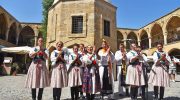
This structure encourages inclusion. A lead singer may guide the melody, but others respond, echo, or support through rhythm or drone. The audience is often part of the sound, clapping, answering, or stepping into the dance circle. Music becomes a shared responsibility, reinforcing social bonds and collective presence.
The Role of Storytelling in Song
Cypriot songs are narrative at their core. Lyrics focus on love, separation, daily labour, migration, honour, and community life. Abstract themes are rare. Instead, songs tell stories that listeners recognise from lived experience.
Some songs recount heroic or historical events, passed down orally across generations. Others are intimate, capturing moments of longing, courtship, or family connection. Because literacy was not always widespread, music became a primary vehicle for preserving memory. Melody helped stories survive where written records did not.
Improvisation, Wit, and Verbal Skill
One of the most distinctive Cypriot traditions is poetic duelling, where singers exchange improvised verses in real time. These exchanges reward wit, timing, and linguistic creativity. The goal is not confrontation, but recognition within the community.
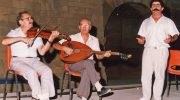
Performed during weddings, festivals, and large gatherings, these verbal exchanges transform language into social performance. The community listens closely, reacting to clever turns of phrase or sharp humour. In these moments, music becomes a test of intellect as much as voice, reinforcing the cultural value placed on expression, memory, and quick thinking.
Instruments That Match the Landscape
The sound of Cypriot music is shaped as much by environment as by tradition. Instruments evolved to suit open-air gatherings, long celebrations, and informal performance spaces where mobility mattered more than volume.
The violin now leads most traditional ensembles, valued for its ability to carry ornamented melodies across crowded spaces. It bends and stretches notes, mirroring the vocal style of the songs themselves. Alongside it, the laouto provides rhythmic stability, grounding the music with steady strumming that supports both dance and song.
Older instruments continue to carry symbolic weight. The pithkiavli, a simple reed flute associated with shepherd life, reflects a slower, seasonal rhythm tied to the land. Frame drums and goblet drums add structure without overpowering the melody, reinforcing the collective nature of performance rather than drawing attention to a single player.
Weddings as the Archive of Tradition
More than any formal institution, weddings preserve Cypriot musical tradition. These events unfold over hours or even days, with music marking each stage of the celebration. Specific songs accompany preparations, blessings, processions, and dances, guiding participants through shared ritual.
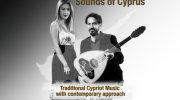
What makes weddings especially important is their continuity. Grandparents, parents, and children experience the same melodies in the same contexts, not as lessons, but as lived moments. Musical knowledge passes naturally through repetition, emotion, and memory rather than instruction. In this way, weddings function as living archives, carrying tradition forward without freezing it in time.
Dance as Collective Expression
Dance in Cyprus is inseparable from music, and its structure reflects the same balance between unity and individuality. Group dances emphasise coordination and shared movement, reinforcing social cohesion. At the same time, moments within the dance allow individuals to step forward, expressing personality through gesture and rhythm.
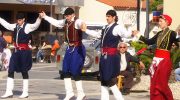
Technical perfection is secondary to participation. Entering the dance circle signals respect for the occasion and connection to the group. This openness keeps traditional dance alive, not as a performance to be watched, but as an activity to be shared.
Change Without Disappearance
Cypriot music continues to evolve, responding to modern influences without abandoning its foundations. Contemporary musicians experiment with new sounds, blending traditional melodies with modern genres and instruments. Diaspora communities adapt familiar songs to new settings, using music as a way to maintain a connection to home.
Crucially, these developments exist alongside older forms rather than replacing them. Traditional music remains present at festivals, family gatherings, and village events because it still serves a purpose. It brings people together, structures celebration, and anchors identity in shared experience.
Experiencing Cypriot Music Today
For visitors, the most meaningful encounters with Cypriot music happen outside formal venues. Village festivals, seasonal celebrations, and local weddings offer insight into how music functions within daily life.
In these settings, music is not staged for observation. It unfolds naturally, inviting participation rather than applause. Listening becomes involvement, and understanding comes through presence rather than explanation.
Why Cypriot Music Still Matters
Cypriot music endures because it continues to do what it has always done. It connects people to place, to memory, and to one another. It carries history without announcing itself as history.
On an island shaped by movement, division, and adaptation, music remains a quiet form of continuity. Each melody holds traces of the past while leaving room for new voices. In Cyprus, music is not something you attend. It is something you step into. And once inside, you become part of its living sound.