The Soli Episcopal Basilica preserves rare fragments of early Christian wall painting from a period when church imagery in Cyprus was still being invented rather than standardised. Painted above the site’s famous mosaics, the fresco remains show Roman decorative habits being adapted into a new visual language for worship, before later Byzantine rules became fixed. This article explains Soli’s rise as an ecclesiastical centre, what the surviving plaster fragments suggest about the original interior, and why the basilica’s destruction ended up preserving an important artistic transition.
Trade, Farmland, Copper, Harbour
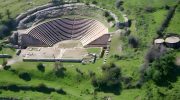
Ancient Soli, also known as Soloi, occupied a strategic position near fertile farmland, copper-rich foothills, and a natural harbour. This combination sustained the city for centuries, from its legendary foundation in the Archaic period through its Roman peak and into the Christian era.
By Late Antiquity, Soli was no longer just a trading hub. It had become an important ecclesiastical centre, serving the surrounding region as Christianity spread across Cyprus. The basilica that rose here in the 4th century was not a modest village church. It was one of the largest early Christian complexes on the island, reflecting both wealth and confidence during a period of profound cultural change.
A Basilica Built on Confidence
The Soli Episcopal Basilica went through multiple phases, mirroring the development of Christian worship itself.
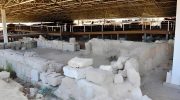
The earliest monumental church was a vast five-aisled basilica, an unusual and ambitious design for Cyprus. Its scale suggests that Soli’s Christian community was both well-established and closely connected to wider Mediterranean networks. Later, in the 6th century, the building was remodelled into a three-aisled structure, in line with architectural trends spreading across the Byzantine world during the reign of Emperor Justinian.
These transformations were not just structural. They changed how the space was experienced, decorated, and understood by its congregation.
What survives, and what was lost
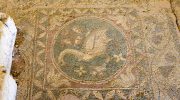
Today, Soli is famous for its mosaics, especially the swan motif that has become one of Cyprus’s most recognisable early Christian images. The wall paintings, by contrast, survive only in fragments.
They were originally painted on plastered walls above the mosaics, forming a visual world that surrounded worshippers at eye level and above. When Arab raids struck Cyprus in the mid-7th century, Soli was burned and abandoned. Roofs collapsed, walls fell, and the painted surfaces shattered. Over time, wind, rain, earthquakes, and stone reuse erased almost everything vertical.
What remains are pieces of painted plaster recovered from the debris during 20th-century excavations. These fragments may be incomplete, but they are deeply informative.
Painting a new faith with old tools
The surviving wall paintings from Soli belong to a transitional moment in the history of Christian art, when visual language was still being negotiated rather than prescribed. Their style reflects deep roots in Roman decorative practice, yet their intention is firmly Christian.
Painted bands imitating marble panels, architectural borders, and geometric framing elements echo interior schemes common in Roman villas and public buildings. These familiar designs gave early Christian spaces a sense of authority and continuity, allowing worshippers to recognise the church as a place of dignity and order, even as its religious meaning was new.
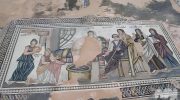
Alongside these decorative elements are fragmentary traces of human presence. Portions of draped garments, raised hands, and simplified facial outlines suggest figures engaged in prayer or devotion. While no complete scene survives, scholars believe these images may have included early representations of saints, donors, or scenes connected to St. Auxibios, the first bishop of Soli and a figure of local importance.
The emphasis was not on a realistic portrayal. Figures were frontal, restrained, and symbolic, designed to communicate spiritual meaning rather than physical individuality.
Before Iconography Had Rules
What makes the Soli frescoes especially significant is the moment in which they were created. At the time, Christian art had not yet settled into the formalised systems that would later define Byzantine iconography.
There were no fixed manuals dictating how holiness should appear or how sacred narratives should be arranged. Artists worked with inherited classical techniques while adapting them to new theological ideas. At Soli, this resulted in imagery that feels both familiar and searching, grounded in tradition yet open to reinterpretation.
This period of experimentation reveals Christianity as a living, adaptive culture rather than a completed visual system. The frescoes reflect a community actively shaping how faith would be seen, understood, and remembered.
Walls and Floors, One Program
Within the basilica, wall paintings and mosaics were not separate decorative programs but parts of a unified visual experience.
The mosaics underfoot offered stability and endurance, filled with symbols of paradise, renewal, and divine order. Above them, the painted walls introduced gesture, movement, and human presence, creating a layered environment that engaged worshippers from every direction.
Together, these elements transformed the basilica into a fully immersive space. Worship did not take place in an empty hall, but within a carefully composed setting where theology, art, and architecture worked in concert. This approach would later evolve into the elaborate painted cycles of Cyprus’s mountain churches, but Soli preserves an earlier and more flexible stage of that artistic conversation.
Excavations and Modern Reconstruction
The violent end of Soli paradoxically ensured the survival of its artistic evidence.
After the Arab raids, the city was abandoned rather than rebuilt. Walls collapsed inward, burying painted plaster beneath rubble and soil. Because the site was not continuously occupied, these fragments remained undisturbed for centuries.
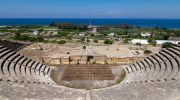
Modern archaeological work, beginning in the 20th century with the Swedish Cyprus Expedition and continued by later research teams, brought these remnants back to light. Through careful study, scholars have been able to reconstruct not only decorative schemes but also the mindset of an early Christian community shaping its visual identity during a time of uncertainty.
Visiting Soli today
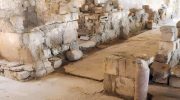
Today, Soli is an open-air archaeological site protected by a modern shelter over the basilica. Visitors can walk along raised paths that reveal the famous mosaics and trace the outlines of the church’s former walls.
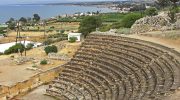
Although the wall paintings themselves no longer survive in place, knowing they once covered the interior changes how the site is experienced. What appears now as a skeletal ruin was once richly colored, visually dense, and carefully staged to guide worshippers through space and meaning.
Soli frescoes to the present days.
The frescoes of the Soli Basilica matter not because they are complete, but because they are truthful.
They preserve a moment before Christian art became rigidly defined, when belief was expressed through adaptation rather than prescription. They reveal how a community balanced inherited artistic language with emerging faith, and how local identity shaped religious expression in Cyprus.
In this way, the Soli frescoes are more than decorative remnants. They are evidence of a culture learning how to see itself anew, negotiating continuity and change through paint, plaster, and shared belief.