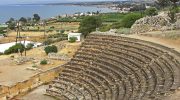
In 45 or 46 AD, two travelers arrived on the eastern coast of Cyprus at the port city of Salamis. Their names were Paul and Barnabas, accompanied by a younger assistant named John Mark. Historians and biblical scholars associate this journey with the early expansion of Christianity beyond Palestine, and Cyprus became one of the first regions where these teachings reached wider Mediterranean communities. The island later developed into an important center of early Christian administration and Byzantine religious culture.
Barnabas was originally from Cyprus, born in Salamis to a Jewish family traditionally associated with the tribe of Levi. Historical religious texts identify his original name as Joseph, while the name Barnabas was later adopted within the early Christian community in Jerusalem. Sources describe him as an influential figure among the earliest followers of the movement.
His companion Paul, known earlier as Saul in historical records, had previously opposed early Christian groups before later becoming one of the movement’s most active organizers and teachers. Together, they departed from Antioch in Syria on a journey that later became widely documented in religious and historical traditions connected to the eastern Mediterranean.
Historical Background
According to historical accounts preserved in the Book of Acts, Paul and Barnabas arrived at Salamis and visited local synagogues, where Jewish communities traditionally gathered for teaching and discussion. This practice of beginning in established urban religious centers became a common feature of their travels.
From Salamis, the group traveled approximately 90 miles westward across the southern coast of Cyprus toward Paphos, which served as the Roman administrative capital of the island during the first century AD.
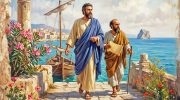
Researchers suggest two possible routes for this journey. One route crossed the northern region through Chytri and the Kyrenia mountain range, while another likely followed the southern Roman road network through Citium (modern-day Larnaca), Amathous, and Kourion.
Historical evidence indicates that these coastal cities functioned as major commercial and administrative centers during Roman rule. Travel across Cyprus in the first century would have involved long journeys on foot through difficult terrain and intense Mediterranean heat.
Later Christian traditions connected the travelers with several local historical figures and locations around Larnaca. While many of these accounts cannot be independently verified, they became an important part of Cyprus’s religious heritage and contributed to the island’s role in early Christian history.
Confrontation at Paphos
The most significant event of their Cyprus mission occurred at Paphos. The city served as the seat of Roman government for the entire island, where the proconsul Sergius Paulus maintained his administration. Paphos was also famous for its impressive Temple of Aphrodite, the Greek goddess of love, making it a center of pagan worship. Paul and Barnabas sought an audience with Sergius Paulus, described in the biblical text as an intelligent man who wanted to hear the word of God.
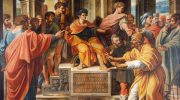
However, they faced opposition from a Jewish sorcerer and false prophet named Elymas, also called Bar-Jesus. Elymas served as a close advisor to Sergius Paulus and feared losing his influence over the proconsul if Paul and Barnabas succeeded in their mission. He actively worked to prevent the meeting and turn Sergius Paulus away from the Christian message.
The confrontation came to a head when Paul, filled with the Holy Spirit, directly challenged Elymas. Paul declared that Elymas would be struck blind as a divine sign, and the sorcerer immediately lost his sight.
This dramatic demonstration of power had a profound effect on Sergius Paulus. According to Acts 13:12, the proconsul believed after witnessing what happened and hearing the teaching about the Lord. This conversion holds immense historical significance. Sergius Paulus became the first recorded Roman official to accept Christianity, making Cyprus the first territory in the world to have a Christian ruler.
Archaeological evidence supports the biblical account:
- An inscription discovered in 1887 at Soli, Cyprus, mentions a proconsul Paulus from the middle of the first century.
- Another inscription found in Rome in 1887 records the appointment in 47 AD of curators for the Tiber River, one of whom was named Sergius, likely the same man after completing his three-year term in Cyprus.
Local Traditions About Paul
Strong local tradition in Paphos holds that Paul suffered punishment before meeting with Sergius Paulus. According to these traditions, Elymas ordered Paul to be tied to a pillar and given 39 lashes. This punishment, known as “forty lashes minus one,” was a standard Jewish penalty for intentional sin. The whip used had 13 separate lashes attached to one handle, so three strikes delivered 39 lashes total. Paul himself mentions in 2 Corinthians 11:24 that he received this punishment five times from Jewish authorities, lending some credibility to the Paphos tradition.
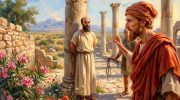
The pillar where this supposedly occurred still stands today at the archaeological site of Panagia Chrysopolitissa Basilica in Paphos. Visitors from around the world come to see this ancient column, known as Saint Paul’s Pillar. However, neither the Book of Acts nor Paul’s letters specifically mention being mistreated in Cyprus, and medieval pilgrims who visited the site recorded seeing an underground prison instead of a pillar. The tradition of the pillar appears to have developed later, possibly in the Byzantine period when the Chrysopolitissa Basilica was built. Whether historically accurate or not, the tradition reflects the deep connection between Cyprus and early Christian history.
Notable Facts About the Mission
The Cyprus journey holds an important place in the historical development of early Christianity. Historians often describe it as one of the earliest organized efforts to introduce Christian teachings beyond the Jewish communities of Palestine and Syria into the wider Roman world.
The visit also reflected the movement’s gradual expansion into multicultural urban centers populated by Greeks, Romans, Jews, and local Cypriot communities. This environment helped shape how Christianity adapted across different languages and social groups throughout the Mediterranean region.
Another notable detail appears in the biblical narrative during the Cyprus account. Earlier passages refer to the travelers as “Barnabas and Saul,” while later sections increasingly use the Roman name Paul and place his name first in the narrative order. Scholars often interpret this change as reflecting Paul’s growing leadership role within the group.
John Mark, the younger assistant who accompanied them, was related to Barnabas according to later historical tradition. After the Cyprus stage of the journey, Mark left the group and returned to Jerusalem. This decision later contributed to a disagreement between Paul and Barnabas regarding future travel plans.
Historical texts describe how Barnabas later traveled again to Cyprus with Mark, while Paul continued his journeys through Syria and Asia Minor with Silas. Despite this separation, later writings associated with Paul continue to mention Barnabas respectfully, suggesting that their professional relationship may eventually have improved.
What Happened to Barnabas
After separating from Paul, Barnabas devoted himself to building up the church in Cyprus. Christian tradition identifies him as the first Bishop of Salamis and the founder of the Cypriot Orthodox Church. He worked tirelessly in his homeland, preaching and establishing communities of believers.
According to church tradition, his death came around 61 AD in Salamis, though historical records cannot verify this date or the circumstances.
The traditional account describes his martyrdom in vivid detail:
- While preaching at a synagogue in Salamis, Jewish opponents became enraged at his success in converting people.
- They dragged him from the synagogue with a rope around his neck, stoned him, and burned his body.
- John Mark, who had returned to work with his cousin, secretly recovered Barnabas’s remains and buried them in a hidden location.
- The tomb remained undiscovered for over 400 years until around 480 AD, when Bishop Anthemios of Cyprus claimed to have a dream revealing its location beneath a carob tree. When opened, the tomb reportedly contained Barnabas’s body holding an illuminated copy of the Gospel of Matthew.
Visiting the Historical Sites Today
Modern visitors to Cyprus can still explore many sites associated with Paul and Barnabas through archaeology, Byzantine architecture, and local historical traditions.
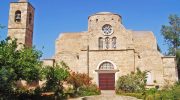
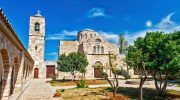
In the Turkish Cypriot-administered northern part of the island, the Tomb of Saint Barnabas near ancient Salamis remains one of the best-known historical attractions. The complex includes a monastery church, an icon museum featuring Byzantine religious artwork, and an archaeological museum displaying ceramics and artifacts from ancient Salamis and nearby Enkomi.
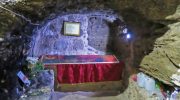
The tomb site itself lies a short distance from the monastery and continues to attract tourists, historians, and visitors interested in Cyprus’s late Roman and Byzantine heritage.
In Paphos, the archaeological site of Panagia Chrysopolitissa contains the column traditionally associated with Paul alongside extensive remains of an early Byzantine basilica. Visitors can see mosaic floors, stone foundations, Corinthian columns, and architectural remains dating from different historical periods.
Nearby stands Agia Kyriaki Church, a structure connected with both medieval and modern religious history in Cyprus. The wider Paphos archaeological zone is recognized as a UNESCO World Heritage Site because of its exceptional historical, architectural, and cultural importance.
Why This Mission Still Matters
The journey of Paul and Barnabas through Cyprus remains historically significant because it illustrates how rapidly early Christianity expanded throughout the eastern Mediterranean during the first century AD. Within a relatively short period, the movement spread from local communities in Palestine into major Roman trade centers and administrative cities.
The association with Sergius Paulus also reflects how new religious and philosophical ideas circulated among educated Roman officials during this era. Cyprus, positioned between the Middle East, Anatolia, Greece, and Egypt, served as an important cultural crossroads where different traditions interacted.
The island’s mixed population and strategic location made it a valuable link between eastern and western Mediterranean societies. As a result, Cyprus later developed into an influential center of Byzantine Christianity, religious art, manuscript production, and ecclesiastical administration.
The story of Paul and Barnabas also presents a broader historical picture of cooperation, disagreement, travel, and cultural exchange within the ancient Roman world. Their journeys became part of a larger historical narrative that shaped religious history, regional traditions, and the cultural heritage of Cyprus for centuries afterward.