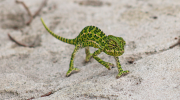
Hidden among the reeds, olive groves, and coastal bushes of Cyprus lives one of the island’s most unusual animals: the Mediterranean chameleon (Chamaeleo chamaeleon). Unlike the island’s snakes and lizards, this remarkable reptile moves slowly, watches the world with independently moving eyes, and can change its colour in response to its surroundings and mood.
Many visitors spend years exploring Cyprus without ever seeing one. Yet this ancient reptile has been part of the island’s natural heritage for thousands of years.
Meet the Mediterranean Chameleon
The Mediterranean chameleon belongs to an ancient family of reptiles that evolved long before humans appeared. While most people associate chameleons with Africa or Madagascar, Cyprus is home to one of the few chameleon species naturally found in Europe.
The Mediterranean chameleon is the only chameleon species living on the island. It spends most of its life among bushes, shrubs, reeds, and low trees, where its camouflage makes it almost invisible.
Unlike fast-moving lizards, chameleons rely on patience rather than speed. They move carefully, swaying gently as if they were leaves blowing in the wind, making it difficult for predators to notice them.
An Ancient Traveller of the Mediterranean
The ancestors of modern chameleons evolved millions of years ago in Africa. Over time, some species spread around the Mediterranean Basin, reaching parts of southern Europe, North Africa, and the Middle East.
Cyprus represents one of the easternmost European strongholds of the Mediterranean chameleon. Historical records suggest that the species has been present on the island for a very long time, although scientists still debate exactly when it first arrived.
For centuries, people across the Mediterranean viewed chameleons with fascination and superstition. Their strange eyes, slow movements, and changing colours made them seem mysterious and almost magical.
In Cyprus, the species survived while disappearing from some other regions, making the island an important refuge for this remarkable reptile.
Nature’s Master of Disguise
At first glance, the Mediterranean chameleon appears rather simple: a medium-sized reptile usually measuring 20–30 centimetres in total length, including its tail.
A closer look reveals an astonishing collection of adaptations.
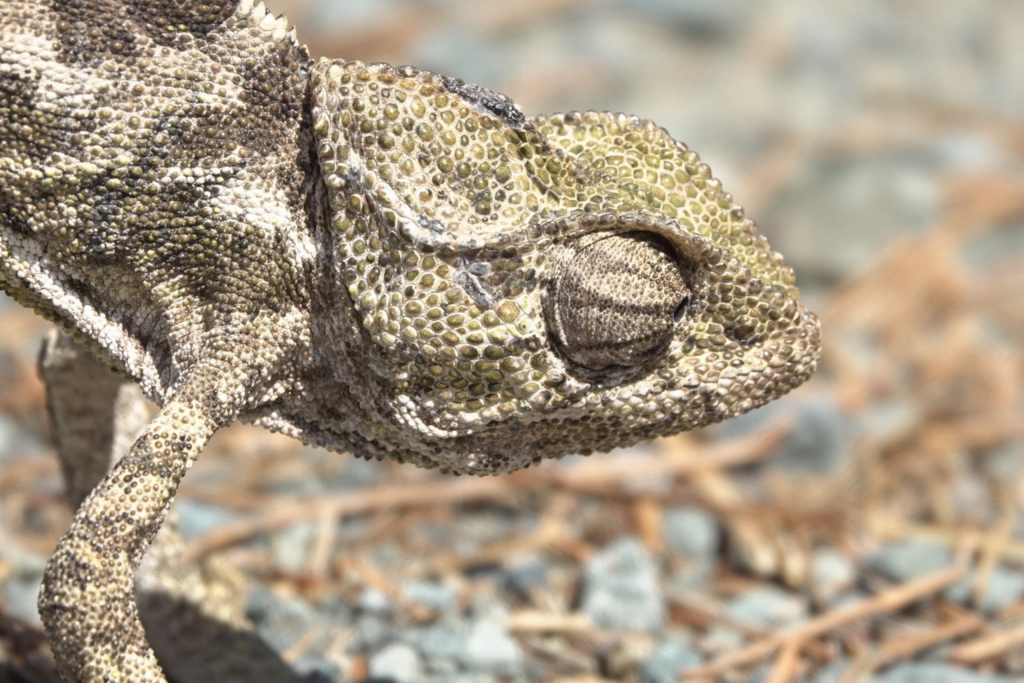
Its eyes can move independently, allowing it to watch two different directions at the same time. When prey is spotted, both eyes focus on the target with remarkable precision.
Its feet are specially adapted for gripping branches, almost like living pincers. The tail acts as an extra limb, wrapping around twigs and stems for support.
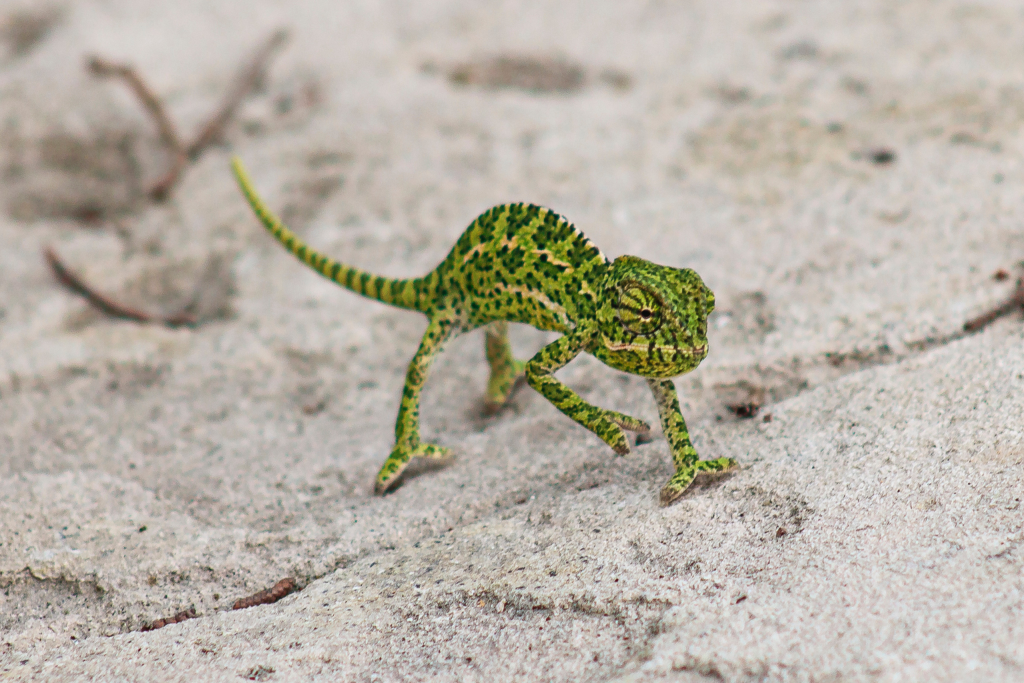
The most famous feature is its colour-changing ability. Contrary to popular belief, chameleons do not change colour simply to match every background. Their colours also reflect temperature, stress levels, health, and social interactions. A relaxed animal may appear green, while an excited or disturbed individual may display darker shades, yellows, or brown patterns.
Perhaps most impressive of all is the tongue. It can shoot out at extraordinary speed, often reaching prey in a fraction of a second before retracting with an unlucky insect attached.
Curious Facts About Cyprus Chameleons
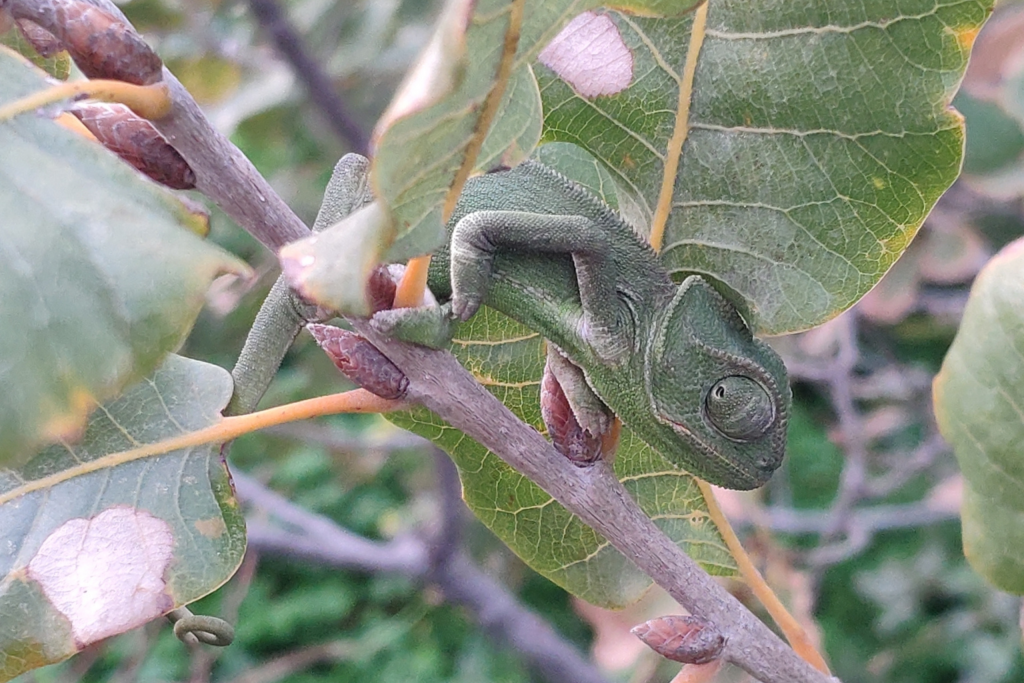
- Eyes Like Independent Cameras – Each eye can rotate almost 180 degrees, allowing a chameleon to scan nearly its entire surroundings without moving its head.
- Lightning-Fast Tongue – A chameleon’s tongue can extend farther than its own body length and strike in less than a second.
- Slow but Successful – Despite moving slowly, chameleons are highly effective hunters because insects often fail to detect them.
- Babies Start Small – Young chameleons hatch from eggs and are tiny replicas of the adults, already equipped with climbing skills.
- Not Always Green – Mediterranean chameleons can display shades of green, yellow, brown, grey, and even almost black depending on conditions.
Life Among the Reeds
In Cyprus, Mediterranean chameleons are particularly associated with coastal habitats, reed beds, river valleys, agricultural margins, and areas of dense shrub vegetation.
Their diet consists mainly of insects, including grasshoppers, crickets, flies, moths, beetles, and other small invertebrates. By consuming large numbers of insects, they play a useful role in maintaining ecological balance.
During the breeding season, males become more territorial and may display brighter colours when encountering rivals or females. After mating, females lay eggs in carefully dug nests in the soil. The eggs remain underground for many months before hatching.
Unlike many reptiles, chameleons are excellent climbers but rarely spend much time on open ground except when moving between habitats or when females are searching for nesting sites.
Why the Chameleon Still Matters Today
The Mediterranean chameleon remains one of Cyprus’s most charismatic reptiles. It is also a valuable indicator of healthy natural habitats.
Unfortunately, modern development has reduced some of the dense vegetation and wetland habitats that chameleons depend upon. Road mortality can also be a problem, particularly during the breeding season when animals move more frequently.
Today, conservationists monitor chameleon populations and work to protect important habitats. The species is protected by law, and many nature enthusiasts consider seeing a wild chameleon one of the highlights of exploring Cyprus.
For a country famous for its beaches and archaeological sites, the chameleon reminds us that Cyprus also possesses a rich and unique natural heritage.
Where Can You See One?
Seeing a Mediterranean chameleon in the wild requires patience and a bit of luck.
The best opportunities are usually found in coastal wetlands, reed beds, and shrub-rich habitats, particularly in eastern and southeastern Cyprus. Areas around the wetlands of the Famagusta region and several coastal nature reserves have historically supported important populations.
The experience can be surprisingly rewarding. A branch that looked completely ordinary suddenly blinks, moves a foot, and reveals itself to be a perfectly camouflaged chameleon.
Because the species is protected, observers should never handle or disturb wild individuals. Watching from a distance is the best way to appreciate their remarkable behaviour.
A Living Piece of Mediterranean History
The Mediterranean chameleon is far more than a colour-changing curiosity. It is a survivor from an ancient reptilian lineage, a skilled hunter, and one of the most distinctive animals living in Cyprus today.
Whether hidden among reeds beside a wetland or resting motionless in an olive grove, this extraordinary reptile reminds us that some of the island’s greatest treasures are not found in museums or monuments, but quietly living among the leaves and branches of the Cypriot countryside.