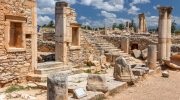
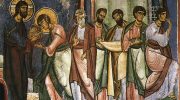
Near the modern village of Dali, 21 kilometers from Nicosia, the ruins of Idalion spread across two hills overlooking the fertile Yialias River valley. This was one of Cyprus’s ten powerful city-kingdoms. It grew wealthy from copper mining and was listed first among Cypriot kingdoms in ancient Assyrian records.
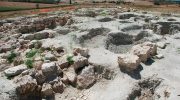
Idalion thrived from the Late Bronze Age, around 1200 BC, until it was absorbed by the Phoenician kingdom of Kition in the mid-5th century BC. The city continued through the Hellenistic and Roman periods, though it lost much of its former importance.
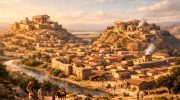
The city had two acropolises and a lower town. The western acropolis, called Ambelleri, had a fortified palace and the Temple of Athena. The eastern acropolis, Moutti tou Arvili, was the sacred center, with temples dedicated to Aphrodite, Apollo, and other gods. The lower town lay between the hills and was fortified during the 5th century BC.
According to legend, Adonis, the lover of Aphrodite, was killed here by the jealous god Ares, giving the area special significance in Greek mythology.
Historical Background
Idalion’s prosperity came from its strategic location, just 10 kilometers from the copper-rich foothills of the Troodos Mountains. The city stood on the south bank of the Yialias River, providing a natural route to the eastern coast ports. This position allowed Idalion to control both the extraction of copper and its distribution to Mediterranean markets.
According to tradition, the city was founded by Chalcanor, an Achaean hero from the Trojan War and a descendant of Teucer, founder of Salamis. Archaeological evidence shows that the western acropolis became a fortified stronghold toward the end of the Late Bronze Age, with a cult place that established a religious continuity lasting centuries.
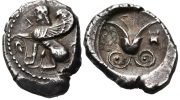
Idalion’s wealth drew attention from major powers. When the Assyrian Empire expanded into the eastern Mediterranean in the 8th and 7th centuries BC, the city appeared on tribute lists. Around 535 BC, Idalion began minting its own coins, with early issues featuring a sphinx on the obverse and a lotus flower on the reverse. This coinage reflected both political authority and economic prosperity.
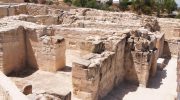
The fortified palace on Ampelleri Hill, built between 750 and 600 BC and rebuilt from 600 to 475 BC to defend against attacks from Kition, was one of the largest royal residences known in Cyprus. Its scale and defensive features reveal the kingdom’s wealth as well as the constant military pressures from rival city-kingdoms and foreign powers.
The Famous Bronze Tablet
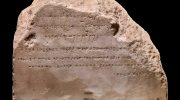
In 1850, a farmer near Dali village discovered a thin bronze tablet close to the western acropolis. The tablet, now preserved in the Bibliothèque Nationale de France in Paris, measures 14.2 by 21.5 centimeters and is inscribed on both sides with the Cypriot syllabary script. Known as the Idalion Tablet, it is the longest inscription in this ancient script and one of the most important surviving documents from Iron Age Cyprus.
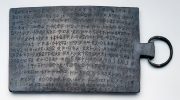
Image Credit:reddit.com
The tablet records a contract between King Stasikypros, likely the last king before Idalion’s fall, and the physician Onasilos, son of Onasikypros, along with his brothers. During a siege by the Persians and Kitians around 478-470 BC, these physicians agreed to treat wounded citizens without payment. In return, the king and city promised them a talent of silver. With the treasury depleted from the siege, the city instead granted the physicians royal lands, clearly defining the boundaries and granting them full rights to sell the property and pass it on to their descendants forever, tax-free.
The tablet reveals several key aspects of Idalion’s society. It shows a political system where the king governed alongside a council of citizens rather than exercising absolute power. It demonstrates the existence of organized public medical services during wartime. It also highlights the hereditary nature of medicine, as the contract extended rights and responsibilities to the physicians’ descendants. The tablet was kept in the official depository of the Temple of Athena, emphasizing how civic documents were preserved within sacred spaces.
Sanctuaries and Religious Life
The eastern acropolis served as Idalion’s sacred center. Worship of the Great Goddess of Cyprus, known as the Wanassa or Queen of Heaven, later identified with Aphrodite, and her consort, the “Master of Animals,” began in the 11th century BC and continued through the Roman period. A major temple dedicated to this deity occupied the summit of Moutti tou Arvili.
Excavations have uncovered at least fourteen sanctuaries and temples in and around Idalion. The Swedish Cyprus Expedition in 1928 revealed a fortified sanctuary of Anat-Athena on the western acropolis. Votive offerings there included weapons and tools, appropriate for a warrior goddess, alongside personal items such as pins, fibulae, earrings, bracelets, and a variety of pottery.
The sanctuary of Reshef-Apollo, located in the valley below the eastern acropolis, illustrates the syncretic nature of Cypriot religion. Phoenician inscriptions refer to the deity as “Reshef-Mikal,” while Greek inscriptions call him “Apollo Amyklos,” showing the merging of Near Eastern and Greek religious traditions at Idalion.
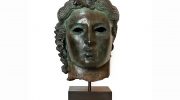
Terracotta and limestone sculptures depicting the goddess and her worshippers were produced in large numbers from the 7th century BC onward. A remarkable bronze statue of Apollo was also discovered, though only the head survived. This piece highlights the exceptional quality of metalwork produced in Idalion, reflecting the city’s wealth and its long-standing association with copper production.
Archaeological Excavations and Discoveries
The first recorded modern visitor to Idalion was Melchior de Vogüé in 1862. Between 1867 and 1875, Luigi Palma di Cesnola, American and Russian consul to Ottoman Cyprus, carried out extensive excavations. He claimed to have opened 15,000 tombs, an exaggerated figure, yet one that reflects the scale of the operations. Antiquities from these excavations were shipped abroad, with one vessel, the Napried, sinking in the Mediterranean in 1872. The others reached New York and contributed to the establishment of the Metropolitan Museum of Art’s Cypriot collection.

In 1868-1869, British Consul R. Hamilton Lang excavated the eastern acropolis, uncovering an open-air sanctuary with bilingual Phoenician and Greek inscriptions. German archaeologist Max Ohnefalsch-Richter conducted the first systematic excavations in the 1880s and 1890s. Unlike previous treasure hunters, he employed surveys and structured techniques, locating numerous shrines and mapping parts of the city.
Recent excavations by German, American, and Cypriot teams continue to shed light on Idalion’s structures and territorial extent. The 2024 conference publication The Topography of Ancient Idalion and Its Territory presents the most current understanding of the kingdom’s layout and its control over surrounding lands, refining centuries of archaeological research.
Why Idalion Matters Today
Idalion shows how Cyprus’s natural resources shaped political and economic development during the Iron Age. Control over copper mines determined which kingdoms thrived and which remained marginal. The city’s position at the top of Assyrian tribute lists reflects both its wealth and strategic importance within Mediterranean trade networks.
The Idalion Bronze Tablet offers unique insight into early democratic governance, public health systems, and medical ethics in the ancient Mediterranean. The fact that physicians were compensated with land grants and that their contracts were preserved in sacred spaces demonstrates sophisticated civic institutions operating under pressure during wartime.
Visiting the Archaeological Site
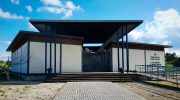
The ancient city of Idalion lies adjacent to the modern village of Dali, roughly 30 minutes from Nicosia. The site is open year-round with an admission fee of €2.50. A modern museum at the entrance displays artifacts uncovered during excavations and provides historical context through exhibits and an audiovisual presentation.
Visitors can see the foundations of the Temple of Athena on the western acropolis, sections of the fortified palace walls, and scattered architectural elements from different periods. The eastern acropolis preserves traces of sanctuary complexes, though much of the area remains unexcavated. In the western necropolis, an archaic tomb features a long, narrow stepped dromos cut into the rock, leading to a stone-built chamber with a distinctive saddle-shaped roof.
A Kingdom Built on Copper and Faith
Idalion matters because it shows how a small inland kingdom could compete with larger coastal powers through control of valuable resources and strategic positioning. The city never had a port, but it commanded the copper trade routes from mountain mines to coastal cities. This economic foundation supported a sophisticated urban culture with palaces, temples, fortifications, and civic institutions.
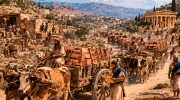
The religious landscape tells an equally important story. The concentration of sanctuaries, the continuity of goddess worship across a millennium, and the syncretism between different religious traditions all demonstrate how sacred spaces anchored community identity even as political control shifted between local kings, Phoenicians, Persians, and eventually Hellenistic and Roman powers.