Explore Cyprus with Our Interactive Map

Explore our top stories and discover ideas worth your time.

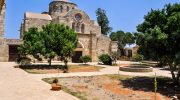
Sanctuary of Aphrodite, Palaepaphos

Sanctuary of Aphrodite, Palaepaphos

In the village of Kouklia, about 14 kilometers east of Paphos, stand the remains of what was once the most famous shrine dedicated to Aphrodite in the ancient world. For more than 1,600 years, pilgrims traveled from across the Mediterranean to worship at Palaepaphos, the place where the goddess of love was believed to have risen from the sea. Today, the site is a UNESCO World Heritage monument and one of the most important archaeological locations in Cyprus. The Sanctuary of Aphrodite at Palaepaphos was founded around 1200 BC during the Late Bronze Age. It remained in continuous use until 391 AD, when the Roman Emperor Theodosius I banned all pagan religions. Palaepaphos was among the most powerful city-kingdoms of ancient Cyprus and became the first site on the island to be added to the UNESCO World Heritage List in 1980. The sanctuary functioned as the main center of Aphrodite worship across the Aegean world, attracting visitors from Greece, Rome, Egypt, and other parts of the eastern Mediterranean. Unlike typical Greek and Roman temples, the sanctuary followed a very different architectural approach. Instead of a roofed building with columns and a statue, it featured an open-air layout influenced by Near Eastern traditions. Aphrodite was not depicted in human form but represented by a sacred conical stone, a practice that sets…

Read more
Mamonia Mélange Cyprus

Mamonia Mélange Cyprus

You can arrive at Mamonia without planning to. You stop to watch the sunset near Petra tou Romiou. You follow a narrow road inland from Paphos. You walk a riverbed after winter rain and pick up a stone that feels heavier and smoother than it should. The land looks familiar yet slightly unsettled. A hillside glows deep red. A green rock appears among pale gravel. A white cliff rises abruptly above darker slopes. It takes a moment to realise the reason. You have not left Cyprus. You have stepped onto land that existed before the island itself. The Mamonia Mélange, a geological area occupying a large portion of West Cyprus: from Akamas Peninsula to Petra Tou Romiou and all the way up to Troodos foothills, belongs to the material tied to the African tectonic plate. Long before Troodos rose and long before Cyprus took shape, this land lay along the margin of the African continent facing the Neo-Tethys Ocean. When that ocean began to close, the seabed fractured violently. Mantle rock, submarine lava and coral reef were compressed together and later lifted above the sea, scrapping themselves ontop of slowly rising Troodos range. Much later the rest of Cyprus formed around it. Therefore, Mamonia Mélange represents an accretionary complex, a term geologists use to describe similar unique occurrences. The origin…

Read more
Calabrian Pine in Cyprus

Calabrian Pine in Cyprus

Imagine stepping onto sun-drenched slopes where tall evergreens sway in the breeze, their long needles catching golden light and filling the air with a fresh, resinous scent. This is the world of Pinus brutia, Cyprus’s most iconic pine and the backbone of the island’s woodlands. Together with its mountain cousin, it reveals a story of ancient resilience that still thrives across the Mediterranean landscape today. A Pine Built for the Island Pinus brutia, commonly known as the Calabrian pine, is a hardy evergreen conifer perfectly suited to the warm, dry conditions of the eastern Mediterranean. In the broad pine family (Pinaceae), it stands out for its fire-adapted seeds and drought tolerance. On Cyprus it reigns supreme, forming the vast majority of the island’s forests from sea level right up to the cooler heights where its relative, the black pine (Pinus nigra ssp. pallasiana), takes over. The Aleppo pine (Pinus halepensis) also appears, sometimes as a planted companion or in transitional zones. Echoes of Ancient Forests In 1881, French forester P.G. Madon climbed Mount Troodos and described a Cyprus once cloaked in “vast forests… pines of different species in dense profusion” mingling with cedar, oak and cypress down to the plains. For millennia these trees supplied timber for Phoenician mines, Ptolemaic fleets, Lusignan palaces and Venetian ships. Yet centuries of temporary…

Read more