Explore Cyprus with Our Interactive Map

Explore our top stories and discover ideas worth your time.

Teaching Traditional Crafts in Cyprus Villages

Teaching Traditional Crafts in Cyprus Villages

Learn a craft even if you don't need to and if you get hungry, practice it." This old Cypriot folk saying reflects the pragmatic wisdom of village life where craftsmen held backup skills to supplement income during agricultural hardship. Not so long ago people living at Cyprus villages were either farmers or shepherds and at the same time practiced a craft. People had to be creative and multi-talented, able to supplement their income if they faced difficulties, and a craft always came in handy. They engaged in basket weaving, icon painting for rich churches and landlords, silversmithing, wood carving, ceramic and pottery making, mosaic making, embroidery, wine and Commandaria making, and many more. The Cyprus Handicraft Service System In 1975 the Ministry of Commerce, Industry and Tourism undertook the responsibility for the preservation of Cyprus Folk Art, its development and encouragement into modern cottage industry and handicrafts. Specialised members of staff made studies and started projects initially funded by the High Commission for Refugees with the main target of offering employment to refugees and other affected persons and in parallel, the long-term development of cottage industry and handicrafts. For the implementation of these goals the Cyprus Handicraft Service created the Handicraft Centre in Nicosia in 1979 with experimental workshops such as Embroidery, Weaving, Woodcarving, Pottery, Metalwork, Basketry and General Handicrafts,…

Read more
Agios Lazaros Church Larnaca

Agios Lazaros Church Larnaca

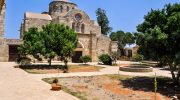
Agios Lazaros Church, located in central Larnaca, is one of the most prominent medieval landmarks in Cyprus. The structure was built in the late 9th or early 10th century over a site traditionally associated with an ancient burial chamber linked to the historical figure Lazarus, a name widely referenced in early Mediterranean religious texts. The building is considered an important example of Byzantine-era architecture on the island and continues to attract interest for its historical, artistic, and archaeological significance. Historical Background According to long-standing tradition, the site is connected to Lazarus, a figure mentioned in early religious writings from the eastern Mediterranean. These traditions describe his arrival in Cyprus during the early centuries AD and his association with the ancient settlement of Kition (modern Larnaca). Historical accounts suggest that during the Arab period (7th–10th centuries), knowledge of the original burial location was gradually lost. In 890 AD, a tomb discovered in Larnaca bearing an inscription referencing Lazarus brought renewed attention to the site. Architectural Features and Transformation Through History The church is built from local limestone and follows a basilica-style plan with three aisles supported by thick stone pillars. The central aisle is covered by domes, while the side aisles use vaulted roofing systems. Originally, the building is believed to have had three domes, a rare architectural feature in Cyprus.…

Read more
Cyprus Police Museum (Nicosia)

Cyprus Police Museum (Nicosia)

The Cyprus Police Museum chronicles law enforcement history in Cyprus from British colonial times through independence to the present day. The British Chief of Police, W.C.C. King, founded the museum in 1933 during the colonial period. The museum documented criminal methods and police responses during a period when Cyprus was transitioning from traditional village life to a more modern urban society. The facility displays uniforms, weapons, equipment, police vehicles, and documents that trace the development of policing on the island. The museum also houses important materials from World War II and the 1955 to 1959 National Liberation Struggle against British rule. Evolution to a Historical Institution Over decades, the museum's scope expanded beyond purely criminal matters. While crime-related exhibits remain important, the collection now covers the broader history of the Cyprus Police Force. The institution documents how policing changed through different political periods, from British colonial administration through the establishment of the Republic of Cyprus in 1960 to modern law enforcement practices. The Police Museum is owned by the Cyprus Police and managed by Department A of the Police Headquarters. It operates as a public institution with free admission, making police history accessible to all visitors. The museum serves both educational purposes and institutional memory, preserving the legacy of police work in Cyprus. Police History Collections A substantial section displays…

Read more