Explore Cyprus with Our Interactive Map

Explore our top stories and discover ideas worth your time.

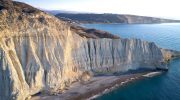
Governor’s Beach, Cyprus

Governor’s Beach, Cyprus

Governor's Beach is actually two connected beaches near Pentakomo village, about ten kilometers east of Limassol. The main section features dark volcanic sand framed by striking white chalk cliffs, while the neighboring Kalymnos beach extends as a narrow sandy strip approximately 200 meters to the west. Together they form a two-kilometer coastline recognized for exceptional water quality and environmental standards. The area sits roughly 40 kilometers west of Larnaca and 30 kilometers east of Limassol, positioned far enough from major tourist strips to maintain a more peaceful character. Historical Background The beach earned its name during British colonial rule when high-ranking officials chose this location for recreational activities. The striking white cliffs and gray sand apparently reminded them of the Dover coastline back home. A British governor maintained a summer residence nearby in Maroni village, though he frequently visited this particular stretch of coast. The first president of independent Cyprus, Archbishop Makarios III, also enjoyed the former colonial cottage, which still stands today awaiting government decisions about its future use. The western section carries the name Kalymnos after professional sponge divers from the Greek island of Kalymnos who berthed their ships in this bay during the late 19th and early 20th centuries. These divers harvested natural sea sponges until overexploitation and disease destroyed the sponge fields throughout the Dodecanese archipelago,…

Read more
Lampadistis Monastery Cyprus

Lampadistis Monastery Cyprus

Ayios Ioannis Lampadistis in Kalopanayiotis is a rare monastery complex where three connected chapels preserve nearly a thousand years of Cypriot worship and wall painting within one enclosed interior. A single timber roof, built for the Troodos climate, protected multiple fresco phases and allowed Byzantine, local devotional, and Western-influenced imagery to survive side by side. This article explains how the complex grew, what each chapel contributes, and why Lampadistis remains one of Cyprus’s clearest records of faith evolving without erasing its past. Built by Layers, Not Plans The Lampadistis complex was never planned as a unified structure. Instead, it grew organically as needs changed, saints were venerated, and political realities shifted. The earliest building, the Church of Saint Herakleidios, dates to the 11th century and follows the classic Byzantine cross-in-square plan. In the 12th century, a second chapel was added to house the tomb of the local saint John Lampadistis, transforming the site into a place of pilgrimage. A third space, now known as the Latin Chapel, was built during Venetian rule in the late 15th century to accommodate Western Christian worship. What makes Lampadistis unusual is that these separate buildings were eventually unified beneath a single, oversized wooden roof. This practical solution protected the interiors from the harsh mountain climate, but it also created a rare architectural experience: three…

Read more
The Soli Basilica Frescoes

The Soli Basilica Frescoes

The Soli Episcopal Basilica preserves rare fragments of early Christian wall painting from a period when church imagery in Cyprus was still being invented rather than standardised. Painted above the site’s famous mosaics, the fresco remains show Roman decorative habits being adapted into a new visual language for worship, before later Byzantine rules became fixed. This article explains Soli’s rise as an ecclesiastical centre, what the surviving plaster fragments suggest about the original interior, and why the basilica’s destruction ended up preserving an important artistic transition. Trade, Farmland, Copper, Harbour Ancient Soli, also known as Soloi, occupied a strategic position near fertile farmland, copper-rich foothills, and a natural harbour. This combination sustained the city for centuries, from its legendary foundation in the Archaic period through its Roman peak and into the Christian era. By Late Antiquity, Soli was no longer just a trading hub. It had become an important ecclesiastical centre, serving the surrounding region as Christianity spread across Cyprus. The basilica that rose here in the 4th century was not a modest village church. It was one of the largest early Christian complexes on the island, reflecting both wealth and confidence during a period of profound cultural change. A Basilica Built on Confidence The Soli Episcopal Basilica went through multiple phases, mirroring the development of Christian worship itself. The…

Read more