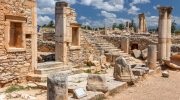
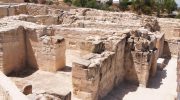
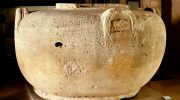
The Amathus Vase is a colossal Cypro-Archaic stone basin carved from local shell limestone, created as a fixed ritual centre in the Sanctuary of Aphrodite at Amathus. Its bull-handles, architectural motifs, and an Eteocypriot inscription fuse water purification, political authority, and indigenous identity into a single monument designed to be permanent. This article explains how the vase functioned in worship, what its imagery and language signal about Amathus, and how its 19th-century removal to the Louvre changed the way Cyprus’s past is seen today.

Fourteen Tons of Ritual Scale
The first thing the Amathus Vase communicates is scale. This is not a container designed to be moved, handled, or admired up close. It belongs to architecture rather than furniture, a fixed presence around which ritual unfolded.
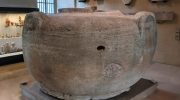
Carved from a single block of local shell limestone, the vessel’s massive form would have dominated the sanctuary courtyard. Its weight alone makes clear that this was not an offering made by an individual, but a statement commissioned by authority. In ancient Cyprus, monumental stone signalled permanence, legitimacy, and divine favour. The vase was meant to endure, both physically and symbolically.
A Vessel Shaped by Place
The limestone used for the vase came from the southern Cypriot coast, embedding the object materially in the landscape of Amathus. Shell limestone is porous and fossil-rich, a stone that carries the memory of the sea. This mattered in a sanctuary where water played a central role.
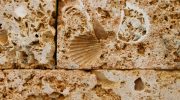
The form of the vase, wide-bodied with a narrow base and low rim, suggests that it was designed to hold a vast volume of liquid. Rather than pouring from it, ritual activity likely took place around it. The basin functioned as a still centre, a controlled body of water within a sacred space.
Bulls, Palmettes, and Sacred Architecture
The vase’s decoration reinforces its architectural character. Four massive handles project from the rim, each carved with a bull in high relief. In the religious language of the eastern Mediterranean, bulls symbolised fertility, strength, and the life-giving force of rain and water. Their placement turns the vessel into a visual ring of power, repeating the same image from every angle.
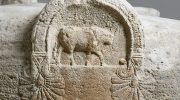
Flanking the bulls are palmette motifs closely related to proto-Aeolic architectural forms. These designs appear in temples and monumental buildings across Cyprus and the Levant. Their presence here signals that the vase was conceived as part of the sanctuary’s built environment, not as an isolated object.
Water, Purification, and Ritual Use
Most scholars agree that the Amathus Vase functioned as a lustral basin. Water drawn from it would have been used for purification rites, libations, and ceremonial preparation before approaching the goddess.

Ancient descriptions mention a stone staircase beside the vessel, allowing priests to reach the rim. This detail transforms the vase from a passive container into an active ritual stage. The act of ascending, drawing water, and performing rites at such a height would have heightened the sensory and symbolic experience of worship, reinforcing both priestly authority and the sacred order of the sanctuary.
In this setting, the vase operated as more than a basin. It embodied abundance, fertility, and cosmic balance, a controlled “sea” placed deliberately at the centre of ritual life.
A Language That Refused to Disappear
What truly distinguishes the Amathus Vase is its inscription. Carved near the handles are lines of Cypro-Syllabic script recording the Eteocypriot language, a pre-Greek tongue that survived in Amathus long after Greek had become dominant across much of the island.
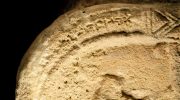
The inscription remains largely undeciphered, not because of scholarly neglect, but because so little comparative material survives. This silence is meaningful. By inscribing a monument of such scale in an indigenous language, the rulers of Amathus asserted continuity with their ancestral past and a conscious refusal to dissolve into wider cultural norms.
Here, language functions as ideology. The goddess was addressed not in the prestige languages of the Mediterranean world, but in the speech rooted in the land itself. The vase thus preserves identity not through explanation, but through presence.
The Sanctuary of Aphrodite at Amathus
The vase originally stood on the acropolis of Amathus within a sanctuary dedicated to a local manifestation of Aphrodite. This goddess differed from the later, idealised figure of classical Greek art. She was a deity of fertility, protection, and sovereignty, deeply tied to landscape and continuity.
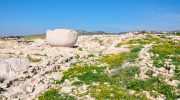
The sanctuary itself was open and layered, shaped by centuries of ritual rather than by strict architectural symmetry. Within this environment, the vase acted as a visual and symbolic anchor. Approaching worshippers encountered it as a threshold, a physical interruption that marked the transition from human space to divine presence.
Its size ensured that it could not be ignored. To move past it was to acknowledge the order it represented.
A Journey Marked by Empire
The modern displacement of the Amathus Vase reflects nineteenth-century imperial collecting practices. In 1865, French authorities arranged for its removal to Paris under orders issued during the reign of Napoleon III. Extracting a fourteen-ton monolith from the Acropolis required engineers, custom-built machinery, and weeks of labour.
Historical accounts suggest that a second, similar vase once stood nearby. Unable or unwilling to transport both, the expedition reportedly destroyed the second vessel, leaving its fragments behind. The loss speaks quietly of the competitive urgency that defined museum acquisition during the period.
When the vase arrived in Paris in 1866, its scale again dictated events. Part of the Louvre had to be dismantled to allow its installation, confirming that even in a modern imperial capital, the object resisted easy accommodation.
Seeing the Vase Today
Today, the Amathus Vase stands in the Near Eastern galleries of the Louvre, positioned among Assyrian and Levantine monuments. This setting subtly reframes Cyprus not as a peripheral culture, but as an active participant in eastern Mediterranean exchange.
Close inspection reveals tool marks, chisel lines, and traces of ancient labour preserved in the limestone. The inscription remains visible, its meaning elusive, but its intent unmistakable. The surface has not been overly refined, allowing the physical reality of its making to remain legible.
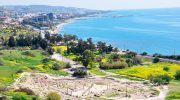
Meanwhile, the acropolis of Amathus remains open to visitors in Cyprus. Though the vase itself is absent, the scale of the site still allows its original presence to be imagined against the horizon and the sea.
What This Object Still Proves
The Amathus Vase matters because it compresses belief, identity, and authority into a single object. It shows how ritual practice, language, architecture, and power could be fused into stone.
Neither fully Greek nor wholly Near Eastern, the vase represents a distinctly Cypriot way of existing within the ancient Mediterranean. It reminds us that identity was not only spoken or written, but carved, lifted, and anchored in place. As a sea of stone, it continues to speak, even in a language no longer fully understood.