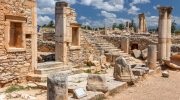
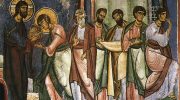
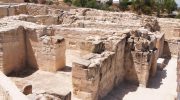
Cyprus is best understood as a layered island, where newcomers rarely erased what came before, and daily life absorbed languages, customs, and beliefs over centuries of close contact. Positioned between Europe, the Levant, and Anatolia, it became a crossroads early through trade, then accumulated Roman, Byzantine, Arab, Latin, Venetian, Ottoman, and British influences without turning into any single one of them.

This article traces how those layers formed, where coexistence was practical rather than ideal, and why “Cypriot” identity still carries many histories at once.
Ten Thousand Years of Settlement
Human settlement in Cyprus stretches back more than ten thousand years. Long before empires arrived, early communities established farming villages and ritual spaces that tied life closely to land and seasons. These foundations mattered because when later cultures arrived, they did not start from nothing.
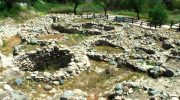
As Cyprus entered the Bronze Age, copper transformed the island into a hub of Mediterranean trade. This was not just an economic shift. It brought constant contact with Egypt, the Levant, and the Aegean, embedding Cyprus into international networks very early in its history. From that point on, isolation was no longer possible. The island’s identity was shaped by exchange.
Greeks and Phoenicians Intertwined
Greek-speaking settlers arrived in large numbers during the late Bronze Age, establishing language, myths, and social structures that would endure for millennia. At the same time, Phoenician traders founded cities along the coast, especially at Kition. What makes Cyprus distinctive is that these influences did not exist in separate worlds.
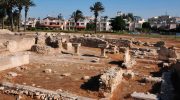
Greek and Phoenician elements overlapped in architecture, religion, and trade. Deities were shared or reinterpreted. Artistic styles blended rather than competed. This early coexistence created a pattern that would repeat throughout Cypriot history, one where cultural boundaries remained porous.
Christianity, Empire, and Shared Rule
Under Roman rule, Cyprus became part of a vast imperial system that brought roads, cities, and administration. Christianity spread early, and by the Byzantine period, it had become central to Cypriot identity. Yet even here, Cyprus followed an unusual path.
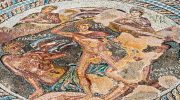
During the early medieval period, the island was jointly administered by Byzantine and Arab authorities for nearly three centuries. Taxes were shared. Power was negotiated. While far from peaceful, this arrangement reinforced a practical lesson that would echo through history: survival on Cyprus often depended on coexistence rather than dominance.
Byzantines and Arabs Shared Rule
The arrival of the Crusaders in the late twelfth century introduced Western European rule to Cyprus for the first time, reshaping both governance and social hierarchy. The Lusignan dynasty left behind soaring Gothic cathedrals, fortified castles, and monastic complexes that still dominate the island’s architectural memory. These structures announced power and faith in stone, but they also marked a clear division within society.

A Latin Catholic elite governed an Orthodox Greek majority, creating layers of privilege that touched every aspect of daily life. Yet even within this unequal system, cultures did not exist in isolation. Legal traditions, agricultural practices, and local customs slowly intertwined. Cyprus did not become culturally Western or remain purely Eastern. It became something more complicated, shaped by coexistence under constraint.
Venetian Walls and Strategic Fear
Venetian control turned Cyprus into a defensive outpost of the eastern Mediterranean. Cities were reshaped by thick walls and angular bastions, designed to resist siege rather than nurture civic life. Defence took priority over population, and local communities often bore the cost of imperial strategy.

Still, Venetian rule added another layer rather than erasing what came before. Urban layouts, maritime trade routes, and administrative practices were folded into the existing fabric of the island. Even today, the physical presence of these fortifications reminds visitors that Cyprus was never marginal. It was central enough to be fought over, fortified, and fiercely guarded.
Ottoman Cyprus, Mixed Villages
The Ottoman conquest of 1571 brought a new political order and introduced a permanent Muslim Turkish Cypriot community to the island. Orthodox Christianity regained institutional authority through the millet system, allowing religious communities a degree of self-governance. What emerged was not a monolithic society, but a layered one.
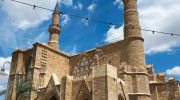
For centuries, Greek and Turkish Cypriots lived in mixed villages, worked the same fields, and shared local customs shaped by climate and necessity. Differences in faith remained important, yet daily life often blurred those lines. Music, food, dialect, and seasonal rituals developed through constant proximity. Coexistence was not idealised, but it was practical, learned, and sustained.
British Rule and Hardened Labels
British rule introduced roads, schools, and legal systems that modernised the island while quietly redefining how people understood themselves. Administrative categories hardened identities that had once been more fluid. Religion gave way to ethnicity as the primary marker of belonging.

Greek Cypriots were increasingly encouraged to imagine their future through connection with Greece, while Turkish Cypriots looked toward Turkey for political and cultural alignment. These outward-facing national narratives disrupted older patterns of local coexistence. Cyprus began to feel pulled apart not by daily life, but by ideas imported from elsewhere.
Speech That Kept Old Traces
Cyprus’s spoken language preserves what politics often tries to simplify. The Cypriot dialect carries traces of Greek, Turkish, Arabic, Italian, and French, woven together through centuries of shared use. These words were not borrowed intentionally. They accumulated naturally through lived experience.

Every day speech still carries this history. Language functions as a living archive, quietly recording centuries of interaction even when official narratives attempt to divide the past into separate stories.
Shared Tables, Shared Sounds
Food and music reveal the same layered identity. Dishes such as halloumi, meze, and slow-cooked stews belong to no single community. They reflect an island culture built around time, sharing, and hospitality. Meals were, and remain, social acts that reinforce connection rather than distinction.

Music and dance echo this continuity. Rhythms, instruments, and melodies cross communal lines, appearing at weddings, village festivals, and seasonal celebrations. Even in times of political tension, these shared cultural expressions endured.
Living Close, Even When Split
Cyprus’s small size has always enforced closeness. Villages preserved older rhythms of life, while cities absorbed modern influences. Even the UN buffer zone, a symbol of division, contains quiet moments of cooperation and shared space.

Places like Pyla, where Greek and Turkish Cypriots continue to live together, challenge simplified narratives of permanent separation. They demonstrate that coexistence is not an abstract ideal, but a daily practice shaped by proximity and habit.
A Generation Asking New Questions
For younger Cypriots, identity is increasingly negotiated rather than inherited. Crossing checkpoints, meeting neighbours once described as strangers, and living in a globalised society have shifted perspectives. Many now choose “Cypriot” as a primary identity, rooted in shared experience rather than distant nationalism.

New waves of migration have added further layers. Students, workers, and refugees have once again turned Cyprus into a place of arrival, echoing patterns that stretch back thousands of years.
What the Layers Still Teach
Cyprus is often described as divided, but that framing misses its deeper truth. The island has always been layered, shaped by accumulation rather than replacement. Civilisations did not arrive, conquer, and disappear. They stayed, interacted, and left traces that remain visible today.

To understand Cyprus is not to choose one identity over another. It is to recognise that the island itself is the identity, formed through centuries of coexistence on shared ground, where history was lived side by side rather than written in isolation.