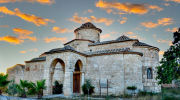
Panagia Kanakaria Monastery stands in the village of Lythrangomi on the Karpasia Peninsula in northeastern Cyprus. The church represents one of the most significant examples of early Byzantine religious architecture on the island, originally constructed in the 5th or 6th century.

The site gained worldwide recognition for its exceptional apse mosaics depicting the Virgin Mary with Christ and archangels, created around 525 to 550 AD. These mosaics survived the iconoclastic period of the 8th and 9th centuries when most religious images were destroyed throughout the Byzantine Empire.
The monastery’s name Kanakaria has three possible origins, including a legend about a Saracen attack and a reference to the Virgin holding Christ on her lap. Today, the church tells two stories, one of ancient artistic achievement and another of cultural heritage theft following the 1974 Turkish invasion.
- Historical Background
- The Extraordinary Apse Mosaics
- Why These Mosaics Matter to Art History
- The Frescoes and Later Decorations
- The Long Recovery Process
- The Church Today and Access
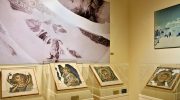
- The Mosaics in the Byzantine Museum
- Significance for Cultural Heritage Protection
- Why This Monastery Matters to Cyprus
Historical Background
The original church at Lythrangomi dates to approximately the 5th century and consisted of a wooden-roofed basilica with a single apse. This early structure served the Christian community during the formative centuries of Byzantine Cyprus when the island became an important center of Orthodox faith. Archaeological evidence suggests the church used stones from a nearby Hellenistic settlement that has since vanished from the landscape.

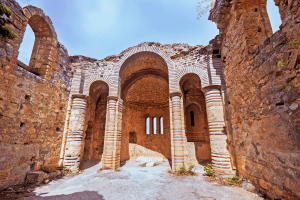
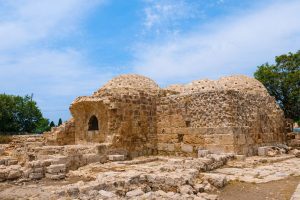
Around the 11th century, builders transformed the modest wooden-roofed basilica into a more elaborate structure. They added vaults, a dome, and created a three-aisled basilica with apsidal east ends. This reconstruction reflected the growing importance of the site and the prosperity of the local Christian community. A narthex was added to the western entrance during the 12th century, providing an architectural transition space between the outside world and the sacred interior.
The Extraordinary Apse Mosaics
The central apse originally contained one of the earliest surviving Byzantine mosaic depictions of the Virgin Mary with the Christ child. Created in the first half of the 6th century, the mosaic showed Mary seated on a lyre-shaped throne, holding the infant Jesus directly in front of her on her lap. This composition, known as the Cypriot type, was revolutionary in its frontal presentation and became influential in later Byzantine iconography.

A mandorla, a symbol of divine glory rendered with colors resembling the rainbow, surrounded Mary and Christ. The background featured a heavenly landscape with palm trees and vegetation set against gleaming gold tesserae. Archangels Michael and Gabriel stood on either side of the Virgin in poses of reverence and protection. Although Mary’s head was not preserved even in the original state visible in the mid-20th century, the remaining portions demonstrated exceptional artistic skill.
Why These Mosaics Matter to Art History
The Kanakaria mosaics represent some of only six surviving early Byzantine mosaic works from this period in the entire world. Their importance extends beyond rarity to their theological and artistic significance. The Council of Ephesus in 431 AD established Mary’s role as Theotokos, meaning God-bearer or Mother of God. The Kanakaria mosaic, created roughly a century later, visually expressed this theological doctrine through its depiction of the Incarnation.

The mosaics survived the iconoclastic period from 726 to 843 AD, when Byzantine emperors ordered the destruction of religious images throughout their empire. Cyprus’s unique political situation during this era protected these artworks. After Arab raids in the 7th century, Cyprus operated under a condominium arrangement between the Byzantine Empire and the Arab Caliphate from 688 to 965. This neutral status meant imperial iconoclastic policies were not enforced on the island, allowing the mosaics to escape the destruction that befell similar works elsewhere.
The artistic technique displayed in the Kanakaria mosaics places them among the finest examples of early Byzantine craftsmanship. The tesserae were made from glass, stone, gold, silver, and gemstones, creating subtle color variations and the shimmering effects characteristic of Byzantine mosaic art. The work demonstrates sophisticated understanding of spatial composition and symbolic representation that influenced religious art for centuries.
The Frescoes and Later Decorations
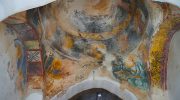
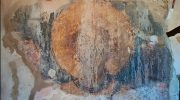
Beyond the famous mosaics, the church also contained wall paintings from multiple periods. Frescoes dating to the 12th, 14th, and 16th centuries covered various wall surfaces, documenting the evolution of Byzantine and post-Byzantine painting styles. Above the southern entrance, a 15th century fresco of the Virgin Mary and Christ survived into the modern era, showing the continued devotion to Marian imagery at the site.

These later frescoes represented different artistic periods and religious emphases. The 12th century paintings reflected the Byzantine restoration after the island returned to full imperial control in 965. The 14th and 16th century works showed influences from the Lusignan and Venetian periods when Cyprus was ruled by Western European powers. The combination of early mosaics and later frescoes made the church an exceptional repository of Christian art spanning nearly a millennium.
The Long Recovery Process
The recovery effort continued for decades. In 1997, the head of Saint Thomas was located and returned. In 2018, the medallion of Saint Andrew was repatriated after being discovered in Monaco, an event celebrated with national recognition. The Medal of Apostle Andreas, the highest distinction of the Archbishopric of Cyprus, was awarded to three individuals who worked for the mosaic’s return.
Later in 2018, art detective Arthur Brand recovered the medallion of Saint Mark from Monaco and formally returned it to the Cypriot Embassy in The Hague. By this point, pieces depicting Saints Luke, Bartholomew, Matthew, James, Thaddeus, Thomas, Andrew, and Mark, as well as the upper portions of the Virgin Mary and Christ, had been recovered. However, significant portions remain missing, including the feet of Christ and other fragments. These pieces are believed to be scattered in private collections, possibly held by buyers unaware of their stolen provenance.
The Church Today and Access
The church building remains standing in northern Cyprus, though it no longer serves an active congregation. Visitors who manage to enter the structure find a haunting space. Madonna images hang on bare walls in deteriorating frames, small candles occasionally flicker, wax figures sit on windowsills, and only marginal fragments of the original mosaics remain in the apse. The skeletal quality of the interior creates an atmosphere that is simultaneously somber, mysterious, and strangely alive.
Three graves north of the church are believed to belong to the last three monks who lived at the monastery, though these have been desecrated. Monastic buildings to the south and west of the church, dating from the 17th and 18th centuries, show the site’s later development but are in varying states of preservation. Access to the church can be challenging, as visitors typically need to contact local authorities for entry.
The Mosaics in the Byzantine Museum
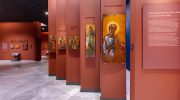
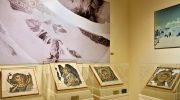
The recovered portions of the Kanakaria mosaics are displayed in the Byzantine Museum at the Archbishop Makarios III Foundation in Nicosia. The museum provides controlled environmental conditions that protect the fragile tesserae from further deterioration. Conservation experts have worked extensively on restoration, addressing damage caused by the violent removal and subsequent improper storage.

A Swiss government-funded project aims to reconstruct the apse as a museum exhibition, allowing visitors to appreciate the original spatial arrangement and artistic vision. The restoration team faces complex decisions about how to present fragments without replacing missing portions inappropriately. The goal is to preserve authenticity while making the remaining artwork comprehensible to viewers who never saw the complete composition.
Significance for Cultural Heritage Protection
The Kanakaria case became a landmark in international law regarding stolen cultural property. The 1989 US court decision established important precedents for repatriation claims and defined the responsibilities of art dealers regarding provenance research. The case demonstrated that purchasers cannot claim good faith ownership when they fail to investigate suspicious origins of significant artifacts.
The theft and recovery process highlighted the vulnerability of cultural heritage in conflict zones. Similar looting occurred at churches and monasteries across northern Cyprus after 1974, with an estimated 173 ecclesiastical treasures stolen from 50 different sites. The Kanakaria mosaics, due to their exceptional quality and age, attracted the most international attention and legal action.
Why This Monastery Matters to Cyprus
Panagia Kanakaria represents the intersection of religious devotion, artistic achievement, and cultural trauma in Cypriot history. The 6th century mosaics documented the island’s importance in early Christianity and its role in developing Byzantine artistic traditions. The survival of these works through iconoclasm demonstrated Cyprus’s unique position within the Byzantine world. The theft and partial recovery of the mosaics became a symbol of the losses suffered by Greek Cypriots after the 1974 partition.

The ongoing effort to recover missing fragments represents broader hopes for restoration of cultural continuity despite political division. For art historians worldwide, the Kanakaria mosaics remain invaluable evidence of early Christian art at a formative moment when theological doctrines were being translated into visual expressions that would influence centuries of religious imagery.