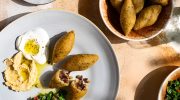
Cypriot cuisine is often described through individual recipes, yet its deeper identity emerges through patterns of use rather than isolated dishes. Makaronia tou Fournou, kolokasi, and traditional sweets occupy very different places on the table, but together they reveal how Cypriots eat across time, season, and social setting. One dish marks a celebration, one sustains daily life, and one formalises hospitality. Seen together, they form a practical map of how food functions in Cypriot culture.
These foods do more than taste distinct. They organise social life. They reflect land, climate, economy, and ritual. To understand them is to understand how Cypriots structure eating itself.
Makaronia tou Fournou and the Language of Celebration
Makaronia tou Fournou is the dish most closely associated with gathering. Known informally as the Cypriot version of pastitsio, it appears at Easter, Christmas, Sunday lunches, and, most notably, weddings. Its importance lies less in the recipe itself and more in what it represents: abundance prepared to be shared.
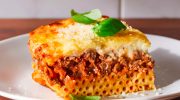
The dish is built in layers. Tubular pasta forms a firm base, a lightly spiced meat sauce sits at its centre, and a thick béchamel enriched with eggs and local cheese seals the top. This structure is deliberate. When sliced, the layers hold their shape, allowing large trays to be portioned cleanly for many people. Long before it became emblematic, this practicality made it ideal for communal meals.
Cypriot versions are distinguished by their flavour profile. Pork is often favoured over beef, dried mint replaces heavier spice blends, and grated halloumi or dry anari gives the béchamel a dense, stable finish. These choices make the dish recognisably local, even though its layered technique reflects Venetian influence. Makaronia tou Fournou is not everyday food. It is food for moments when families expand, and tables grow.
Kolokasi and the Discipline of the Land
If Makaronia tou Fournou represents social gathering, kolokasi represents agricultural continuity. This taro root has been cultivated in Cyprus for centuries, particularly in the red-soil villages of the Famagusta region. Its persistence is not nostalgic. It survives because it grows reliably, stores well, and feeds households through long seasons.
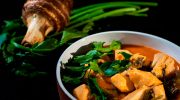
Kolokasi is almost always cooked with meat, most often pork or chicken, and prepared slowly so that its starch thickens the sauce naturally. Traditional handling is strict. The root is never washed with water before cooking, as this releases a sticky sap that ruins the texture. Instead, it is peeled dry and snapped into rough pieces so it cooks evenly without disintegrating.
This attention to method reflects respect for the ingredient rather than complexity for its own sake. Kolokasi dishes are filling, mild, and deeply satisfying. They are not festive centrepieces, but meals that anchor routine. Their continued presence on modern tables speaks to a food culture that values endurance over novelty.
Sweets and the Ritual of Hospitality
Cypriot sweets function differently from main dishes. They are rarely eaten casually and almost never served without purpose. Their primary role is kerasma, the act of offering something sweet to a guest.
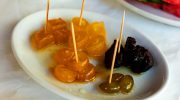
The most recognisable example is glyko tou koutaliou, or spoon sweets. Made by preserving fruit, peels, or nuts in sugar syrup, these sweets are served in small portions, traditionally on a single spoon with a glass of water. The ritual matters as much as the flavour. Offering a spoon sweet signals welcome, respect, and care.

Carob-based sweets such as pastelli reflect a similar logic. Carob trees were once economically central to rural Cyprus, and transforming their pods into syrup and toffee preserved value over time. The labour-intensive process of stretching and aerating pastelli was historically communal, tying sweet-making to shared effort and seasonal rhythm.

Other sweets, including pastries filled with anari cheese or syrup-soaked doughs, appear at festivals and religious events. Across all forms, sweetness in Cyprus is measured and intentional. Desserts are not everyday indulgences but social gestures that formalise relationships.
Three Roles, One Food Culture
What links these foods is not flavour but function. Makaronia tou Fournou gathers people. Kolokasi sustains them. Sweets formalise their relationships. Together, they demonstrate how Cypriot cuisine organises itself around use rather than excess.
This structure explains why many traditional dishes have survived with little change. They continue to meet practical needs. Celebration still requires scale and structure. Daily cooking still favours resilience. Hospitality still values restraint and symbolism.
Even as modern variations appear, these underlying roles remain intact. New ingredients, techniques, and presentations may emerge, but the social logic of the cuisine persists.
Why This Perspective Matters
Understanding Cypriot food through these roles offers a clearer picture than focusing on recipes alone. It shows how eating habits reflect land, history, and social expectations. The cuisine is not defined by constant reinvention, but by repetition refined over time.

For visitors, these dishes offer more than flavour. They provide insight into how Cyprus balances continuity and adaptation. For locals, they remain touchstones of identity, appearing not because tradition demands it, but because they still make sense.
In that way, Makaronia tou Fournou, kolokasi, and traditional sweets do more than represent Cypriot cuisine. They explain how it works.