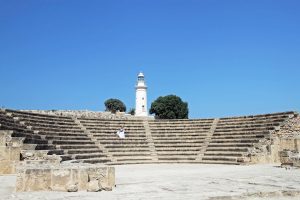
The Ancient Odeon of Paphos stands on the slopes of Fabrica Hill as one of Cyprus’s most elegant survivors from Roman times. Built entirely from carefully carved limestone blocks in the 2nd century AD, this semicircular amphitheater today hosts both visitors and live performances in a setting that connects modern audiences with ancient traditions.
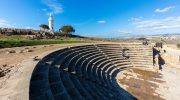
The Odeon began its life during the Hellenistic period when Paphos served as the capital of Ptolemaic Cyprus. The theater formed part of the Agora complex in the northern center of the ancient city. During the 2nd century AD, the Romans altered and expanded the structure to its present form. The builders integrated the theater into the natural slope of Fabrica Hill, cutting most of the amphitheater directly from solid rock and lining only the lower sections with separate limestone blocks.
The structure originally contained 25 rows of seating. Archaeological evidence suggests the theater had a roof, which would have protected spectators from the Mediterranean sun and enhanced the acoustics. A devastating earthquake struck Cyprus in the 4th century AD, causing severe damage throughout Paphos. While many buildings collapsed entirely, the Odeon survived with 13 rows of its seating intact. The stage, measuring 11 meters in diameter, remained largely undamaged, along with parts of the proscenium and the original cobblestone floor.
Discovery and Modern Restoration
The Cyprus Department of Antiquities uncovered the Odeon during excavations conducted in 1973 and 1974. The discovery revealed a remarkably well preserved structure considering its age and the natural disasters it had endured. The department undertook partial restoration work to stabilize the monument and make it accessible to visitors while preserving its archaeological integrity.
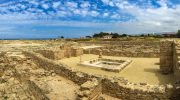
The restored Odeon features 12 rows of semicircular stone seating. The seating capacity accommodates approximately 1,200 spectators. The restoration team focused on the lower sections where the original structure remained most intact. They did not attempt to rebuild the upper rows that the earthquake had destroyed, instead leaving them as evidence of the building’s history and the forces of nature that shaped it.
The limestone blocks show exceptional craftsmanship. Ancient stonemasons cut and fitted each piece with precision, creating a structure that has withstood earthquakes, weathering, and more than 1,800 years of exposure. The hewn limestone provides natural acoustic properties that amplify sound from the stage without artificial enhancement.
The Agora and Surrounding Monuments
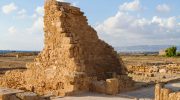
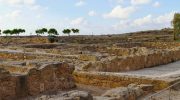
The Odeon sits within a complex of structures that formed the civic heart of ancient Paphos. The Roman Agora stands directly in front of the theater. This marketplace originally featured four porticos with white marble and granite columns surrounding an open square where citizens gathered for commerce and public discourse. Archaeological excavations have revealed the foundations and partial columns of this important public space.
South of the Odeon lie the remains of the Asklepieion, a temple dedicated to Asklepios, the god of medicine. This complex functioned as more than a religious site. It served as the city’s medical center, nursing home, and care facility for disabled residents under the protection of the deity. The Asklepieion contained multiple rooms arranged around a central courtyard, demonstrating both the faith of ancient Paphos residents and the sophisticated infrastructure of Roman Cyprus.
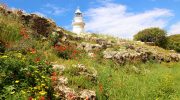
To the north of the theater, sections of the ancient city walls remain visible. These defensive structures protected Paphos during its centuries as the island’s capital. Near the Odeon stands a rocky mound believed to be the acropolis of the ancient town. The Paphos Lighthouse, a much more recent structure built in 1888, rises behind the amphitheater and has become part of the iconic view from the seating area.
Cultural Events Return to Ancient Stones
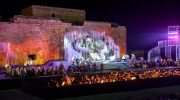
The restored Odeon functions again as a venue for cultural events, continuing a tradition that began nearly two millennia ago. The International Festival of Ancient Greek Drama brings classical plays to the stage each summer. Audiences sit on the same stones where ancient Cypriots watched performances, though now they see modern interpretations of works by Sophocles, Euripides, and other Greek dramatists.
The Paphos Choir Festival takes place annually in June. Choirs from across Cyprus and international groups compete and perform in this unique acoustic setting. The natural amplification created by the semicircular design and limestone construction allows voices to carry clearly to every seat without electronic equipment. Musical performances held throughout the summer months demonstrate how the ancient design principles still function effectively for modern entertainment.
The Rhythms of Light Festival occurs every Wednesday during summer months. This event features dance performances that animate the ancient stage with contemporary movement. Three performances take place each festival evening, transforming the historic monument into a living cultural space. These events draw both tourists and local residents who appreciate the combination of ancient architecture and modern artistry.
The Archaeological Park Context
The Odeon stands within the Paphos Archaeological Park, part of the UNESCO World Heritage Site inscribed in 1980. The park encompasses the major portion of ancient Nea Paphos, including structures dating from prehistoric times through the Middle Ages. Visitors who come to see the famous Roman villas with their exceptional mosaic floors also encounter the Odeon, often as a pleasant surprise given its excellent state of preservation.
The House of Dionysus lies within walking distance from the Odeon. This villa, built at the end of the 2nd century AD and abandoned after 4th century earthquakes, contains some of the finest mosaic work in the Mediterranean region. The House of Theseus, which served as the residence of the Roman proconsul or governor, demonstrates the wealth and political importance of Paphos during the Roman period. The House of Aion, discovered in 1983, features mosaics considered among the most exceptional works of ancient Roman art.
A larger Hellenistic Roman theater, dating to the end of the 4th century BC, stands in the northeastern area of ancient Paphos. Excavations by the University of Sydney have continued since 1995, gradually revealing this earlier performance venue. Unlike the Odeon, this larger theater remains largely unrestored and closed to the public, preserved in its excavated state for ongoing archaeological study.
Practical Details for Visitors
The Odeon is accessible as part of the Paphos Archaeological Park admission. A single ticket costing 4.50 euros grants access to all sites within the park. Alternatively, visitors can purchase a day pass for 8.50 euros that covers all ancient monuments and museums in Paphos. The park operates year round except for public holidays. Summer hours run from April 16 to September 15, with the site open from 8:30 AM to 7:30 PM. Winter hours from September 16 to April 15 extend from 8:30 AM to 5:00 PM.
He entrance to the Ancient Odeon is located on Galatiani Street, accessible from the roundabout at Kings Avenue Mall toward the port of Kato Paphos. The site sits in the heart of the tourist area, making it easily reachable on foot from hotels, restaurants, and the harbor. Free parking is available near the Archaeological Park entrance for those arriving by car.
What Makes This Theater Special
The Ancient Odeon represents a rare example of a Roman period theater that remains functional for its original purpose. While many ancient theaters across the Mediterranean have been excavated and preserved, few host regular performances on their original stages. The Odeon’s partial destruction by earthquake paradoxically aided its survival, as later generations did not quarry it extensively for building materials, unlike many fully intact ancient structures.
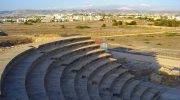
The integration of the theater into Fabrica Hill demonstrates sophisticated Roman engineering. By cutting directly into rock, the builders created a stable foundation that has withstood seismic activity better than freestanding structures. The natural stone also provides acoustic properties that would be difficult to replicate with constructed materials. Modern sound engineers who test the acoustics consistently express surprise at how effectively voices and music project from the stage to the highest remaining seats.
The building’s transformation from performance venue to workshop and back to cultural space tells a story common to many archaeological sites. Ancient structures adapted to changing needs across centuries before scholars recognized their historical value. The Odeon spent more time as a forgotten ruin and workshop than it functioned as a theater, yet restoration has allowed it to reclaim its original identity.
Why the Odeon Matters Today
The Ancient Odeon connects Paphos to a broader Mediterranean cultural tradition. Similar theaters appear throughout Greece, Turkey, Italy, and North Africa, physical evidence of how Roman civilization spread common architectural forms and cultural practices across its empire. The Paphos example demonstrates how Cyprus participated fully in this cultural network despite its island location.
For modern Cyprus, the Odeon provides a valuable cultural venue that links contemporary performances with ancient roots. When choirs sing or actors perform on the same stage where Roman residents gathered, the continuity of human artistic expression becomes tangible. The theater proves that ancient buildings need not function solely as museums but can remain active participants in cultural life.