The House of Aion in Kato Paphos preserves a late Roman mosaic program designed to communicate ideas, not just decorate a room, using myth to argue for cosmic order, education, and limits on human ambition. Made in the 4th century AD during the empire’s rapid Christianisation, the floor reads as a coherent statement from a pagan elite defending continuity through refined symbolism rather than confrontation.
This article explains where the building sits in ancient Paphos, how the five scenes build one argument, and what the mosaics reveal about power, belief, and artistic change in late antiquity.
Paphos, Power, and Maloutena
The House of Aion lies in the Maloutena district of ancient Nea Paphos, once the island’s administrative and cultural centre under Roman rule. This was a prestigious neighbourhood, close to the seat of the Roman governor and surrounded by villas that reflected wealth, education, and political influence.
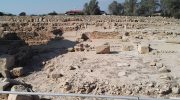
Its location matters. The house was not hidden or marginal. It stood among the most powerful spaces in the city, signalling that the ideas expressed inside were meant to be seen, discussed, and shared by those at the top of provincial society.
A Reception Room for Debate
Although commonly called a “house,” the structure breaks with standard Roman domestic design. The main reception room, a large triclinium, sits directly near the entrance rather than being tucked away at the back.
This arrangement suggests that the building functioned as a gathering place rather than a private family residence.
Archaeological evidence points to a possible association or intellectual circle meeting here, perhaps linked to artistic, philosophical, or religious traditions centred on Dionysus. Hidden storage spaces and richly painted walls reinforce the impression of a semi-public venue designed for discussion, ritual, and shared identity.
The Figure at the Centre: Aion
The mosaics take their name from Aion, the personification of eternal, cyclical time. Unlike Chronos, which marks passing moments, Aion represents the unchanging order of the universe, the rhythm behind seasons, lives, and cosmic renewal.
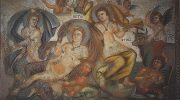
In the central mosaic panel, Aion appears as a youthful, authoritative judge presiding over a beauty contest. This is a striking departure from earlier versions of the myth, where judgment belongs to the mortal Paris.
Here, beauty and value are assessed not by human desire, but by eternity itself. The message is clear. True order is cosmic, not temporary.
A Story Told in Five Scenes
The mosaic floor unfolds as a sequence rather than a collection of unrelated myths. Each scene builds on the last, guiding the viewer through a progression of ideas.
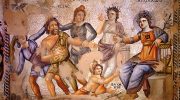
The upper panels explore origins and formation. Zeus approaches Leda, illustrating the moment when the divine crosses into the human realm. Nearby, the infant Dionysus is nurtured and educated, an image that emphasises care, continuity, and preparation rather than unchecked power.
At the centre, Aion judges between Cassiopeia and the sea nymphs. Human excellence is affirmed over untamed nature, not through arrogance, but through harmony with cosmic law. The judgment is calm, deliberate, and detached from emotion, reinforcing the authority of eternal order.
The lower panels move from principle to consequence. Dionysus appears in triumph, surrounded by ritual movement and collective presence, symbolising transformation through participation and shared belief.
The final scene, the punishment of Marsyas by Apollo, completes the argument. Artistic challenge without understanding leads not to liberation, but to destruction. The act is not portrayed as cruelty, but as inevitability within a universe governed by balance.
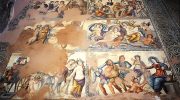
Seen together, these scenes operate as a philosophical statement rather than ornamental storytelling. The floor reads as a coherent argument laid out in visual form.
A Quiet Response to a Changing World
When the mosaics were created, Christianity was no longer peripheral. It was reshaping public space, authority, and symbolism across the empire. The House of Aion responds to this shift with refinement rather than confrontation.
Christian imagery is subtly echoed and reinterpreted throughout the mosaics. The nurturing image of the infant Dionysus recalls contemporary depictions of the Virgin and Child. Apollo appears clothed and composed, marked by visual authority rather than classical nudity.
These choices are not accidental. They demonstrate an awareness of emerging visual language and a deliberate effort to speak within it.
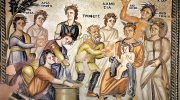
Rather than rejecting the new order outright, the mosaics argue for continuity. They present pagan philosophy as enduring, adaptable, and rooted in universal principles rather than fading belief.
Craftsmanship and Late Antique Style
The technical execution of the mosaics reflects both skill and intention. Stone and glass tesserae are deployed selectively, with glass reserved for divine figures and symbolic emphasis. Light interacts differently with these materials, subtly directing attention across the scenes.
Stylistically, the mosaics sit between classical naturalism and the emerging visual logic of the Byzantine world. Figures appear flatter, outlines are clearer, and symbolism takes precedence over illusionistic depth.
This stylistic transition mirrors the intellectual moment in which the work was produced, as meaning increasingly outweighed realism.
Visiting the House of Aion Today
Today, the House of Aion remains one of the most accessible and intellectually engaging sites within the archaeological park. A protective shelter preserves the mosaics, while elevated walkways allow visitors to follow the sequence without interruption.
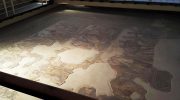
Those who linger often notice how the eye is guided from panel to panel, encouraged to read the floor as a unified composition.
Visiting during quieter hours, particularly early morning or late afternoon, allows the narrative clarity and visual balance of the mosaics to emerge more fully.
What the Floor Proves
The House of Aion endures because it captures a moment when ideas were under pressure, and art became a means of response. It shows how a community confronted cultural transformation not by retreating, but by articulating its values with precision and confidence.
These mosaics do more than preserve myth. They preserve reasoning. They remind us that floors can argue, that images can think, and that carefully structured ideas can outlast the walls that once contained them.