Explore Cyprus with Our Interactive Map

Explore our top stories and discover ideas worth your time.

House of Eustolios In Cyprus Roman Villa Mosaics

House of Eustolios In Cyprus Roman Villa Mosaics

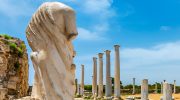
Perched on the southern cliffs of ancient Kourion near modern Limassol, the House of Eustolios stands as one of Cyprus's most fascinating archaeological sites. This late 4th-century complex blends Roman luxury with early Christian devotion, creating a unique window into a transformative period in Mediterranean history. Originally built as a private villa, the structure evolved into a public recreation center that served Kourion's citizens for over two centuries. Historical Background The House of Eustolios rose from the ruins of catastrophe. In 365 AD, a massive earthquake devastated the eastern Mediterranean, striking Kourion with particular force. The ancient city, which had thrived as one of Cyprus's major kingdoms since the 13th century BC, lay in rubble. Buildings collapsed, infrastructure crumbled, and the population struggled to survive among the wreckage. Twenty-five years after the disaster, Kourion remained in a dismal state. Into this scene returned Eustolios, a wealthy Christian citizen who had been away from his hometown. Shocked by the continued suffering of his fellow citizens, he made a remarkable decision. Rather than simply rebuild for himself, Eustolios constructed an elaborate complex on the ruins of an earlier Roman villa and donated the entire facility for public use. The timing proved significant. Emperor Theodosius I had just made Christianity the official religion of the Roman Empire in 380 AD. Eustolios embraced this…

Read more
Work Culture and Employment Opportunities in Cyprus

Work Culture and Employment Opportunities in Cyprus

The country sits at the crossroads of three continents. This strategic position has shaped its economy into a diverse hub for international business. Cyprus joined the European Union in 2004 and adopted the euro in 2008, which strengthened its position as a business center. The economy grew by 3.6% in 2025, outpacing most eurozone countries. This growth stems from strong performance in tourism, information technology, financial services, and shipping. The island hosts over 1,500 active job listings at any given time, with companies actively seeking both local and international talent. Cyprus offers several practical advantages for workers. The corporate tax rate stands at 12.5%, one of Europe's lowest. English is widely spoken in business settings, particularly in cities like Nicosia and Limassol. The climate provides sunshine year-round, and the cost of living remains moderate compared to other EU nations. Understanding the Cypriot Work Environment Workplace culture in Cyprus blends European professionalism with Mediterranean warmth. Companies value relationship-building and personal connections as much as technical competence. Trust develops through consistent interaction, and many business relationships extend beyond office hours into social settings. The standard working week spans 38 to 40 hours across five days. Most offices operate from 8:00 AM to 5:00 PM, though some businesses follow split schedules with afternoon breaks. Employees can expect 20 days of paid annual leave…

Read more
Ayios Nikolaos Sea Cave

Ayios Nikolaos Sea Cave

Cape Greco is a headland located between Ayia Napa and Protaras at the southern end of Famagusta Bay. The area covers 385 hectares and was designated as a National Forest Park under the administration of Cyprus's Forestry Department. The coastline here features dramatic limestone cliffs that reach 30 feet (roughly 10 meters) in height and contains numerous sea caves carved by wave action. The caves are formed from layered limestone that was deposited in warm seas millions of years ago. The rock consists of hard and soft layers that erode at different rates. Waves constantly pound against the cliffs and dissolve the softer limestone faster than the harder layers above and below. This differential erosion creates the caves, arches, and tunnels that characterize the Cape Greco coastline. Historical Background The formation process began thousands of years ago when sea levels and wave patterns were different. Water enters cracks in the limestone and widens them through both mechanical force and chemical dissolution. Seawater contains salt and is slightly acidic, which helps dissolve calcium carbonate in the limestone. The caves show an almost horizontal layer of soft limestone that waves eroded easily. The overlying harder layer protected the caves from collapse and created roof structures. The lower layer is also harder and forms a several-meter-wide ledge. At some locations, this ledge is…

Read more