Explore Cyprus with Our Interactive Map

Explore our top stories and discover ideas worth your time.

Sanctuary of Opaon Melanthios

Sanctuary of Opaon Melanthios

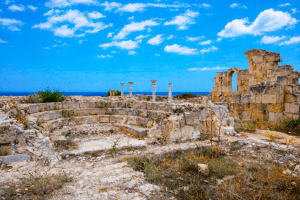
A rural shrine dedicated to a local healing deity (Melanthios), illustrating the existence of indigenous Cypriot gods worshipped alongside the Greek pantheon. The Sanctuary of Opaon Melanthios stands as a profound example of Cyprus's religious syncretism, where an indigenous deity associated with shepherds and rural healing was venerated in harmony with Greek gods like Pan and Apollo. Situated on the 'Petros Anthropos' hill north of Amargeti in the Paphos district, this rural shrine highlights the island's unique spiritual landscape, blending local Cypriot traditions with Hellenistic influences. As a healing deity, Opaon Melanthios, whose name translates to "Dark Shepherd", was invoked for protection over flocks, health, and fertility, reflecting the agrarian society's reliance on divine intervention for well-being and prosperity. This site underscores Cyprus's role as a cultural crossroads, where native gods coexisted with imported pantheons, fostering a resilient worship that endured from the Archaic period through Roman times, and continues to intrigue archaeologists today. A Rural Shrine of Syncretism The Sanctuary of Opaon Melanthios, perched on a modest hill overlooking the verdant valleys of Amargeti, embodies the quiet devotion of Cyprus's rural communities to a deity who bridged local folklore and Greek mythology. Covering a small area of rocky terrain dotted with ancient olive trees, the site features remnants of a temple structure, altars, and votive deposits that speak to…

Read more
Cavo Greco Sunrise Viewpoint, Cyprus

Cavo Greco Sunrise Viewpoint, Cyprus

The Cavo Greco sunrise viewpoint sits at the southeastern edge of Cyprus, positioned at 95 meters above sea level on a small limestone mountain within Cape Greco National Forest Park. This protected area spans 385 hectares between the resort towns of Ayia Napa and Protaras. The viewpoint marks the easternmost point of both the Republic of Cyprus and the European Union, offering unobstructed panoramas of the Mediterranean Sea, Famagusta Bay, and the surrounding coastline. Visitors come here primarily for the spectacular sunrise displays that occur daily, with the sun rising directly from the sea in vibrant colors that illuminate the limestone cliffs and turquoise waters below. Historical Background The limestone cliffs and formations seen today were created through a combination of tectonic activity and the erosive forces of the sea and wind over millions of years. The karst topography has produced numerous caves and natural arches throughout the area. The cape was known as Cape Pedalion in antiquity, and according to Strabo the trapezoidal hill lying above it was sacred to Aphrodite. Archaeological evidence shows the area has been inhabited since Neolithic times, with one of the oldest settlements in Cyprus discovered here in 1992. Cape Greco was designated as a National Forest Park in 1993 to preserve its unique ecosystems and prevent further degradation. Between 1910 and 1920, the…

Read more
Tips of settling in Cyprus

Tips of settling in Cyprus

Moving to a new country brings excitement mixed with practical challenges. Cyprus welcomes thousands of newcomers annually, from retirees seeking Mediterranean sunshine to professionals building international careers. The island nation offers a comfortable climate with over 320 sunny days yearly, affordable living costs compared to Western Europe, and a welcoming expat community. English speakers find integration particularly smooth, as the language remains widely spoken due to Cyprus's British colonial history lasting until 1960. Understanding the essential steps before arrival transforms what could be an overwhelming process into a manageable transition. This guide covers the practical elements of settling in Cyprus successfully. Finding Housing That Fits Your Budget Housing costs vary dramatically by location and proximity to coastlines. Limassol and Nicosia command the highest rents, with one-bedroom city center apartments ranging from €700 to €1,500 monthly. Paphos and Larnaca offer more affordable options at €400-700 for similar accommodations. Mountain villages and inland areas provide the lowest costs, with properties sometimes available under €400 monthly. Purchase prices follow similar patterns. Coastal properties in tourist zones cost €3,000-5,000 per square meter, while inland locations range from €1,300-2,500. Property buyers must account for additional expenses including VAT (5-19% depending on property type and value), stamp duty (0.15-0.2%), and transaction fees (1%). Non-EU buyers require Council of Ministers approval, though this rarely causes delays. Popular…

Read more