Explore Cyprus with Our Interactive Map

Explore our top stories and discover ideas worth your time.

Cyprus Water Scarcity Desalination

Cyprus Water Scarcity Desalination

Cyprus faces one of Europe's most severe water scarcity challenges, with dam levels hovering around 12 percent of capacity as of early 2026. The island's 108 dams and reservoirs, built since the 1980s to capture winter rainfall, now hold just 35 million cubic meters compared to 75 million at the same time in 2025. Climate change has accelerated drought cycles from once every 20 years to nearly every two years since 2007. The 2024-2025 hydrological year ranked among the driest since 1878, with only 312.5 millimeters of total rainfall. January 2025 recorded the lowest monthly rainfall in almost three decades. This crisis has forced Cyprus to become heavily dependent on desalination, which now supplies approximately 70 percent of the island's drinking water. The government has committed 196 million euros for water measures in 2026 alone, including 140 million euros specifically for purchasing desalinated water. The Shift From Dams to Desalination Technology Cyprus introduced large-scale desalination in 1997 with a 20,000 cubic meter per day reverse osmosis plant at Dhekelia. The facility was soon expanded to 40,000 cubic meters daily due to prevailing drought conditions. This marked a fundamental shift in Cyprus's water strategy. Prior to 1997, the island relied almost entirely on dam storage and groundwater extraction through boreholes. In 1991, Cyprus exploited 36.3 million cubic meters of water, with…

Read more
Pierides Museum Cyprus

Pierides Museum Cyprus

The Pierides Museum is the oldest private museum in Cyprus and operates in the ancestral home of the Pierides family, a colonial-style mansion built in 1825. The institution houses more than 2,500 artifacts that document 9,000 years of Cypriot civilization. The collection was initiated by Demetrios Pierides in the 19th century (1811-1895), with the aim of protecting and preserving Cyprus' antiquities and preventing the loss of the island's history. Today the museum functions under the management of the Bank of Cyprus Cultural Foundation and serves as a testament to five generations of dedicated collecting. The building sits in the heart of Larnaca and provides visitors with a journey through the major periods of Cypriot prehistory and history. Historical Context Demetrios Pierides was a Greek Cypriot banker, vice consul of Great Britain and collector of ancient Cypriot artifacts. Born in 1811, he studied history and literature in England and served as a private tutor of Greek for the Duke of Sutherland before becoming a professor of English language in Greece. He was the Director of Ottoman Bank in Larnaca and participated in an 1849 expedition led by Royal Navy Captain T. Graves to compile the first proper map of Cyprus. Demetrios Pierides began purchasing artifacts to preserve them and keep them in Cyprus rather than allowing foreign dealers to remove the…

Read more
How Infrastructure Overcomes Cyprus’s Rugged Terrain

How Infrastructure Overcomes Cyprus’s Rugged Terrain

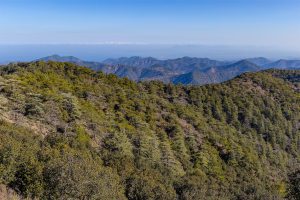
The Troodos Mountains cover roughly one-third of Cyprus, stretching across most of the western portion. Mount Olympus rises to 1,952 meters, making it the island's highest peak. These mountains formed through the collision of African and European tectonic plates, pushing ancient seabed rock formations skyward over millions of years. The landscape varies dramatically within short distances. Coastal areas sit at sea level while mountain villages perch at elevations exceeding 1,000 meters. Steep valleys cut through the terrain, with rivers carving gorges that modern roads must somehow cross. In 2011, heavy rainfall triggered 128 separate landslide incidents in Paphos, causing significant damage to roads and buildings. These geological realities force engineers to constantly assess slope stability when planning new infrastructure. The island's geology includes unstable clay-rich soils and fractured rock formations that shift during rainfall, creating ongoing maintenance demands. Building Motorways Through Mountains Cyprus developed its motorway network relatively recently compared to European neighbors. The A1, completed in October 1985, became the island's first motorway. Despite this late start, Cyprus now leads all European Union members with 36.8 kilometers of motorway per 100,000 inhabitants. The network totals approximately 7,206 kilometers of paved roads and 4,387 kilometers of unpaved routes. No toll roads exist anywhere on the island. The Public Works Department manages motorways and major roads, while municipalities handle urban streets…

Read more