Explore Cyprus with Our Interactive Map

Explore our top stories and discover ideas worth your time.

Traditional Cypriot Rural Life

Traditional Cypriot Rural Life

Cyprus's rural economy developed around livestock farming for thousands of years before modern tourism. Goats, sheep, and donkeys formed the backbone of village life, providing milk, meat, wool, transportation, and labor. These animals adapted perfectly to the island's hot, dry climate and rocky terrain. Families raised small herds using methods passed through generations, with women typically managing milk production and cheese making while men handled field work and shepherding. The livestock fit naturally into Cyprus's agricultural cycle, grazing on wild plants during rainy months and consuming crop residues during summer. This system created self-sufficient communities where nearly every household maintained animals. Archaeological evidence shows Cypriots domesticated these species during the Aceramic Neolithic Period around 7000 BCE, making livestock farming one of the island's oldest continuous traditions. Ancient Origins of Cypriot Animal Husbandry Prehistoric settlers brought domesticated animals to Cyprus during the early Bronze Age around 2500 BCE. These people possessed navigation skills that allowed them to transport household goods and livestock across the Mediterranean. They introduced pigs, sheep, goats, and cattle to the island. Evidence from Bronze Age sites like Politiko Troullia shows communities consumed sheep, goat, cattle, and pig while also hunting fallow deer for ritual feasts. The indigenous Cyprus Fat-tailed sheep developed over millennia of breeding in local conditions. This triple-purpose breed produced milk, coarse wool, and meat,…

Read more
Cyprus Holy Site Pilgrimages

Cyprus Holy Site Pilgrimages

Cyprus has been a destination for pilgrimage and cultural travel for more than 1,700 years. The island holds a distinctive place in Mediterranean history due to its early adoption of Christianity during the Roman period and its later development into an important center of Byzantine religious administration and art. Across the island, dozens of monasteries, churches, and heritage sites are distributed from coastal cities to mountainous regions. These locations preserve artifacts, architectural structures, icons, and long-standing traditions that reflect the development of religious life in Cyprus from late antiquity through the Byzantine and post-Byzantine periods. Visitors from different regions, including Eastern Europe and the Mediterranean, have historically traveled to these sites for cultural interest, historical study, and religious observance. Religious and cultural tourism in Cyprus brings together historical exploration and natural landscapes. Pilgrimage routes and heritage sites are located in varied environments, including ancient urban centers, rural villages, and remote mountain monasteries. Visitors encounter Byzantine frescoes, preserved manuscripts, architectural remains, and decorative art spanning several centuries. The experience provides insight into how religious institutions influenced art, education, and social life across Cyprus. Whether approached from a historical, archaeological, or cultural tourism perspective, these sites illustrate the island’s long-standing role in the development of Eastern Mediterranean heritage. Historical Background The tradition of pilgrimage to Cyprus is closely connected to developments in…

Read more
Cypriot Wine Bottles and Vessels

Cypriot Wine Bottles and Vessels

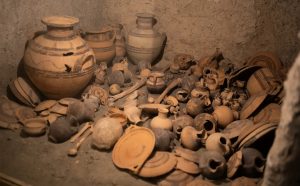
Cyprus developed a distinct tradition of wine storage and transport vessels over 6,000 years. The island's geographic position between three continents made it a vital Mediterranean trading hub where wine culture flourished. From ancient egg-shaped jars discovered at Erimi dating to 3000 BCE to massive pitharia storage vessels holding up to 2,000 liters, these containers represent far more than simple pottery. Each vessel type served specific purposes in wine production, fermentation, storage, and trade. The containers tell stories of technical innovation, economic networks, and cultural practices that shaped wine civilization across Europe and the Mediterranean. Historical Context Archaeological excavations at Erimi-Bamboula conducted by Porphyrios Dikaios between 1932 and 1935 uncovered egg-shaped jars from the Chalcolithic period around 3900 to 2500 BCE. These jars featured long narrow necks, pointed nipple bases, and no handles. Tests conducted in 2005 analyzed residues from eighteen jar bases, with twelve showing large traces of tartaric acid, a naturally occurring compound found primarily in grapes. This discovery confirmed these vessels were used to intentionally process wine, making them predecessors to later amphora-type wine storage containers. The Bronze Age brought expansion in wine trade. From 3300 to 2000 BCE, organized small-scale commerce developed with Egypt and the Syrian-Palestinian coast. The Canaanite amphora emerged as the earliest commercial vessel type in the Mediterranean, serving as a model for…

Read more