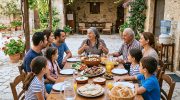
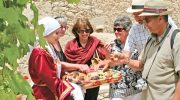
Filoxenia in Cyprus is a practical social system that turns welcome into trust, shaping how guests are treated, how newcomers are absorbed, and how communities respond during crisis. Rooted in older Mediterranean ideas of sacred hospitality and refined through centuries of change, it appears most clearly at the table, in coffee culture, and in the way people share space without keeping score.
This article traces where filoxenia comes from, how it works in everyday life across the island, and why it still helps Cyprus stay socially resilient.
- A value older than borders
- When myth becomes behaviour
- Empires Added Layers, Not Replaced Them
- The table as a social contract
- Coffee, patience, and the rhythm of trust
- Different landscapes, the same instinct
- 1974: Hospitality as Survival
- Faith, festivals, and collective memory
- Filoxenia in Digital Cyprus
- Why It Still Holds Society Together
A value older than borders
The idea of filoxenia did not emerge from tourism or modern etiquette. Its roots stretch back to the ancient Greek world, where hospitality was considered sacred rather than optional. A stranger at the door was not simply a visitor, but a moral test.
Ancient belief held that gods could walk among humans in disguise. Treating a guest poorly risked divine punishment, while generosity was seen as a sign of virtue. This belief gave hospitality weight. It was no longer politeness, but duty.
That mindset survived centuries of political change on the island. Even as empires rose and fell, the expectation remained that a guest must be fed, welcomed, and protected before being questioned. In Cyprus, this ancient logic never fully faded.
When myth becomes behaviour
Stories from classical literature helped fix hospitality into social memory. Tales like that of Baucis and Philemon, an elderly couple rewarded for welcoming unknown travellers, were not simply myths but moral blueprints.

The lesson was direct and enduring. Generosity revealed character. Wealth did not excuse refusal, and poverty did not absolve responsibility. What mattered was willingness.
Over time, these ideas settled into everyday Cypriot behaviour. Offering food without being asked, insisting a guest stay longer, or expressing concern for a stranger’s family are not gestures designed to impress. They are inherited reflexes, reinforced by repetition rather than instruction, and absorbed long before they are consciously understood.
Empires Added Layers, Not Replaced Them
Cyprus has always existed at the intersection of trade routes, faiths, and empires. Its version of filoxenia absorbed influence without losing its core purpose.
Under Ottoman rule, hospitality was shaped by adab, a code of dignified conduct that valued patience, respect, and measured behaviour. Coffee houses emerged as shared spaces where hospitality was expressed through time and conversation rather than material display.
British administration later introduced bureaucratic order and linguistic openness, yet personal warmth remained separate from institutional formality. Even during periods of political tension, Cypriots learned to distinguish authority from humanity. A guest was still a guest, regardless of history.
Rather than weakening filoxenia, these layers refined it, allowing the value to remain recognisable while adapting to changing social structures.
The table as a social contract
Within the Cypriot home, filoxenia finds its clearest expression at the table. Hospitality begins with food, but its significance lies in what the meal creates rather than what it contains.

Meals unfold slowly, guided by conversation rather than schedule. Dishes arrive in stages, allowing time to stretch and relationships to settle. The structure of the meze reflects this intention. Shared plates dissolve hierarchy, replacing formality with collective participation.
Abundance carries symbolic weight. An empty table suggests neglect rather than restraint. Hosts continue offering food not to overwhelm guests, but to ensure that care has been unmistakably conveyed.
Even the smallest gestures hold meaning. A spoonful of sugar offered with water and coffee is not a dessert. It is an acknowledgement. You are welcome here, even if only for a moment.
Coffee, patience, and the rhythm of trust
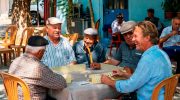
Cypriot coffee culture reinforces the same values in public space. Coffee is prepared slowly and consumed without urgency. Conversation lingers as the grounds settle. Time is allowed to expand.

Inviting someone for coffee is rarely incidental. It signals openness and creates space for trust to form gradually. In a society where relationships matter more than transactions, patience becomes a social skill rather than an inconvenience.
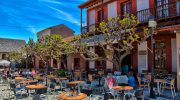
In villages, coffee houses continue to function as informal centres of exchange, where news, opinion, and reassurance circulate freely. In towns and cities, cafés perform a similar role. The setting changes, but the underlying rhythm remains constant.
Different landscapes, the same instinct
Filoxenia adapts to geography without altering its character. In mountain villages, like in Phini village, hospitality often takes a direct and personal form. Visitors are drawn into daily routines through shared meals, conversation, and local customs. Tourism here is quieter, shaped more by pride than performance.

Along the coast, hospitality becomes more outward-facing and multilingual, responding to seasonal movement and international visitors. Yet even in these settings, neighbours frequently offer guidance, food, or simple companionship without prompting. The gesture remains unchanged. Only the context shifts.
1974: Hospitality as Survival
The deepest strength of filoxenia emerges during moments of collective strain. After the displacement of 1974, communities absorbed thousands of refugees not solely through formal systems, but through shared homes, extended families, and mutual responsibility.
Living spaces were crowded. Resources were stretched. Yet support moved horizontally, sustained by obligation rather than charity. Education was protected as a form of continuity, and social bonds replaced institutional certainty.
Decades later, during periods of financial instability, similar patterns reappeared. When systems faltered, people turned to one another. Hospitality became a means of endurance rather than comfort.
Faith, festivals, and collective memory
Religious festivals continue to reinforce these bonds. Village fairs and celebrations function as acts of remembrance as much as joy. Food, music, and ritual intertwine, reconnecting dispersed families and reaffirming shared identity.

Participation matters more than spectacle. Visitors are not positioned as observers, but folded into the event itself. Inclusion becomes the expression of hospitality rather than its outcome.
Filoxenia in Digital Cyprus
As Cyprus modernises, filoxenia evolves without losing relevance. Hospitality now extends into digital spaces, shaping how information is shared, how services are explained, and how trust is built online.
The same principles apply. Clarity over exaggeration. Warmth over persuasion. Respect for the visitor’s time and intelligence. The medium changes, but the ethic remains recognisable.
Why It Still Holds Society Together
Filoxenia endures because it works. It creates cohesion, reduces friction, and offers stability in uncertain conditions. It is not symbolic or performative. It is practical.
In a region shaped by movement, loss, and renewal, hospitality became a form of continuity. It is reinforced through habit rather than declaration, and sustained through necessity rather than nostalgia.
In Cyprus, welcoming the stranger was never about courtesy alone. It was about preserving the social fabric itself. And that is why filoxenia still matters.