Traditional dance competitions in Cyprus are not performances staged for spectacle alone. They are structured moments where history, regional identity, and communal memory are actively tested and refined. Across village squares, coastal towns, and formal festival stages, dancers are judged not only on technique but on how faithfully they carry movements shaped by centuries of Cypriot life. What emerges is not nostalgia, but discipline. Not a postcard version of tradition, but a living standard that Cyprus expects its dancers to meet.
- More Than Dance: Why Competition Matters in Cyprus
- A Shared Language with Regional Accents
- When Movement Becomes a Marker of Place
- From Village Gatherings to Organised Festivals
- How Competitions Are Judged
- Dances That Test Skill and Control
- Music as an Equal Partner
- Costumes That Speak Without Words
- Festivals Where Competition Becomes Collective Memory
- Passing the Rhythm Forward
- Why These Competitions Still Matter
More Than Dance: Why Competition Matters in Cyprus
In Cyprus, dance has never been separate from daily life. For generations, it accompanied weddings, harvests, religious festivals, and seasonal gatherings. Competition emerged naturally from this environment, not as rivalry for its own sake, but as a way of recognising skill, confidence, and social standing.
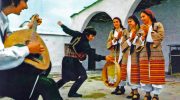
Modern competitions continue that older logic. They exist to ensure that dances are not diluted by convenience or modern taste. Judges evaluate how well performers understand structure, rhythm, posture, and cultural intent. Winning matters, of course, but correctness matters more. To dance well in Cyprus is to show that you know where the movement comes from and why it exists.
A Shared Language with Regional Accents
Cypriot folk dance operates on two levels at once. There is an island-wide vocabulary of steps and formations that most dancers recognise instantly, and there are local variations that quietly signal regional identity.
Dances such as the Syrtos form the backbone of this shared language. Its circular formation and steady rhythm appear across Cyprus, creating a sense of continuity between communities. Yet small details, such as tempo, posture, or emphasis, can reveal whether a group comes from the east, west, or north of the island. In competition, those details are not treated as decoration. They are treated as evidence. Judges expect dancers to perform not just the correct dance, but the correct version of that dance for their region.
When Movement Becomes a Marker of Place
Regional identity in Cypriot dance is often most visible in costume and styling rather than steps alone. The cut of a garment, the way a headscarf is tied, or the weight of fabric used can all point to a specific district.
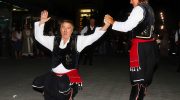
In Paphos, for example, women’s costumes tend to be wider, reflecting older rural styles, while eastern regions favour straighter cuts designed for mobility. In Karpasia, some elements of dress and movement are preserved with remarkable consistency, echoing patterns that stretch back thousands of years. Competitions turn these distinctions into living reference points. They prevent regional styles from being flattened into a single “Cypriot look” and ensure that local identity remains legible in motion.
From Village Gatherings to Organised Festivals
Historically, competition in dance was informal. At weddings, men would dance one after another, watched closely by the community. Confidence, control, and rhythm mattered. A skilled dancer was admired not only for his movement, but for what it suggested about character and capability.
Formalisation began in the twentieth century as folklore associations, municipalities, and cultural bodies sought to protect these traditions from erosion. Organisations such as national dance federations introduced clear categories, judging criteria, and repertoires. This shift did not replace village culture. It reinforced it by creating standards that could be taught, assessed, and passed on. In this sense, formal competitions became another layer of continuity rather than a break from the past.
How Competitions Are Judged
Modern dance competitions in Cyprus are rigorous. Performances are evaluated across several dimensions, each designed to prevent superficial interpretation.
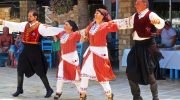
Judges typically assess:
● Technical accuracy, including footwork, posture, and timing
● Synchronisation, especially in group dances like the Syrtos
● Flow and transitions, ensuring movements connect naturally
● Cultural authenticity, reflecting the correct regional style
● Interpretation, where storytelling or symbolism is involved
Mistakes are treated seriously. A missed step, a loss of balance, or even a costume failure can affect scoring. This strictness reinforces the idea that tradition deserves discipline, not approximation.
Dances That Test Skill and Control
Some Cypriot dances exist specifically to test mastery. These are not decorative pieces, but technical challenges passed down through generations.
The Tatsia dance, for example, requires a performer to spin a sieve while balancing glasses of wine without spilling them. Precision, focus, and calm under pressure are essential. Other dances demand a different kind of control. The Drepani uses a large hooked sickle to mimic the cutting of crops, requiring strength, timing, and spatial awareness. The Kouza is performed by women and centres on a narrative of a clay pot broken at a fountain, with tension resolved through symbolic gestures and dance.
In competition, these dances reveal whether performers understand the balance between form, story, and restraint. They test whether the dancer can hold tradition steadily rather than simply decorate it.
Music as an Equal Partner
Dance competitions would be incomplete without music that follows the same principles of authenticity. Traditional Cypriot music relies heavily on the violin and lute, supported by percussion and older wind instruments such as the pithkiavlin.
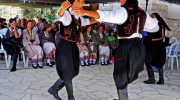
In the most respected competitions, live musicians are preferred because they allow a dialogue between dancer and musician. Tempo and energy can respond to one another in real time, and a skilled dancer knows how to ride those shifts without breaking form. Recorded music may be permitted in some contexts, but it is often viewed as a compromise rather than an ideal.
Costumes That Speak Without Words
Costume in Cypriot dance is not decorative. It communicates region, era, and social meaning, and judges examine materials, proportions, and historical accuracy carefully.
For men, the vraka trousers, waistcoat, and boots form a recognisable ensemble, with subtle details signalling formality or status. For women, garments such as the sagiya and sarka vary significantly by region, and incorrect combinations are quickly noticed. A costume worn incorrectly can undermine an otherwise strong performance because clothing is treated as part of the choreography, not an accessory.
Festivals Where Competition Becomes Collective Memory
Some of Cyprus’s most important dance competitions take place during long-established festivals. Kataklysmos in Larnaca is a prime example. Held annually around Pentecost, it brings together dance, music, poetry, and communal celebration.
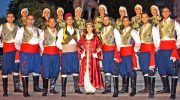
During these festivals, competition does not feel isolating. It is embedded within shared experience. Audiences understand what they are watching, and elders recognise movements they have seen all their lives. Success carries cultural weight because it is witnessed by people who can tell the difference between performance and inheritance.
Passing the Rhythm Forward
Traditional dance remains part of formal education in Cyprus. Children learn steps at school, join local associations, and gradually move into competitive contexts as their skills develop. This progression ensures that competitions do not become closed systems dominated only by professionals.
In recent years, digital archiving and motion-capture projects have added another layer of preservation. These tools are not replacing dancers. They are supporting teachers and researchers by recording movements with a precision that written descriptions cannot fully capture.
Why These Competitions Still Matter
Traditional dance competitions in Cyprus endure because they serve a clear purpose. They prevent tradition from becoming vague, sentimental, or simplified into a tourist-friendly version of itself. By insisting on accuracy, context, and discipline, they keep cultural memory active.
What appears on stage is not simply a dance. It is a conversation between generations, shaped by land, labour, celebration, and restraint. As long as Cyprus continues to judge its traditions with care rather than convenience, these competitions will remain one of the island’s most effective ways of remembering who it is.