Religious family celebrations in Cyprus structure the year, linking church life to home routines through repeated gatherings, shared food, and public ritual. Easter, Christmas, Name Days, and village panigyria work as social glue because they bring generations into the same spaces, reinforce kinship roles, and keep hospitality active rather than symbolic. This article explains how the calendar shapes family behaviour, what key celebrations look like in practice, and why these rituals still provide continuity in modern Cypriot life.

A Calendar That Shapes Everyday Life
The rhythm of Cypriot family life follows the Orthodox Christian calendar, which blends fixed feast days like Christmas with movable celebrations centred on Easter. This structure does not simply schedule holidays. It divides the year into periods of preparation, restraint, and release, giving time a recurring, almost circular quality.
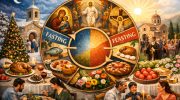
Families move together through fasting seasons and feast days, knowing what comes next and preparing for it collectively. Food, church attendance, and domestic routines all shift in response. In this way, religious time does not interrupt ordinary life. It gives it form.
The Family as the First Sacred Space
In Cyprus, faith is rarely practised alone. The family operates as a small extension of the church, where belief is learned through observation rather than instruction. Children absorb ritual by watching grandparents light candles, prepare fasting meals, or cross themselves before leaving the house.
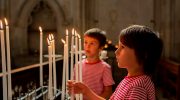
Elders hold a central role during celebrations. Seating order at the table, who speaks first, and who blesses the meal all reflect an inherited hierarchy that reinforces respect and continuity. Religious gatherings quietly reaffirm family structure while bringing multiple generations into the same shared moment.
Easter: The High Point of the Ritual Year
Easter, or Pascha, is the most emotionally charged and socially unifying celebration in Cyprus. It is prepared for over weeks, beginning with the Great Lent fast and intensifying during Holy Week. Families adjust their diets, routines, and schedules together, creating a sense of shared anticipation.

Holy Thursday is marked by domestic activity, especially the baking of flaounes, the distinctive Cypriot Easter pastries filled with cheese and aromatic spices. Eggs are dyed red, symbolising life emerging from the sealed tomb. These tasks are rarely solitary. They are collective efforts that draw children, parents, and grandparents into the same workspace.
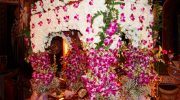
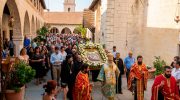
Good Friday brings the community into the streets. Churches overflow with flowers as families decorate the Epitaphios bier, which is then carried through villages and neighbourhoods in a solemn evening procession. The public space itself becomes sacred, temporarily reshaped by shared movement and song.
Midnight Light and Courtyard Fires
The transition from mourning to celebration occurs at midnight on Holy Saturday. Churches fall into darkness before a single flame is passed from candle to candle, filling the space with light. The greeting “Christos Anesti” replaces ordinary conversation, signalling a shift not only in theology but in social mood.
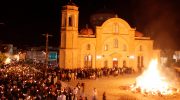
Outside, large bonfires burn in church courtyards, often built by local youth as a rite of passage. After the service, families carry the flame home, marking doorways with candle smoke to symbolically protect the household. Celebration does not end at the church doors. It continues indoors, where the fast is broken together and the night stretches into conversation.
Easter Sunday: Slow Lamb, Long Talk
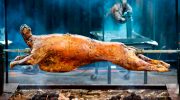
Easter Sunday centres on food, but not simply as indulgence. The meal itself is a ritual of reunion. Lamb is roasted slowly outdoors, drawing relatives together for hours before eating begins. The table becomes the place where stories are retold, absences are noted, and family bonds are reinforced.
Simple games, like tapping red eggs to see which remains unbroken, quietly blend faith with play. Even these small acts carry symbolic meaning, linking luck, vitality, and blessing in ways that children understand intuitively.
Christmas: Faith Turned Inward
While Easter opens outward into streets and courtyards, Christmas in Cyprus turns inward, drawing family life closer to the home. The season unfolds slowly, guided by a long fasting period that encourages restraint before celebration. Anticipation builds quietly, shaped by routine rather than spectacle.

Homes fill with familiar scents as kitchens come alive. Honey warms on the stove, spices are measured by memory, and Christopsomo, the ceremonial Christmas bread, is prepared and marked with a cross. These acts are not rushed. They are part of creating a domestic rhythm that mirrors the spiritual one, allowing faith to be felt through repetition and care.

Christmas Day begins early, often with church attendance, followed by a meal that favours presence over excess. Conversation lingers. Time stretches. The celebration continues beyond a single day, extending through the New Year and Epiphany, giving families space to remain gathered rather than quickly returning to routine.
Name Days and the Open House Tradition
Alongside major religious feasts, Name Days occupy a distinctive place in Cypriot life. Tied to the feast day of a saint rather than a birth date, they emphasise continuity and collective identity over individual milestones.
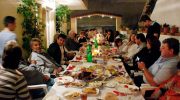
The tradition reverses expectations. Instead of receiving guests by invitation, the person being honoured keeps their home open throughout the day. Visitors arrive freely, often unannounced, sharing coffee, sweets, and conversation. Hospitality becomes the central gesture, reinforcing relationships across families, neighbours, and extended networks. In this way, private homes briefly become shared social spaces.
Panigyri: The Village Fills Again
Some celebrations extend beyond the household into the wider community through panigyria, village festivals dedicated to patron saints. These events begin with religious services and processions, then gradually spill into public squares filled with food, music, and movement.
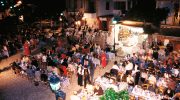
Panigyria dissolve generational boundaries. Children, adults, and elders gather in the same space, eating and celebrating together without separation. For many urban families, these festivals offer a return to ancestral villages, reconnecting them with places, people, and rhythms that shaped earlier generations.
Traditional Carried by the Extended Family
The endurance of these celebrations relies heavily on the extended family. Grandparents serve as living memory, passing down prayers, recipes, and ritual details through practice rather than explanation. Their presence anchors celebrations in continuity, ensuring that meaning survives even as circumstances change.
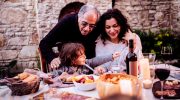
Spiritual kinship strengthens this network. Godparents, κουμπάροι, and wedding sponsors remain lifelong figures within the family circle, included in celebrations and treated as relatives. These bonds expand the definition of family, reinforcing community through shared responsibility and mutual care.
Sacred Life in a Modern Context
Modern life has reshaped how celebrations are organised, but not why they matter. Families adapt by hosting gatherings in restaurants, coordinating schedules across cities, or including relatives abroad through messages and live connections. Tradition adjusts to circumstance without losing its core purpose.

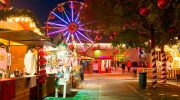
At the same time, organised festivals and seasonal Christmas villages have emerged, supporting rural communities while making tradition visible to wider audiences. These public expressions do not replace family rituals. They complement them, extending participation while preserving meaning at home.
Why These Rituals Still Hold
Religious family celebrations in Cyprus endure because they provide what modern life often fragments. They create predictable moments of gathering, shared purpose, and belonging. They link homes to villages, private faith to public space, and present families to past generations.
Through repetition, food, movement, and shared time, faith becomes lived rather than abstract. In a rapidly changing world, these celebrations remain one of Cyprus’s strongest forms of cultural continuity, binding families together through rituals that are both sacred and deeply human.