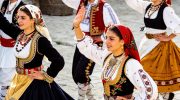
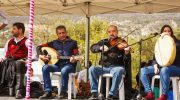
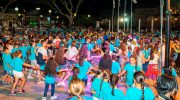
The Pentozali is one of the most powerful dances ever to cross the sea between Crete and Cyprus. Born in the mountains of western Crete as a dance of resistance and endurance, it later became part of Cyprus’s festival life, folk education, and stage tradition. When performed on Cypriot soil today, the Pentozali is not treated as a foreign import, but as a shared expression of strength, memory, and collective identity within the wider Hellenic world.
This is not a dance meant to decorate an evening. It is meant to command attention.
- A Dance Built on Movement, Not Decoration
- Why Leadership Matters in Pentozali
- A Dance Shaped by History, Not Performance Halls
- Music That Drives the Body Forward
- How Pentozali Lives in Cyprus Today
- Subtle Adaptations Within a Cypriot Context
- Watching Pentozali as an Audience Member
- Why Pentozali Belongs in Cyprus
A Dance Built on Movement, Not Decoration
Pentozali belongs to the family of pidichtos dances, a term that refers to leaping, high-impact movement rather than flowing steps. The body does not glide. It strikes, lifts, stamps, and suspends itself in the air. The posture is upright and direct, with little ornamentation, because the focus is on force and timing rather than elegance.
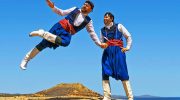
The dance is usually performed in an open circle or semi-circle, with dancers linked at the shoulders. That formation creates both physical stability and a sense of collective strength. Everyone moves as one unit, but the attention belongs to the leader at the front of the line, whose improvisations set the intensity of the performance.
Why Leadership Matters in Pentozali
Unlike many communal dances, Pentozali places enormous responsibility on the first and second dancers. The leader breaks away from the fixed shoulder hold, gripping the second dancer’s hand instead. This creates a flexible anchor that allows for explosive jumps, fast turns, and sudden changes in direction.
The second dancer’s role is just as demanding. They must remain solid and grounded, acting as a human support while the leader pushes the limits of balance and speed. This relationship is not accidental. It mirrors older ideas of collective responsibility, where strength depends on trust, readiness, and the ability to step forward when needed.
A Dance Shaped by History, Not Performance Halls
Pentozali emerged during the late eighteenth century in Crete, in a period marked by rebellion against Ottoman rule. Its structure was deliberately designed to carry memory through movement. Each repetition reinforced unity, courage, and shared purpose, without the need for spoken words.
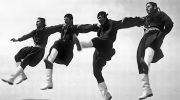
When the dance later reached Cyprus, that historical weight did not disappear. Cyprus had its own long experience of occupation, resistance, and cultural survival. The Pentozali resonated because it spoke the same physical language of endurance. On Cypriot stages, it is often introduced with a brief explanation of its origins, not as a lesson, but as a reminder of why the dance exists at all.
Music That Drives the Body Forward
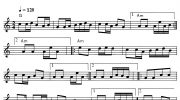
Pentozali is danced in a fast, driving rhythm, usually in 2/4 time. In Crete, the melody is traditionally led by the lyra, supported by the laouto. In Cyprus, the violin often takes the lead role, blending the dance into the island’s own musical texture.
This change does not soften the dance. If anything, the sharper tone of the violin heightens the tension between movement and music. The lead dancer listens closely, responding to subtle shifts in tempo and emphasis, while the musician watches the line for signs of fatigue or readiness. Together, they push the dance toward its physical edge, creating intensity without losing control.
How Pentozali Lives in Cyprus Today
In contemporary Cyprus, Pentozali appears most often at major cultural gatherings where tradition is presented with pride rather than nostalgia. It is performed during large festivals, village panigyria, and national celebrations, often reserved for moments when energy and focus are at their highest.
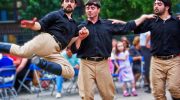
Dance schools and cultural associations treat Pentozali as a test of discipline and endurance. Students are not introduced to it casually. They are trained first in posture, rhythm, and stamina, learning to respect the structure of the dance before attempting improvisation. What the audience sees as a brief, electrifying performance is the result of long preparation and physical commitment.
Subtle Adaptations Within a Cypriot Context
While the core of Pentozali remains unchanged, Cypriot performances often reveal small adaptations that reflect local practice rather than alteration. Sequences may be slightly condensed to suit festival programs. Musical phrasing may lean toward Cypriot stylistic preferences. Costume choices follow Cretan tradition but are integrated smoothly into broader folk presentations.
These adjustments do not weaken the dance. They allow it to remain alive rather than fixed, responsive to its environment while retaining its essential character.
Watching Pentozali as an Audience Member
To watch Pentozali closely is to notice its internal dialogue. Applause does not wait for the final note, but follows moments of risk, difficult jumps, or inspired improvisation. Shouts of encouragement are common, especially as the tempo increases and the physical demands intensify.
At community events, participation is sometimes invited, though always with unspoken rules. New dancers join at the end of the line, observing before acting, listening before attempting. The dance does not exclude, but it does require respect for rhythm and collective movement.
Why Pentozali Belongs in Cyprus
Pentozali has endured in Cyprus because it expresses something that remains deeply relevant. It speaks of strength shared rather than displayed, of discipline earned rather than assumed, and of memory carried through action rather than words.
In a region shaped by layered histories and shifting borders, Pentozali survives not as a relic, but as a living practice. It reminds both dancers and audiences that culture is not preserved by repetition alone. It is preserved by effort, attention, and the willingness to move together in time.