The Church of Timios Stavros in Pelendri is a layered Troodos interior built and repainted between the 12th and 16th centuries, preserving multiple fresco phases within a single working church. Dated inscriptions, shifting styles, and later aisle additions make the building a readable archive of rural devotion, local patronage, and Lusignan-era overlap rather than a single “perfect” moment. This article explains how the structure expanded, how the fresco programs differ by period, and why the church remains one of Cyprus’s clearest examples of belief accumulating without erasing what came before.
A Church Shaped by Reuse
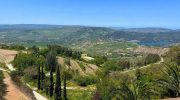
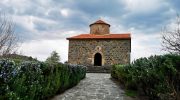
Pelendri lies high in the Pitsilia region, surrounded by steep slopes and dense forest, far from the coastal cities that usually dominate Cyprus’s medieval history. Timios Stavros stands just outside the village core, a placement that suggests it functioned originally as a cemetery church rather than a parish centrepiece.

Its position tells an important story. This was not a monument built for display or prestige. It was a working religious space, shaped by generations who returned to it repeatedly for worship, burial, and memory. Over time, necessity and devotion changed their form, resulting in the layered structure that survives today.
From Modest Chapel to Complex Basilica
The earliest version of the church dates to the mid-12th century, when it existed as a single-aisled domed structure typical of rural Byzantine chapels. Only the eastern apse from that phase survives intact, quietly anchoring everything that followed.
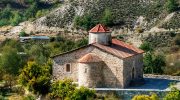
In the late 13th and early 14th centuries, the church was rebuilt and expanded, incorporating the older apse into a new central nave. Shortly after, a northern aisle was added, likely commissioned by the Lusignan feudal elite who controlled the region at the time. A final southern aisle followed in the 16th century, completing the triple-aisled basilica seen today.
What matters here is not architectural symmetry, but continuity. Each phase reused what already existed, turning the building into a physical record of survival, repair, and adaptation.
Inscriptions That Fix History in Place
Unlike many painted churches, Timios Stavros preserves multiple dated inscriptions, offering unusually clear insight into its decorative history.
The earliest inscription records the original frescoes in the apse in 1171 or 1172 and names local priests and villagers as patrons, pointing to a communal effort rather than elite sponsorship. A later inscription above the west entrance marks the major repainting of the nave in the 1330s, while fragments of a third inscription link the church to Lusignan patronage during the 14th century.
These texts remove guesswork. They show that the church was not decorated all at once, but repeatedly, each generation adding its own layer of meaning.
Frescoes That Speak in Multiple Registers
Inside Timios Stavros, the walls do not speak with a single voice. Instead, they preserve a conversation across centuries, styles, and artistic intentions. The richness of the church lies not in uniformity, but in coexistence.
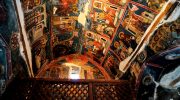
The earliest frescoes, preserved in the apse, belong to the restrained Comnena tradition of the 12th century. Figures are controlled and hieratic, their gestures economical, their expressions composed. Colour is luminous but disciplined, reinforcing a theology rooted in order and transcendence.
The later frescoes, added during the 14th century, reflect the emotional and visual expansion of the Palaeologan period. Bodies gain weight and movement. Faces carry sorrow, tenderness, and introspection. Narrative scenes unfold with greater psychological depth, inviting the viewer into the story rather than holding them at a distance.
Art historical analysis suggests that at least three painters contributed to this later phase. One shows close familiarity with Constantinopolitan models. Another works with a flatter, more linear approach. A third reflects local Cypriot conventions. Together, they do not clash. They coexist, revealing how artistic language adapts to place, patron, and purpose.
The Life of the Virgin as a Continuous Story
Across the western sections of the nave unfolds an extended cycle from the life of the Virgin Mary, the most complete surviving Marian narrative in Cyprus. Rather than functioning as isolated scenes, the cycle reads as a continuous story, guiding the viewer through birth, devotion, and divine encounter.
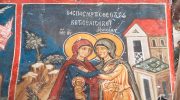
Several scenes include iconographic details rarely found elsewhere on the island. In the Visitation, the unborn John the Baptist is shown bowing toward Christ within their mothers’ wombs, a motif drawn from Armenian and Eastern Christian traditions. Such details are not ornamental flourishes. They reflect the circulation of ideas across the eastern Mediterranean and Cyprus’s role as a cultural crossroads.
Here, theology travels through paint. Doctrine becomes visible. Belief becomes something that can be followed with the eye.
Where East and West Quietly Intersect
The northern aisle introduces another layer of meaning. Likely commissioned under Lusignan patronage, it incorporates elements more commonly associated with Western Europe, including donor portraits, heraldic motifs, and genealogical imagery such as the Tree of Jesse.
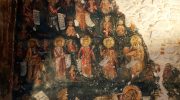
Yet these elements do not disrupt the Orthodox visual language. They are absorbed into it. Latin patrons did not impose a foreign system of imagery. Instead, they adopted existing Byzantine forms, adapting them to express authority, lineage, and legitimacy within a familiar sacred framework.
This quiet blending offers insight into medieval Cyprus itself. Cultural overlap here was not always confrontational. Often, it was negotiated, shared, and normalised through daily religious life.
Experiencing the Interior
Timios Stavros is not designed to overwhelm. Light enters slowly through small openings, allowing figures to emerge gradually from shadow. Gold highlights catch the eye briefly, then soften again as the space settles into stillness.
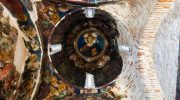
The interior remains cool even during the summer months. Sound is muted. Chant would have carried more easily than speech. Everything about the space encourages patience rather than spectacle, attention rather than movement.
This restraint is deliberate. It allows the paintings to work over time, revealing themselves slowly to those willing to linger.
What Timios Stavros Preserves
Timios Stavros matters because it demonstrates how belief accumulates rather than replaces itself. Each generation added to the church without erasing what came before. What survives is not a single historical moment, but a long and continuous act of devotion.
For scholars, the church offers rare clarity about medieval workshops, patronage, and artistic exchange. For visitors, it offers something less analytical and more lasting: a space where history feels settled rather than curated.
In the Troodos landscape, Timios Stavros does not demand attention. It rewards it.