Most people have heard of the infamous Black Widow spider, but few realise that Cyprus is home to an entire family of its close relatives. Hidden beneath stones, among dry grasses, inside old walls and even around our homes live a remarkable group of spiders known as the widow and false widow spiders.
While one species deserves respect for its medically significant venom, the others are harmless or only mildly venomous, quietly helping to control insect populations across the island.
- Meet the Widow Family
- Ancient Spiders with an Ancient Reputation
- Cyprus' Widow and False Widow Species
- Engineers of Extraordinary Silk
- Courtship Among Giants and Dwarfs
- Venom: Respect, Not Fear
- Fun Facts
- Life Across Cyprus
- Living Alongside Widow Spiders
- Nature's Silent Pest Controllers
- Finding Them in the Wild
- More Than Just a Fearsome Name
Meet the Widow Family
Widow and false widow spiders belong to the subfamily Latrodectinae, a branch of the cobweb spider family (Theridiidae). These spiders are famous for building messy, three-dimensional webs instead of the familiar circular orb webs.
Cyprus hosts several members of this fascinating group, including the Mediterranean Black Widow (Latrodectus tredecimguttatus) and a number of false widows belonging to the genus Steatoda. Although they share a common ancestor and often resemble one another, only Latrodectus species are considered true widow spiders.
Their tangled silk traps are masterpieces of engineering, capable of capturing insects many times larger than the spiders themselves.
Ancient Spiders with an Ancient Reputation
Widow spiders have lived around the Mediterranean for millions of years. Long before modern science, people recognised that certain glossy black spiders could deliver painful bites.
The Greek physician Dioscorides, writing in the first century AD, described symptoms that closely resemble those caused by Black Widow venom today. Throughout history, farmers harvesting wheat often encountered these spiders hidden among dry stalks, giving rise to numerous legends and superstitions.
The name Latrodectus comes from Greek words meaning “hidden biter,” a fitting description for an animal that spends most of its life concealed beneath vegetation or stones.
False widows, despite their intimidating appearance, have never carried the same reputation. Only in recent decades have scientists begun to appreciate how closely related they are to the true widow spiders.
Cyprus’ Widow and False Widow Species
Several species of Latrodectinae have been recorded on Cyprus.
Mediterranean Black Widow (Latrodectus tredecimguttatus)
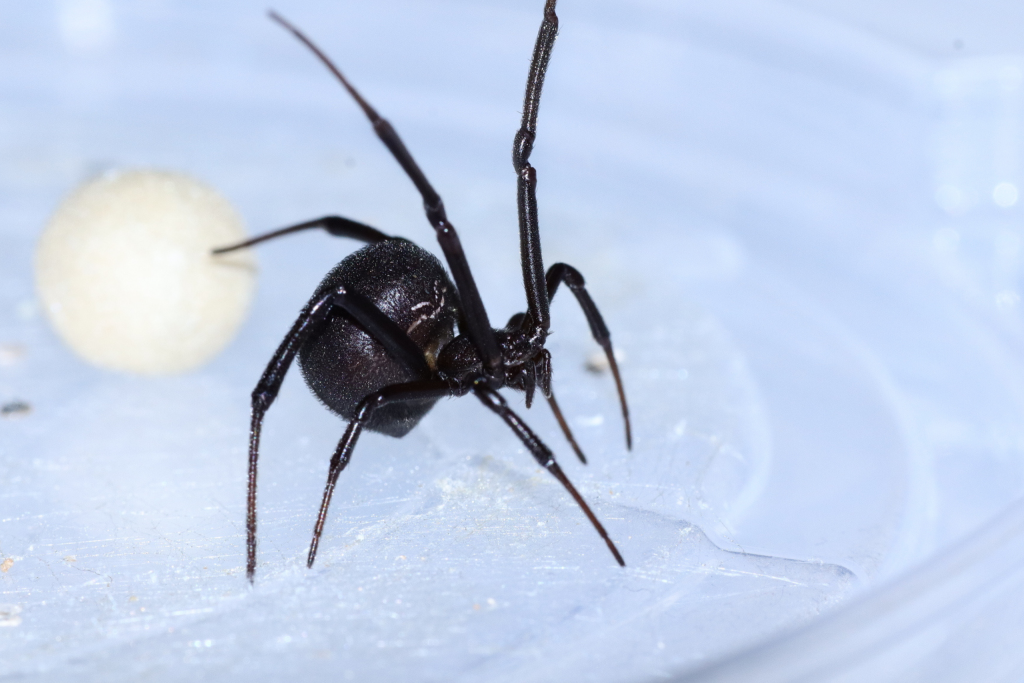
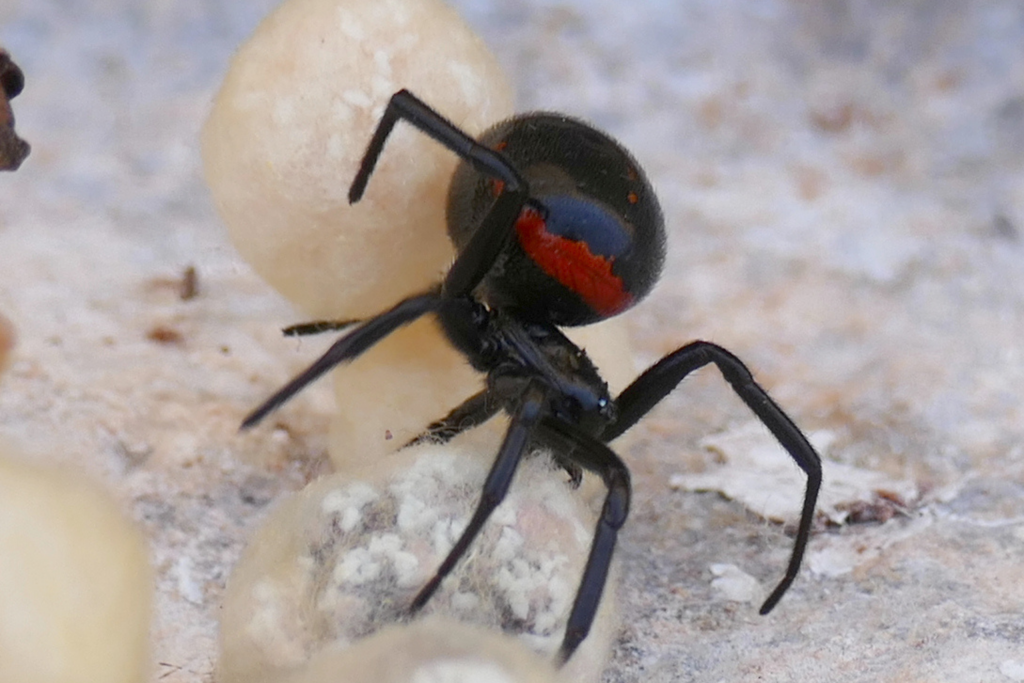
The island’s largest and most famous widow spider. Adult females are glossy black with distinctive red or orange spots across the abdomen, although older individuals may appear almost completely black.
Its venom is medically significant, but the spider is shy and bites only when trapped or handled.
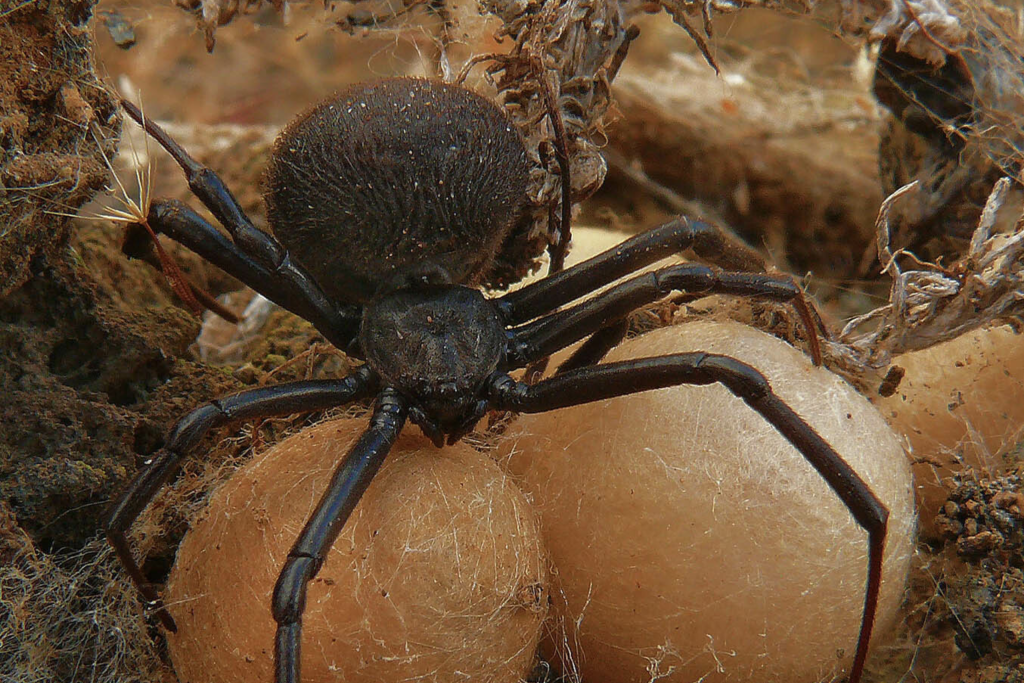
Mediterranean Black Widow, adult female with egg sacks © wp-polzin iNaturalist
False Widows (Steatoda species)
Cyprus is also home to several false widow spiders, including:
- Steatoda paykulliana
- Steatoda grossa
- Steatoda triangulosa
- Steatoda nobilis (reported from Cyprus)
- additional Steatoda species may also occur
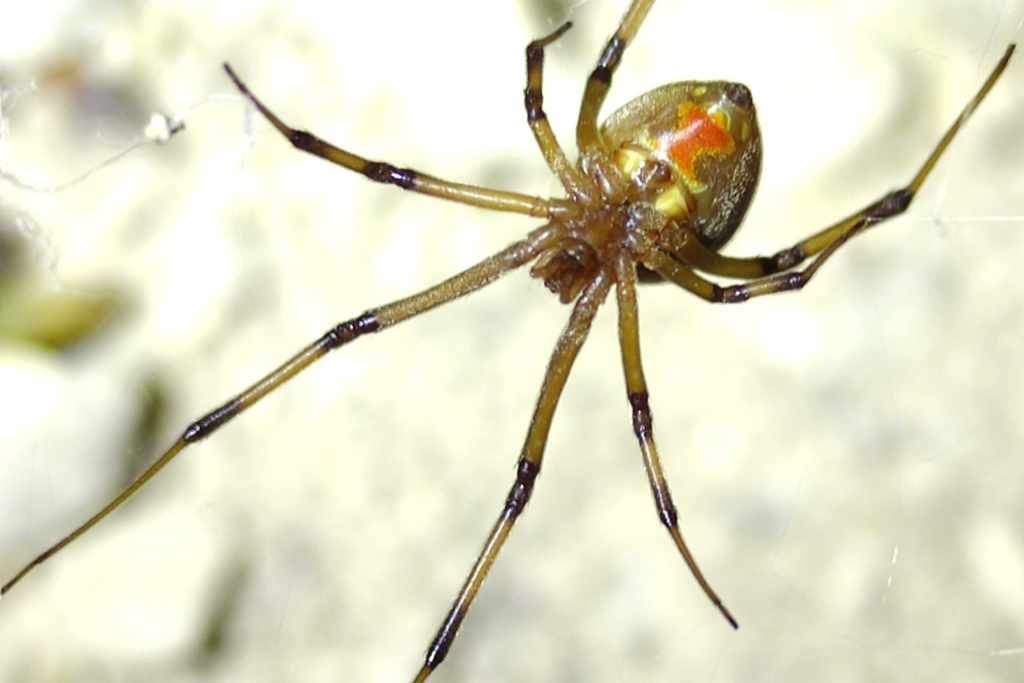
False widows have rounded abdomens similar to true widows but usually display brown, cream or reddish patterns rather than the glossy black appearance of Latrodectus.
Although their venom contains compounds related to those of Black Widows, their bites are generally mild and rarely require medical treatment.
Engineers of Extraordinary Silk
Unlike orb-weaving spiders that build elegant circular webs, widow spiders create irregular three-dimensional tangles of silk.
Some strands stretch down to the ground like invisible tripwires. When an insect brushes against one, the silk snaps upward, lifting the prey into the air where the spider can safely wrap it in silk before delivering a venomous bite.
The silk produced by widow spiders is among the strongest natural fibres known. Relative to its thickness, it rivals or even exceeds the strength of steel while remaining remarkably elastic.
These spiders feed on:
- beetles
- flies
- grasshoppers
- crickets
- cockroaches
- moths
- other spiders
Large female Black Widows occasionally capture small geckos, juvenile lizards or even tiny rodents that become entangled in their exceptionally strong webs.
Courtship Among Giants and Dwarfs
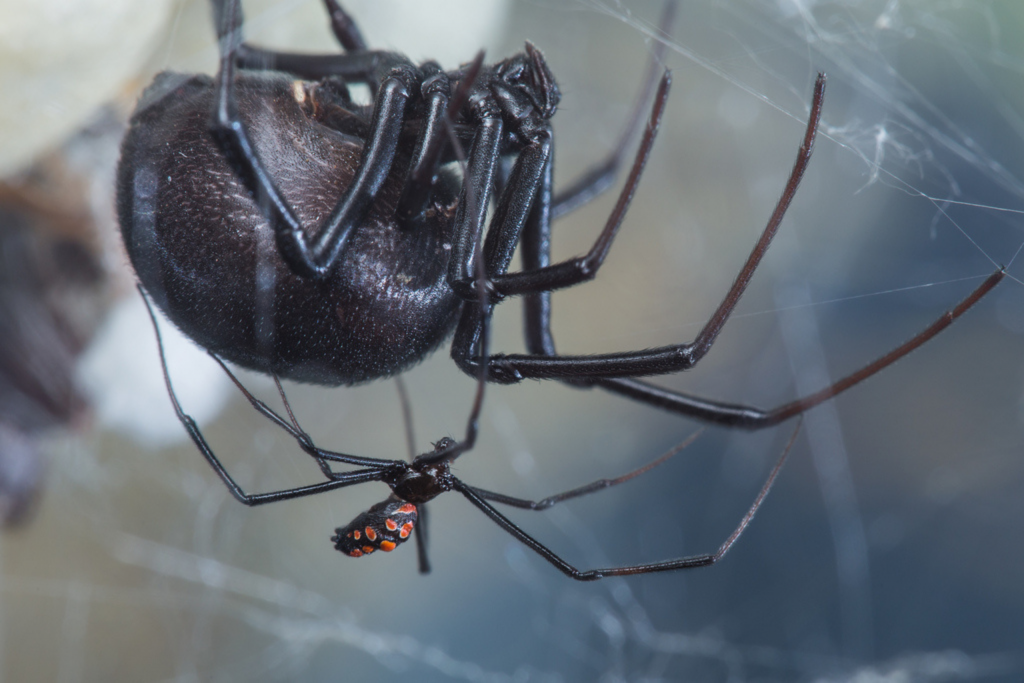
One of the most remarkable features of widow spiders is the enormous difference in size between the sexes.
Adult females may outweigh males by twenty to fifty times. Before mating, a tiny male cautiously approaches the female’s web and produces specific vibrations that announce he is a potential mate rather than prey.
Courtship may last several hours before mating occurs.
Despite their fearsome reputation, females do not usually eat their mates. Sexual cannibalism is much less common in nature than popular culture suggests and occurs mainly when food is scarce.
Females produce several silk egg sacs, each containing between one and four hundred eggs. Once hatched, the spiderlings disperse by “ballooning,” releasing fine silk threads that allow the wind to carry them over remarkable distances.
Venom: Respect, Not Fear
The Mediterranean Black Widow possesses one of Europe’s most potent spider venoms.
Its main toxin, α-latrotoxin, affects the nervous system and may cause severe muscle pain, cramps, sweating and abdominal discomfort, a condition known as latrodectism.
Fortunately, bites are uncommon because these spiders are remarkably timid. Most occur only when the spider is accidentally trapped against the skin, for example while gardening or moving stones.
False widow spiders possess much milder venom. Their bites may resemble a bee or wasp sting and usually resolve without serious complications.
Today, severe illness from widow spider bites is uncommon thanks to modern medical care, and fatalities are exceptionally rare.
Fun Facts
- 🕸️ Widow spider silk is one of the strongest natural materials ever studied.
- 🕷️ Only adult females are considered medically important; males are too small to pose a serious risk.
- 🎈 Newly hatched spiderlings can travel several kilometres by floating through the air on silk threads.
- 🌍 Widow spiders occur on every continent except Antarctica.
- 🦎 Large Black Widows have occasionally been observed catching geckos and other small vertebrates.
- 🌾 Mediterranean Black Widows were once known as “harvest spiders” because farmers most often encountered them during grain harvesting.
- 🕷️ False widow spiders often become natural pest controllers inside buildings by feeding on flies, mosquitoes and cockroaches.
Life Across Cyprus
Widow and false widow spiders occupy a surprising variety of habitats.
The Mediterranean Black Widow prefers dry grasslands, vineyards, olive groves, rocky slopes and abandoned farmland, where it builds webs close to the ground beneath stones or among low vegetation.
False widows are even more adaptable. They can be found in gardens, forests, village walls, caves, sheds and occasionally inside houses, where they quietly remove unwanted insects.
Although widespread across Cyprus, these spiders are rarely noticed because they spend most daylight hours hidden within their webs.
Living Alongside Widow Spiders
Despite their reputation, widow spiders are not aggressive animals.
Simple precautions are usually enough to avoid accidental encounters:
- Wear gloves when gardening or lifting stones.
- Shake out boots, gloves and clothing left outdoors.
- Avoid placing bare hands into dark crevices.
- Observe spiders without disturbing them.
Like snakes, widow spiders bite only as a last resort when they cannot escape.
Nature’s Silent Pest Controllers
Widow and false widow spiders are valuable members of Cyprus’ ecosystems.
Each individual catches hundreds of insects every year, helping to regulate populations of flies, beetles, grasshoppers and other invertebrates. By keeping insect numbers under control, they contribute to the natural balance of both wild habitats and agricultural landscapes.
Rather than being feared, these spiders deserve appreciation as skilled hunters that have shared the island with humans for thousands of years.
Finding Them in the Wild
The best time to observe widow spiders is from late spring through autumn, when adult females are most active.
Look carefully beneath rocks, among dry grasses, around old stone walls or under low shrubs. Their webs are often easier to spot than the spiders themselves.
False widows are more commonly encountered around buildings and gardens, especially during warm evenings when insects are abundant.
If you do discover one, admire it from a respectful distance. Their glossy bodies, delicate silk and patient hunting behaviour make them among Cyprus’ most fascinating arachnids.
More Than Just a Fearsome Name
The name “widow spider” has inspired countless myths, but the reality is far more interesting. Cyprus is home not only to the Mediterranean Black Widow, one of Europe’s most remarkable spiders, but also to a rich community of false widows that quietly protect our gardens and countryside from insect pests. Together they remind us that even the most misunderstood creatures have an important place in nature – and that beauty, ingenuity and ecological value can often be found hidden within a tangled web.