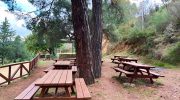
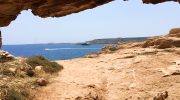
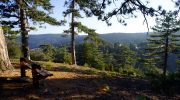
The Troodos Mountains have a way of pulling you in before you even realize it has happened. There is something about the altitude and the stillness up there that feels separate from the rest of the island. Petros Vanezis Nature Trail sits right at the heart of this mountain world and offers a walk that is both grounding and genuinely beautiful.
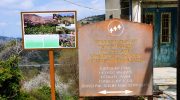
What sets this trail apart from others in the Troodos region is the sense of depth it carries. The forest here is dense and old and the trees feel like they have earned their place on this mountain. Every section of the path has a different quality to it.
For those who want a trail that rewards attention rather than speed this one delivers consistently. It is not a trail you rush through. It is a trail you settle into and that distinction makes all the difference in how you experience it.
Trail Overview
- Location: Alona Village (Pitsilia area), Nicosia District
- Distance: 1.5 miles (2.4 km)
- Route Type: Circular (Loop)
- Difficulty: Easy
- Elevation Gain: 100 meters
- Duration: 45 – 60 minutes
- Best Time to Visit: February to May
- Terrain: Rocky and Dirt Path
The Forest That Surrounds You From the Start
From the moment the trail begins you are already inside the forest and that shift in atmosphere is immediate. The canopy of Black Pine and Cedar closes over the path and the temperature drops a few degrees almost at once. The air carries the resin of the pines and that scent alone sets a tone for the entire walk ahead.
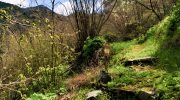
The Troodos forest is not a decorative backdrop on this trail. It is the main event. The trees are tall and the undergrowth is thick and the path weaves between them with a naturalness that makes the whole experience feel unscripted. There is no point on this trail where the forest feels managed or artificial. It simply exists and you move through it on its terms.
Light filters through the canopy in long uneven shafts and the effect on the forest floor is genuinely beautiful. Patches of moss cover the older rocks and the roots of the pines push through the soil in shapes that seem almost deliberate. Every few minutes the path shifts slightly and a new arrangement of trees and light opens up ahead of you.
What the Trail Itself Feels Like Underfoot
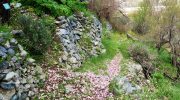
The surface of the Petros Vanezis Trail is varied in a way that keeps you present throughout the walk. Some sections follow a soft forest floor where the pine needles have built up over years into a cushioned layer that makes the walk feel almost effortless. Other sections push across exposed rock and loose stone where your footing requires more care and attention.
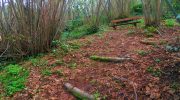
That variation is one of the trail’s real strengths. A path that is too uniform becomes predictable and predictable paths are easy to mentally check out from. This trail does not allow that. The terrain keeps asking something of you and in return it keeps offering something back. A cleared ridge with a view of the valley below. A shaded gully where the light barely reaches. A stretch of open ground where the sky suddenly feels very large above you.
The loop format of the trail also works well here. You never retrace your steps and that means every section of the walk is a new experience rather than a repeat of what you have already seen.
Views and Natural Highlights Along the Route
At several points the forest opens up and the views that appear are worth every uphill stretch it took to reach them. The Troodos range stretches out in layers of green and grey and on a clear day you can see far beyond the immediate mountains to where the land eventually flattens toward the coast.
One of the most memorable moments on the trail comes roughly at the midpoint where the path crests a ridge and the full width of the valley below becomes visible. It is the kind of view that makes you stop walking without even deciding to. You just stop and look for a while and that feels exactly right.
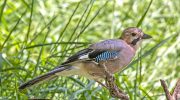
Wildlife is also a quiet presence on this trail. The forest supports a healthy population of birds and the sound of them in the trees above is a constant companion throughout the walk. Jays and woodpeckers are common here and if you are patient and quiet the chances of a sighting are reasonable. The Mouflon which is Cyprus’s native wild sheep also inhabits the Troodos forest though a sighting requires genuine luck and a still approach.
The Story Behind the Trail’s Name
Petros Vanezis was a Cypriot forester and conservationist whose work in the Troodos National Forest Park left a lasting mark on how the region’s natural environment was protected and managed. The trail that bears his name is a tribute to his dedication and it is fitting that the route passes through some of the most well-preserved sections of the Troodos woodland.
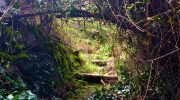
Knowing that background adds something to the walk. You are not just on a recreational path. You are on a trail that exists because someone fought to protect this forest and the fact that the trees here are as healthy and full as they are is partly a result of that effort. That context gives the walk a sense of meaning that goes beyond the exercise or the views.
Practical Advice for the Walk
The trail is accessible from the Troodos Square area which has car parking and basic facilities nearby. From there the path is clearly marked and the waypoints are reliable so navigation is not a concern for most walkers. That said a trail map is always worth having because the forest can disorient even confident walkers once the path dips into its denser sections.
Footwear should be sturdy and supportive. The trail rewards proper boots over casual shoes particularly on the rockier sections toward the upper part of the loop. Water is essential and a litre per person at minimum is a sensible baseline for a walk of this length in the mountain environment.
The trail is best walked between April and November when the weather in the Troodos range is stable and the forest is at its most alive. Spring brings wildflowers to the clearings and the forest floor. Autumn turns the undergrowth golden and the light through the canopy takes on a warmth that makes the whole landscape feel cinematic.