Cyprus operates two international airports and maintains one of Europe’s most extensive motorway networks per capita. Nearly 98% of all arrivals and departures to the island occur via air transport, with Larnaca and Paphos airports serving over 12 million passengers annually. The road system connects these airports to major cities through modern toll-free motorways, creating an efficient transportation network across the southern part of the island.

Larnaca International Airport stands as Cyprus’s main aviation gateway. Located 4 kilometers southwest of Larnaca city, the airport handled approximately 8.5 million passengers in 2024, representing nearly 70% of total air traffic. The facility was hastily developed at the end of 1974 after the Turkish invasion forced the closure of Nicosia International Airport, which remains abandoned in the buffer zone.

Paphos International Airport serves the western part of Cyprus, handling around 3.5 million passengers in 2024. The airport caters primarily to leisure travelers heading to resort areas in Paphos, Polis, and Latchi. Despite its smaller size compared to Larnaca, Paphos plays a crucial role in distributing tourist traffic across the island.
Record Passenger Traffic and Growth Patterns
Cyprus airports achieved record-breaking performance in 2024, with total passenger numbers reaching 12.3 million. This represented a 5.6% increase compared to 2023 and a 9.1% rise above pre-pandemic 2019 levels. The Transport Ministry described it as the best performance in terms of passenger volume in the airports’ history.

Key source markets demonstrate the strong appeal of Cyprus as both a tourist and business destination. The United Kingdom, Greece, Israel, Poland, and Germany accounted for 64% of total passengers, bringing 7.8 million travelers. London and Athens each drew around 1.4 million passengers, while Tel Aviv contributed close to 1 million.
Seasonal variation affects airport traffic significantly. July and August see the highest numbers, with each month handling over 1.5 million passengers. December experienced mixed performance in 2024, with Larnaca seeing a 15.06% increase while Paphos showed a slight 0.74% decrease. The overall aircraft movements in December totaled 5,732 flights, marking a 4.12% rise from the previous year.
Major Expansion Projects at Both Airports
Construction began in March 2025 on the second phase of development programs for both airports, with a total investment of €170 million. President Nikos Christodoulides laid the foundation stone in June during a ceremony organized by Hermes Airports, emphasizing the government’s commitment to modernizing aviation infrastructure.

At Larnaca, the expansion covers approximately 20,000 square meters. The project includes a new western wing with additional arrival and departure gates linked to the main terminal, new baggage claim belts, expanded passport control and security check areas, enlarged commercial space, and increased aircraft parking capacity. Once completed, the upgrades will raise Larnaca’s annual capacity from current levels to 12.4 million passengers. The expansion is expected to take 30 months.
The Motorway Network Connecting Major Cities
Cyprus boasts the highest motorway kilometers per capita in the European Union at 38.6 kilometers per 100,000 inhabitants. The road network in Republic-controlled areas consists of approximately 8,564 kilometers of paved roads and 4,387 kilometers of unpaved roads. All motorways operate toll-free, funded entirely through national budgets and EU contributions.

The A1 motorway forms the main arterial connection between Nicosia and Limassol, covering 73 kilometers. This route underwent recent upgrades to expand sections between Strovolos Junction and Alambra Interchange from four lanes to six lanes, accommodating increased traffic volumes between the capital and the island’s second-largest city.

The A3 motorway efficiently links Larnaca Airport to Ayia Napa and the eastern resort areas. This route serves heavy tourist traffic during summer months, providing direct access from the main airport to popular beach destinations. The A5 connects Larnaca to Limassol along the southern coast, while the A6 runs 66 kilometers from Limassol to Paphos.
Ongoing Road Infrastructure Development Projects
The Ministry of Transport, Communications and Works allocated €439.3 million for building a modern and safe road network through 2026. Ten major infrastructure projects currently under implementation are expected to transform the face of Cyprus’s road system, bringing economic growth, improved travel quality, safer roads, and reduced accidents.
The Nicosia Perimeter Motorway represents one of the most ambitious projects. Phase A1, covering 7.5 kilometers between Lakatamia Industrial Area and Dali Industrial Area, reached completion in 2024 after beginning in March 2020. The project includes approximately 10 kilometers of secondary roads connecting to the existing network. The new motorway section opened on November 6, 2024, receiving nearly €44 million in EU funding from the CEF Transport program, covering 85% of total costs.
The first phase of the A7 concerns the section from Polemidia to Palodia, approximately 3.6 kilometers long. The project includes a seven-kilometer secondary road network, four roundabouts, an overpass, an underpass, and retaining walls. Work began in May 2021 with an expected completion in December 2025, financed by national resources at a cost of €86.8 million.
Limassol Port as a Critical Transportation Hub
The Port of Limassol serves as Cyprus’s principal seaport and the busiest maritime facility in the Eastern Mediterranean transit trade. After the 1974 Turkish invasion left Famagusta Port inaccessible in the occupied north, Limassol rapidly developed to handle the island’s cargo and passenger needs.

Approximately 4,000 ships call at Limassol annually, handling 4.67 million tonnes of cargo, 418,000 TEU containers, and 371,600 passengers. The port accommodates vessels up to 250 meters in length with a water depth of 14 meters, accessed through an approach channel 15 meters deep and 150 meters wide between two breakwaters.
The port was privatized in 2017 through three separate concessions. Eurogate Container Terminal Limassol handles containerized cargo exclusively. DP World Limassol operates the multi-purpose terminal for general cargo, oil and gas services, cruise ships, and passenger vessels. P&O Maritime Cyprus provides marine services to vessels. The 25-year concession agreements brought significant private investment and international expertise to port operations.
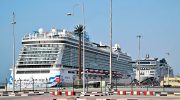
Over 50 international cruise lines include Cyprus in their Mediterranean routes, with Limassol serving as the primary cruise port. The new 7,000-square-meter passenger terminal began operations in July 2017, providing modern facilities for the growing cruise industry. DP World aims to re-establish Cyprus as the leading cruise hub in the Eastern Mediterranean.
Future Connectivity Challenges and Plans
Cyprus faces ongoing challenges in balancing infrastructure development with environmental protection and quality of life concerns. Traffic congestion in Nicosia and Limassol during peak hours demonstrates the limits of current road capacity despite extensive motorways. The government continues investing in bus lanes, park and ride facilities, and sustainable mobility alternatives.

Airport capacity remains a concern during peak summer months when passenger numbers surge. The expansion projects address current bottlenecks, but continued tourism growth may eventually require additional capacity increases or demand management strategies. Seasonal variation creates inefficiency, with facilities operating below capacity during winter months.

Northern Cyprus remains largely disconnected from southern transportation networks. Crossing points allow limited movement, but integrated planning for the entire island would require political resolution of the division. If reunification occurs, transportation infrastructure would need significant investment to create truly island-wide connectivity.

Climate change adds urgency to infrastructure planning. Rising temperatures increase air conditioning demands in airports and vehicles, while extreme weather events could damage coastal facilities and roads. Adaptation measures and resilient design become increasingly important for long-term infrastructure viability.