Explore Cyprus with Our Interactive Map

Explore our top stories and discover ideas worth your time.

Cyprus Greek Dance Music

Cyprus Greek Dance Music

Greek and Cypriot dance music is not background sound. It is structure, instruction, and memory working at the same time. Across villages, islands, and generations, specific rhythms have guided how people move together, celebrate together, and mark life’s most important moments. This article explains how three core dance forms, Syrtos, Sousta, and Ballos, shape the musical language of Cyprus and Greece, why their rhythms matter, and how they continue to function not as performances, but as social glue. Music That Tells the Body What to Do In Greek and Cypriot tradition, dance music is practical before it is expressive. Its primary job is not to impress the listener, but to tell the dancer when to step, pause, turn, or leap. This is why rhythm matters more than melody. The structure of the beat dictates how bodies move together, whether in long communal lines or intimate pairs. Over time, certain rhythmic patterns became deeply familiar, allowing dancers to respond instinctively without instruction. Two broad movement styles dominate this musical world: Dragging, grounded movement, where dancers glide horizontally across the ground Leaping, spring-like movement, where energy rises and falls vertically These qualities are not abstract. They are felt immediately in the music. Syrtos: The Music of the Line and the Circle The Syrtos is the backbone of Greek and Cypriot dance music.…

Read more

Pylon Art & Culture Limassol

Pylon Art & Culture Limassol

Pylon Art & Culture operates as a nonprofit organization dedicated to contemporary art in Limassol, Cyprus. The name comes from the ancient Greek word "pylon," which refers to the monumental gateway to Egyptian temples. This meaning captures the organization's core mission: to serve as an entry point into contemporary art and new ways of experiencing it. The space presents contemporary works across multiple media, from painting and sculpture to photography, video art, and installations. Founded by entrepreneur and art collector Alexandros Diogenous, Pylon emerged from over 30 years of personal engagement with contemporary art. The organization functions on the premise that art and culture form essential cornerstones of human development. Its programs focus on making contemporary art accessible and relevant to wider audiences, particularly those who might not typically visit galleries or museums. Building a Contemporary Art Hub Alexandros Diogenous established Pylon Art & Culture as a way to engage with the contemporary art world in a more meaningful manner. He runs a fourth-generation family business with interests spanning automotive products and services, digital technologies, cybersecurity, and consumer goods. His role as an art collector for more than three decades shaped his understanding of how to build connections between artists, collectors, and the general public. The organization chose Limassol as its base, specifically at 1A Athinon Street in the city…

Read more
Royal Poinciana Trees in Cyprus

Royal Poinciana Trees in Cyprus

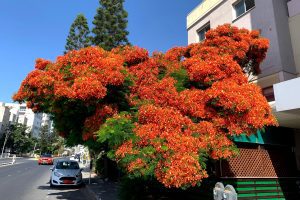
Picture a quiet street in Ayia Napa or Limassol in early June, when the heat has already settled in. Suddenly the whole canopy ignites in a blaze of scarlet and orange, as if someone has draped living flames across the branches. This is the royal poinciana of Cyprus – a tree so spectacular that locals and visitors alike stop to stare every summer. The Royal Flame in the Legume Family Delonix regia belongs to the vast Fabaceae (legume) family, specifically the Caesalpinioideae subfamily – the same group that includes carob, senna and many beautiful tropical trees. The genus Delonix is small, with just a handful of species, nearly all native to Madagascar and nearby islands. Locally it is known as Φλαμπουγιάν (Flambouyian) or Βασιλική Ποιντσιάνα (Vasiliki Pointsiána), names that echo its French nickname “flamboyant” (showy or flaming) and its older scientific synonym Poinciana regia. The genus name itself comes from ancient Greek: delos (visible or conspicuous) + onyx (claw), perfectly describing the long, claw-like petals that make each flower look like a tiny exotic bird. From Madagascar to Cypriot Shores Native to the dry deciduous forests of Madagascar, the royal poinciana was unknown to science in the wild until the 1930s, though it had already been carried around the tropics by traders and gardeners for centuries. It reached the Mediterranean…

Read more