Cyprus follows left-hand traffic, a legacy of British colonial rule that makes it one of only three EU nations where vehicles drive on the left side of the road. This characteristic stems from over 40 years of British administration, which shaped the island’s road infrastructure before independence in 1960. The country has developed a comprehensive set of driving regulations that blend European standards with local requirements.

With 658 cars per 1,000 inhabitants, Cyprus ranks fourth highest in the European Union for car ownership, significantly exceeding the EU average of 560 vehicles per 1,000 people. This extraordinary car dependency reflects limited public transportation options, dispersed settlement patterns, and cultural factors where car ownership is often viewed as a status symbol.
The Basic Rules Every Driver Must Follow
Driving in Cyprus requires adherence to specific regulations that all motorists must understand before taking to the roads. Seat belts are mandatory for all occupants, including rear passengers. Children under five years old cannot travel in the front seat under any circumstances. Children between five and ten years old may sit in the front only if an appropriate child seat is fitted. Children under 150 centimeters must use proper child restraint systems regardless of seating position.

The legal blood alcohol limit is 0.22 milligrams per 100 milliliters of breath for drivers with more than three years of experience. New drivers and motorcyclists face stricter limits at 0.09 milligrams per 100 milliliters. Using mobile phones while driving is strictly prohibited unless hands-free devices are installed. Eating or drinking while driving is also illegal. Smoking in a vehicle with a child present is forbidden.
Headlight use is mandatory from half an hour before sunset to half an hour before sunrise. Horn use is restricted between 11 PM and 7 AM except in emergency situations. High-beam headlights cannot be used in built-up areas except during emergencies. These regulations are actively enforced through police patrols and camera systems.
Speed Limits and Road Network Standards
Cyprus has established clear speed limits across different road types. Motorways have a maximum speed of 100 kilometers per hour with a minimum speed requirement of 65 kilometers per hour, making Cyprus unique in enforcing both upper and lower limits. Other major roads outside built-up areas allow 80 kilometers per hour. Residential areas have a 50 kilometer per hour limit, though this can vary depending on specific signage. Villages typically enforce 30 kilometer per hour limits with speed bumps for traffic calming.
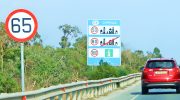
The enforcement allows small tolerance margins above posted limits. Within towns, drivers can exceed the limit by 10 percent plus two kilometers. With a 50 kilometer per hour limit, the maximum permitted speed is 57 kilometers per hour, with fines imposed from 58 kilometers per hour. On motorways and intercity roads, the maximum permitted speed is 20 percent above the limit. With a 100 kilometer per hour limit, drivers can legally travel at 100 kilometers per hour.

Road signs appear in both English and Greek, making navigation easier for foreign visitors. Distances are measured in kilometers rather than miles. The growing motorway network connects major cities, though drivers should exercise caution on slip roads, which can be very short and end in sharp 90-degree turns with speed limits as low as 25 kilometers per hour. Minor roads can have uneven surfaces and small potholes, leading many drivers to drive close to or beyond the center line to avoid rough edges.
Understanding Roundabouts and Right of Way
Roundabouts are extremely common in Cyprus, and understanding the rules governing them is essential. Vehicles approaching from the right have priority at intersections and roundabouts without specific signage. Drivers should signal right when entering a roundabout and left when exiting. However, local drivers do not always follow these rules correctly, requiring extra caution from visitors. Vehicles already within the roundabout have right of way over those approaching.

Road markings often take precedence over signs in Cyprus. Yellow markings indicate upcoming intersections, while directional arrows show where and when to turn. Extra lanes at traffic lights are designated for specific directions, so positioning the vehicle carefully before turning is critical. The far-right motorway lane is reserved for overtaking only. After overtaking, drivers must return to the left lane. Overtaking on the left is forbidden except when a vehicle ahead is turning right.
The Penalty Points System and Fines
Cyprus implemented a stricter penalty points system in 2020 to improve road safety. Drivers accumulating 12 penalty points face a six-month license suspension. Points remain on driving records for up to two years. This system applies to both residents and foreign drivers renting vehicles on the island.

Speeding fines range from 1 euro to 1,500 euros depending on the severity of the violation. Mobile phone use while driving incurs fines up to 300 euros plus two penalty points, doubling for repeat offenses. Failure to wear a seat belt results in a 150 euro fine plus three points for the first offense, with 300 euros for repeat violations. This penalty applies to passengers as well. Transporting children without proper car seats costs 150 euros plus three to six points, doubling for subsequent offenses.
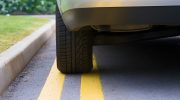
Parking violations carry an on-the-spot fine of 85 euros. Double yellow lines prohibit both parking and waiting at all times. Single yellow lines allow loading and unloading but prohibit parking at all times. Reserved parking spaces for disabled motorists may be used by foreign disabled drivers with valid blue badges.
Fines must be paid within 15 days at the original amount. After 15 days, fines increase by 50 percent. After another 14 days, cases proceed to court, potentially complicating future visits to Cyprus or other EU countries. Rental companies typically receive camera-detected fines and may forward them to drivers or provide driver information to police.
Why Cyprus Has Such High Car Ownership
The 658 cars per 1,000 inhabitants statistic reveals Cyprus’s extraordinary car dependency. This rate has grown 19.9 percent from 549 per 1,000 in 2012 to current levels, outpacing EU average growth. Cultural factors contribute significantly, as car ownership is seen as a status symbol and many people aspire to own vehicles. Limited public transportation infrastructure makes cars essential for most daily activities.
The dispersed nature of Cypriot settlements requires personal vehicles for accessing work, shopping, and services. Cyprus registered 578,158 passenger cars in 2020, representing continuous growth from just 92,207 vehicles in 1980. Vehicle registrations surged 33.5 percent during January to April 2024 compared to the same period in 2023, with passenger car registrations increasing 31.3 percent to 13,851 units. Of these, 43.8 percent were new vehicles while 56.2 percent were used cars.

The shift toward electric and hybrid vehicles is gradually accelerating. Electric car share increased from 2.3 percent in 2023 to 3.6 percent in 2024, while hybrid cars grew from 26.6 percent to 37.4 percent. Petrol-driven passenger cars decreased from 60.1 percent to 48.9 percent during the same period. These trends suggest Cyprus is slowly transitioning toward more sustainable transportation options while maintaining its high overall car ownership levels.
Practical Advice for Driving in Cyprus
Visitors from Britain, Ireland, and Australia find Cyprus particularly easy since the left-hand traffic feels familiar. Drivers from right-hand traffic countries need time to adjust. The minimum age for driving is 18, while car rental requires being at least 21 years old. Drivers under 25 typically pay young driver surcharges. All valid national driving licenses from EU countries, the UK, US, and Australia are recognized. International Driving Permits are only required if licenses are written in non-Latin alphabets and from countries outside the EU.
Four-wheel drive vehicles are popular rental choices for Cyprus due to numerous dirt and unsurfaced roads leading to tourist attractions like Lara Beach, Adonis Baths, and Blue Lagoon. These vehicles provide elevated driving positions and extra comfort on uneven terrain. Comprehensive car insurance is mandatory for all vehicles. Drivers must carry their license, vehicle registration certificate, and insurance documents at all times.
Cyprus demonstrates how infrastructure history shapes modern transportation patterns. The British legacy of left-hand traffic continues defining Cypriot roads seven decades after independence. Combined with geographic factors and limited public transport alternatives, this has created one of Europe’s most car-dependent societies where personal vehicles remain essential for daily life despite their environmental and economic costs.